For more than a decade, Jennifer Lawrence has occupied a rare space in popular culture. She has been the blockbuster star, the awards darling, the meme queen, the accidental comedian, and the reluctant spokesperson for authenticity in Hollywood. Few actors of her generation reached such a level of fame so quickly — and fewer still managed to step back without disappearing entirely.
Now, in her mid-30s, Lawrence is back in public view, promoting a challenging new film, appearing at premieres and festivals, and once again becoming the subject of intense scrutiny. But this time, something unexpected has happened.
Jennifer Lawrence has become a fashion reference point.
Not in the traditional sense of a red-carpet risk-taker or couture showstopper. Not as a trend-chasing influencer or a brand-saturated style ambassador. Instead, she has emerged as a quiet symbol of something many women seem to be craving right now: ease, self-possession, and a kind of cool that doesn’t demand performance.
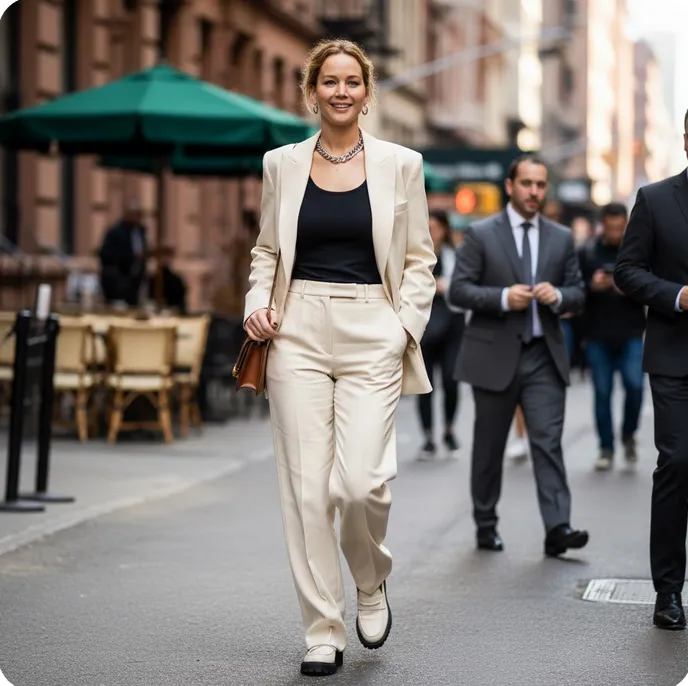
Her recent outfits — photographed on sidewalks, outside hotels, pushing strollers, slipping into cars — have sparked essays, shopping guides, and impassioned commentary across fashion media and Substack newsletters. They are not dramatic. They are not flashy. And yet they feel deeply resonant.
This isn’t an accident. It’s a reflection of how the idea of “cool” itself is changing — and how Jennifer Lawrence, almost inadvertently, has become one of its most compelling avatars.
The Original Jennifer Lawrence Persona: Effortless, Loud, Lovable
To understand why Lawrence’s current fashion moment feels so significant, it helps to remember who she was when she first became famous.
In the early 2010s, Lawrence was everywhere. She won an Oscar in her early 20s, led a massive franchise, and dominated talk shows with an unfiltered charm that felt refreshing in an industry built on polish. She laughed loudly, swore casually, talked about junk food, and tripped on couture gowns — more than once — in front of millions of viewers.
She was widely positioned as the antidote to Hollywood artifice.
This version of Lawrence aligned neatly with a then-dominant cultural archetype: the “cool girl.” She was beautiful but didn’t seem to care. Glamorous but approachable. Successful but self-deprecating. She appeared to reject vanity while benefiting from its rewards.
At the time, that persona felt liberating. In hindsight, it was also a performance — one that carried its own expectations and limitations.
The Weight of Being Relatable
The “relatable cool girl” image, once embraced, can become a trap.
For Lawrence, it meant constant pressure to be funny, accessible, and self-effacing. Interviews became spectacles. Every candid moment was amplified. Her mistakes were framed as endearing — until they weren’t.
As cultural conversations evolved, so did perceptions of that archetype. Critics began to question whether the cool girl ideal was ever truly empowering, or simply another way women were expected to make themselves palatable. The idea of effortlessness itself came under scrutiny: Who gets to look effortless? At what cost?
Lawrence, for her part, has been candid about feeling uncomfortable with her earlier public self. She has described past interviews as embarrassing, and spoken about wanting more boundaries between her personal life and her professional work.
That shift — from openness to intentional privacy — is crucial to understanding her current style evolution.
A New Era: Quiet Clothes, Loud Impact
Fast forward to now, and Lawrence’s public image feels markedly different.
She still attends premieres and film festivals, often wearing couture from a major luxury house. But the real conversation is happening elsewhere — on sidewalks, in candid photographs, in moments that feel uncurated even if they’re not.
Her everyday wardrobe consists of pieces many people recognize:
- Oversized coats
- Relaxed trousers or sweatpants
- Knit sweaters and loose T-shirts
- Flat shoes, clogs, or understated sneakers
- Accessories that feel personal rather than strategic
There’s nothing particularly daring about these choices. And that’s precisely why they’re resonating.
In an era of hyper-styled celebrity fashion — where outfits are often assembled to go viral, generate clicks, or satisfy brand contracts — Lawrence’s look feels refreshingly human.
She doesn’t appear to be dressing for an audience. She appears to be dressing for her life.
Why This Style Moment Feels Different
Many actors have attempted “effortless” style before. What sets Lawrence apart is timing and context.
We are living in a moment of aesthetic fatigue. Social media has flattened fashion into repeatable formulas. Trends cycle at breakneck speed. Celebrity looks are dissected and replicated almost instantly.
Against that backdrop, Lawrence’s style reads as an antidote.
It’s not timeless in the traditional sense — it reflects contemporary silhouettes and brands — but it feels grounded. It suggests comfort, confidence, and a lack of urgency. It doesn’t scream youth or aspiration. It doesn’t rely on sex appeal or shock value.
Instead, it reflects a kind of adulthood that is rarely celebrated in pop culture.
The Appeal of “I Could Wear That”
One reason Lawrence’s outfits have sparked so much discussion is that they feel attainable.
Not necessarily inexpensive — many of the brands she wears are luxury or niche labels — but conceptually accessible. The silhouettes are familiar. The combinations are intuitive. The clothes don’t demand a specific body type or lifestyle fantasy.
This is particularly meaningful for women navigating major life transitions: parenthood, career shifts, aging, changing priorities.
Lawrence herself has entered this phase publicly. She has spoken about motherhood, privacy, and choosing projects more selectively. Her clothing mirrors that recalibration.
It communicates: I am comfortable. I am busy. I am not dressing for approval.
The Substack Effect and the New Fashion Conversation
It’s no coincidence that much of the analysis around Lawrence’s style is happening on Substack.
This platform has become a hub for fashion writing that resists trend-chasing and embraces personal interpretation. Writers there focus on how clothes feel, not just how they photograph. They explore identity, labor, and lifestyle alongside shopping links.
Lawrence’s wardrobe aligns perfectly with this sensibility.
She wears the kinds of pieces these writers champion — well-made basics, slightly eccentric accessories, garments that suggest taste rather than spectacle. When she appears in them, it feels like validation rather than aspiration.
The message is subtle but powerful: You don’t need to transform yourself to be stylish. You’re already doing it.
Redefining the “Cool Girl” for a New Generation
The concept of the “cool girl” hasn’t disappeared — it’s been rewritten.
The modern version is quieter. She doesn’t explain herself. She doesn’t overshare. She doesn’t need to prove she’s low-maintenance or fun. Her coolness comes from restraint, not performance.
Jennifer Lawrence embodies this shift.
She speaks less publicly. She maintains clearer boundaries. She lets her work speak louder than her personality. Her clothes function as an extension of that choice — expressive, but not revealing; stylish, but not loud.
This cool girl isn’t trying to be liked. She’s trying to be at ease.
Fashion as a Reflection of Privacy
One of the most interesting aspects of Lawrence’s current style is how it communicates personality without demanding access.
In earlier eras, celebrities were expected to reveal themselves — through interviews, anecdotes, scandals. Today, many choose to express identity visually instead.
Lawrence’s outfits hint at creativity, humor, and individuality, but they don’t invite interrogation. They suggest a person with inner life, not a brand.
This approach echoes other iconic figures whose style became legendary precisely because they remained elusive. Their clothes became a language — a way to communicate values without explanation.
Motherhood, Maturity, and the Grown-Up Wardrobe
Lawrence’s style evolution also reflects a broader cultural shift toward honoring grown-up femininity.
For years, fashion narratives centered youth above all else. Trends were driven by teenage aesthetics, hyper-sexualization, and novelty. Women over 30 were often sidelined or pressured to appear younger.
That dynamic is changing.
There is increasing appetite for fashion that acknowledges complexity: bodies that have changed, lives that are full, priorities that extend beyond visibility. Lawrence’s wardrobe fits squarely within this movement.
These are clothes you could wear to school pickup, a work meeting, or a late drink with a friend — without changing your entire identity in the process.
The Role of Styling Without Over-Styling
Lawrence works with a stylist, of course. Her look is not accidental. But the success of this era lies in its refusal to feel engineered.
The styling choices often include slight oddities — unexpected proportions, playful accessories, combinations that feel intuitive rather than trend-driven. This creates the impression of personal taste rather than professional assembly.
That distinction matters.
In a media landscape saturated with perfection, imperfection feels luxurious.
Why This Moment Feels Sustainable
Perhaps the most compelling aspect of Lawrence’s fashion renaissance is that it doesn’t feel like a phase.
It’s not tied to a single film, trend cycle, or marketing push. It reflects deeper changes in how she presents herself — as an artist, a public figure, and a person.
That makes it durable.
Audiences sense when an image is strategic. They also sense when it’s rooted in genuine self-alignment. Lawrence’s current style feels like the latter.
Beyond Clothes: A Shift in Cultural Values
Ultimately, the fascination with Jennifer Lawrence’s wardrobe isn’t really about clothes.
It’s about permission.
Permission to dress comfortably.
Permission to change.
Permission to retreat from constant visibility.
Permission to age without apology.
In a culture that still rewards spectacle, choosing simplicity is a radical act.
Lawrence isn’t reinventing fashion. She’s reflecting a collective desire for something softer, slower, and more personal.
The New Cool Is Knowing Yourself
Jennifer Lawrence’s journey from loud relatability to quiet confidence mirrors a broader generational shift.
We are learning that cool doesn’t have to be exhausting. It doesn’t have to be ironic or performative. It doesn’t require constant reinvention.
Sometimes, cool is just knowing who you are — and dressing accordingly.
And if Jennifer Lawrence is any indication, that might be the most influential style statement of all.