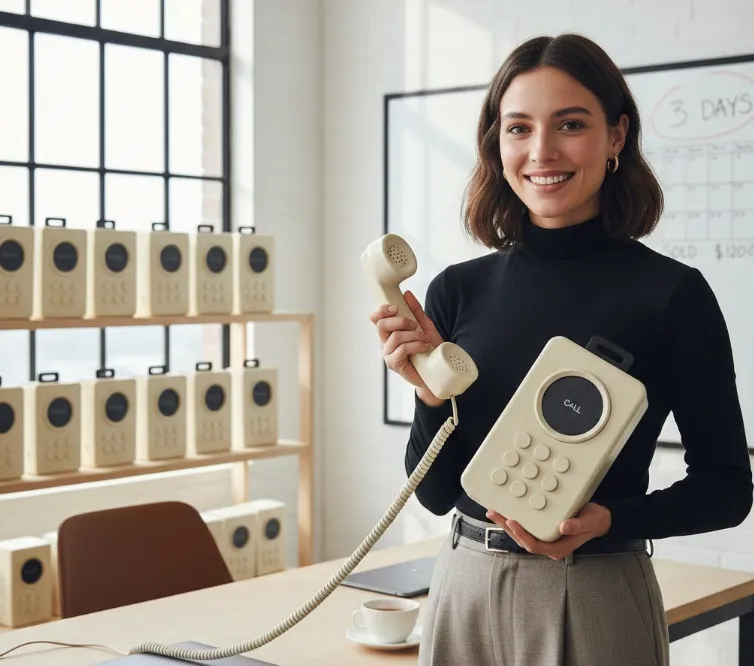
We live in a world of silent buzzes, haptic murmurs, and relentless, glowing rectangles. Our most intimate conversations are mediated through cold glass, our attention fragmented into endless scrolls. For Cat Goetze, a founder deeply embedded in the tech world, this digital friction reached a breaking point. Her journey away from the omnipresent smartphone didn’t lead to a minimalist dumbphone or a trendy lockbox. Instead, it led her backward—to the tactile curl of a coiled cord, the satisfying kachunk of a clamshell handset, and the singular, purposeful ring of a landline.
What began as a personal hack—a whimsical solution to a very modern malaise—has exploded into a phenomenon. In a stunning three-day debut, her venture, Physical Phones, saw over $120,000 in sales, a figure that speaks less to a clever gadget and more to a collective, simmering desire for a different relationship with our connected lives. This is the story of that desire, and the pink, Bluetooth-enabled phone that became its unlikely symbol.
The Catalyst: A Zillennial’s Yearning for Analog Friction
Cat, known to her online community as CatGPT, embodies a fascinating contradiction: a tech-native creator building a bridge back to analog simplicity. Her moment of clarity arrived not from a productivity guru, but from a flash of nostalgia. “I was kind of just sitting around,” she recalls, “thinking it’d be so cute if we still had landline phones and you could twirl the cord and talk with your friends.” That image—chic, nostalgic, focused—felt like an antidote to the chaotic pings of modern communication.
Her initial, practical search for a real landline revealed a dead end: new numbers, service contracts, infrastructure meant for a bygone era. The system was too rigid. So, the 20-something founder did what her generation does best: she hacked it. A thrifted pink landline handset was gutted and ingeniously retrofitted with Bluetooth compatibility. It wasn’t about rejecting connectivity, but reconfiguring it. This Frankensteined creation became the star of her apartment, a conversation piece that served a profound function. Answering the building’s buzzer from this elegant relic or placing a call without ever unlocking a smartphone created small, intentional moments of separation.
From Apartment Hack to Lightning in a Bottle
For two years, the phone was Cat’s secret. Then, in the summer of 2025, she shared it with her audience. The response was instantaneous and visceral. Hundreds of comments poured in with a unified message: “I need this.” The sheer volume was a shock. Expecting maybe two dozen serious inquiries, she set up a simple pre-order site, imagining a cozy side project of hand-assembled units.
The market response was a thunderclap. $120,000 in sales in 72 hours. By the end of October, that figure had surged past $280,000, representing over 3,000 units sold. “It literally felt like we had captured lightning in a bottle,” Cat describes. This wasn’t just a product launch; it was the rapid crystallization of a widespread sentiment waiting for a tangible outlet.
What Is a Physical Phone? The Mechanics of Intention
So, what exactly did people buy? Physical Phones are not resurrected landlines. They are elegant, deliberate portals. Ranging from $90 to $110, these devices (now in five distinct styles) connect via Bluetooth to both iPhones and Androids. They act as a dedicated, beautiful handset for your smartphone’s call function.
When your smartphone receives any voice or video call—be it a standard carrier call, FaceTime, WhatsApp, or even Instagram and Snapchat audio—the Physical Phone rings with its distinctive, full-bodied sound. The audio routes directly to the handset. To make an outgoing call, you either dial a number directly on the keypad or press the star (*) key to activate your phone’s voice assistant, instructing it to call a contact by name.
The genius is in its constrained functionality. It does one thing: voice calls. There is no browser, no email, no notifications, no infinite feed. It creates what we might call “analog friction”—a positive, tactile barrier that demands intentionality. You pick up the handset to talk. You hang it up to end. The interaction is complete, bounded, and satisfyingly physical. It transforms a call from a mere app function into a dedicated event.
The Cultural Groundswell: More Than Nostalgia
Cat is quick to contextualize her success not as a fluke, but as a symptom of a massive cultural correction. She points to the COVID-19 pandemic as a pivotal accelerant. Isolated and anxious, we plunged deeper into our devices, using platforms like TikTok for connection and escapism. Our smartphones became our lifelines, our offices, our social spaces, and our prisons.
Now, in the aftermath, a hangover has set in. “We feel more anxious. We’re less present and unable to enjoy our lives. We’re going through a total loneliness epidemic,” Cat observes. The very devices that promised connection have, for many, fostered a profound sense of disconnection and fragmentation. Compounding this is the new frontier of AI-generated content, making the digital world feel increasingly synthetic and overwhelming.
People are, as she puts it, “starting to put their foot down.” The movement isn’t about full Luddite rejection—Cat is careful not to “demonize” technology, acknowledging its role in medicine, sustainability, and global communication. The question she’s helping people answer is: “How do we live in harmony with it?”
Physical Phones are a tool for that harmonization. They represent a philosophy of “conscious compartmentalization.” It’s the idea that we can leverage technology’s benefits while cordoning off its tyrannical aspects. The phone leverages the smartphone’s connectivity but jettisons its attention-hijacking interface.
The Broader Landscape: From Digital Minimalism to The Analog Renaissance
Physical Phones did not emerge in a vacuum. They are a flagship product within a growing “Analog Renaissance” and the broader digital wellness movement. Consider the trends:
- The Dumbphone Revival: Sales of basic phones are rising, particularly among Gen Z, who are seeking relief from the social media storm.
- The Notebook Resurgence: Sales of physical planners and journals are booming, as people rediscover the cognitive benefits of writing by hand.
- The “Silent Mode” Rebellion: Apps and features that track screen time, block distractions, or schedule focus periods are increasingly popular.
What makes Physical Phones uniquely compelling is that they don’t require a full retreat. They are a gateway tool. You don’t have to abandon your smartphone, your WhatsApp groups, or your essential apps. You simply create a dedicated, delightful space for the most human of all interactions: the voice conversation.
This taps into a deep-seated nostalgia that transcends mere aesthetics. The landline phone represents a time when communication was location-specific, less frequent, and therefore often more meaningful. A call was an intrusion into the home that required politeness. A ringing phone demanded a decision to answer or not—there was no sending it to silent oblivion. Physical Phones reintroduce a whisper of those social boundaries.
The Road Ahead: Harmony in a Hybrid World
As the first batches of Physical Phones ship to eager customers, the question becomes: what’s next? The product’s success proves there’s a substantial market for tools that facilitate digital harmony. It points to a future where our tech ecosystem might include more devices that are intentionally less capable, that celebrate single-tasking in a multitasking world.
For Cat Goetze and her customers, the goal is presence. It’s about being able to have a phone conversation while looking out the window, pacing the room, or twirling that cord—without the irresistible pull of a notification dragging your eyes to a screen. It’s about reclaiming the activity of calling from the device that hosts it.
The $120,000 three-day surge is more than a sales statistic. It’s a vote. A vote for intention over impulse, for depth over breadth, and for a sliver of sonic and tactile poetry in our digitally flattened world. In the end, the story of Physical Phones isn’t just about a clever Bluetooth hack. It’s a signal flare, illuminating a path for anyone who has ever felt exhausted by their screen, who has longed for a simpler click, a clear ring, and a conversation that feels, once again, like their own.
It turns out, the tool we needed to navigate the future was sitting in our past, waiting for a fresh charge. And all it took was one person to listen to that quiet yearning, pick up the proverbial handset, and say “hello.”