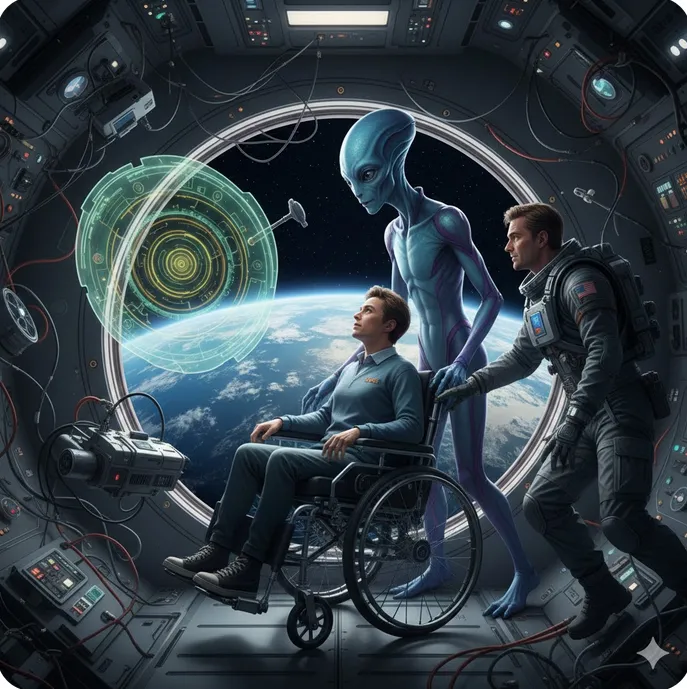
In a landmark moment for space exploration and inclusivity, a German aerospace engineer became the first person who relies on a wheelchair to cross the recognized boundary of space on December 20, 2025. Michaela "Michi" Benthaus, an accomplished mechatronics specialist working with the European Space Agency (ESA), soared beyond the Kármán Line aboard a commercial suborbital rocket operated by Blue Origin. This brief but profound journey—not just a personal triumph but a powerful statement about accessibility in the final frontier—was facilitated by an unexpected collaborator: a veteran engineer who spent nearly two decades at Blue Origin's primary rival, SpaceX.
Benthaus's flight marked the 37th mission for Blue Origin's New Shepard vehicle, a reusable suborbital system designed for short trips to the edge of space. The capsule carried six passengers on an approximately 11-minute adventure, accelerating to over three times the speed of sound before offering several minutes of weightlessness and breathtaking views of Earth. For Benthaus, who sustained a severe spinal cord injury in a mountain biking accident in 2018, the experience represented the realization of a childhood dream that many assumed was out of reach.
From Accident to Aspiration: Michi's Unyielding Path
Michi Benthaus's story begins long before the launch pad in West Texas. Growing up with a passion for adventure sports—parkour, backflips, and extreme biking—she embodied fearless exploration. Tragedy struck at age 26 when a mountain biking mishap left her paralyzed from the waist down. In the aftermath, as she adjusted to life using a wheelchair, Benthaus confronted not only physical challenges but societal assumptions about what people with disabilities can achieve.
Rather than retreating, she channeled her energy into aerospace engineering. Earning advanced degrees, she joined the ESA, contributing to projects aimed at interplanetary science and collaboration. Her determination shone through in other pursuits: in 2022, she participated in zero-gravity parabolic flights for research, and in 2024, she completed a two-week analog astronaut simulation in Poland. She even took up wheelchair tennis, proving that limitations on the ground don't define one's spirit.
Yet spaceflight seemed elusive. "I always dreamed of going to space, but after the accident, I thought it might be impossible," Benthaus reflected in interviews leading up to the flight. She wondered if severe mobility impairments—like a complete spinal cord injury—were simply "too much" for space agencies or commercial providers to accommodate, especially compared to cases involving prosthetics.
Advocates for disability inclusion in space have long argued that microgravity environments could be liberating, allowing free movement without the constraints of gravity or wheelchairs. While progress has been made—such as a cancer survivor with a leg prosthesis orbiting in 2021 and a Paralympian with a prosthetic being cleared for potential ISS missions—Benthaus's case pushed boundaries further.
An Unexpected Connection Across Rival Lines
The turning point came through a serendipitous professional encounter. Benthaus, both German-born, connected online with Hans Koenigsmann, a pioneering aerospace engineer who had been one of the earliest hires at SpaceX in 2002. Koenigsmann played a pivotal role in developing the Falcon 1 rocket's avionics and later rose to vice president of mission assurance, often serving as the public face during high-stakes launches.
At a space industry event in Munich the previous year, the two compatriots struck up a conversation. Benthaus casually voiced her lingering dream of spaceflight, mentioning interest in a suborbital hop rather than a full orbital mission. Koenigsmann, inspired by her resilience, quietly set out to make it reality. He reached out to contacts at Blue Origin—SpaceX's fiercest competitor in the reusable rocket arena—and pitched the idea.
Blue Origin responded enthusiastically, seeing an opportunity to demonstrate their commitment to broadening access to space. The company adapted procedures and equipment specifically for the mission, including a transfer bench for capsule entry and straps to manage limb movement in zero gravity. Koenigsmann joined the flight as Benthaus's designated companion, ready to assist if needed during weightlessness or emergency scenarios.
This collaboration raised eyebrows in the tightly competitive private space sector. Koenigsmann had departed SpaceX in 2021 amid reported tensions over a prototype test incident, where differing views on accountability clashed with leadership. Yet here he was, bridging divides to enable a historic flight on a rival vehicle. "Her drive convinced me to experience this myself," Koenigsmann later said, noting the intensity of the ride exceeded his expectations from years observing launches from the ground.
The Mission: Preparation, Launch, and Triumph
The crew for this mission, dubbed NS-37, included a diverse group: Benthaus and Koenigsmann alongside investor Joey Hyde (a Ph.D. astrophysicist), entrepreneur Adonis Pouroulis, business leader Neal Milch, and space enthusiast Jason Stansell. They trained extensively at Blue Origin's facilities near Van Horn, Texas, with multiple visits to refine accommodations.
Originally slated for December 18, the launch faced a brief delay due to a technical check issue, rescheduling to December 20. On launch day, the autonomous New Shepard booster ignited flawlessly, propelling the crew capsule upward. Benthaus entered independently using the custom bench, strapped in, and prepared for the ride.
Passengers experienced intense acceleration, followed by the serene silence of apogee above 100 kilometers (62 miles). In microgravity, Benthaus floated freely, laughing as she attempted flips and gazed at Earth's curvature. She used a strap to secure her legs, preventing uncontrolled movement, and returned to her seat with minimal assistance.
The capsule descended under parachutes, landing softly in the Texas desert. Recovery teams unrolled a path for immediate wheelchair access. Emerging last, carried gently by Koenigsmann and staff, Benthaus beamed: "It was the coolest experience! The views, the weightlessness, even the ascent—everything was incredible." She emphasized gratitude to Blue Origin and her companion for turning doubt into reality.
Post-flight, Koenigsmann described the forces as "slower but more forceful" than anticipated, a new perspective after decades in mission control.
Why This Matters: Inclusivity in the New Space Age
Benthaus's achievement is more than a personal milestone; it's a beacon for inclusive space travel. Space tourism, while still exorbitantly expensive (estimates for similar flights run hundreds of thousands of dollars), is evolving. Blue Origin has flown passengers with various abilities, including those with hearing or vision impairments and older adults. Their capsule design prioritizes broader accessibility compared to traditional astronaut programs.
However, challenges remain. Orbital flights demand more rigorous physical standards, emergency egress capabilities, and life support adaptations. Benthaus acknowledged that widespread access for wheelchair users will require systemic changes—modified procedures, equipment, and mindsets. Financial barriers are significant too, as seats are privately funded or sponsored.
She is using her platform to raise awareness and funds for spinal cord research through organizations like Wings for Life. Her plush hippo—a comfort item from her hospital days—accompanied her to space, symbolizing resilience.
The Broader Landscape of Commercial Spaceflight
This flight underscores the maturing commercial space industry. Blue Origin's New Shepard has now carried over 90 people to space, including celebrities like Jeff Bezos himself and William Shatner. Rivals like Virgin Galactic offer similar experiences, while SpaceX focuses on orbital missions and Starship development.
Koenigsmann's crossover highlights how talent flows between companies, fostering innovation despite competition. As reusable rockets lower costs over time, suborbital tourism could become more attainable, potentially opening doors for diverse participants.
Benthaus's message post-landing resonated widely: "Never give up on your dreams. Sometimes the probability is low, but with luck and support, it can happen." In an era where space is increasingly democratized, her journey proves that barriers—whether gravitational or societal—can be overcome.
This historic flight not only expanded who can call themselves a space traveler but also inspired countless others watching from Earth. As private companies push boundaries, moments like these remind us that the stars are meant for everyone.