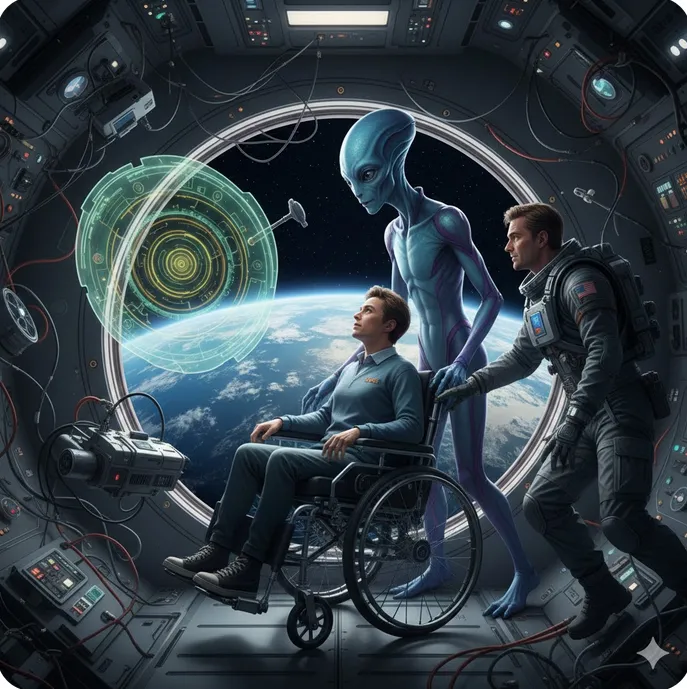
For as long as humans have tried to define what makes us unique, language has stood at the center of the discussion. Long before computers existed, philosophers argued that speech, grammar, and meaning separated humans from all other creatures. Language was not just a tool—it was evidence of thought itself.
Now, in the age of artificial intelligence, that assumption is being quietly but profoundly challenged.
Recent advances suggest that some AI systems are no longer limited to producing fluent sentences or mimicking conversation. They are beginning to analyze language in ways that look surprisingly similar to how trained linguists do it. This development raises a deep and unsettling question: if machines can reason about language—not just use it—what does that mean for our understanding of intelligence, creativity, and what it means to be human?
This moment may represent more than just a technical milestone. It may signal a shift in how we understand both AI and ourselves.
Language as Humanity’s Defining Trait
The idea that language defines humanity is ancient. From early philosophers to modern cognitive scientists, language has been viewed as the foundation of reasoning, social organization, and culture.
Language is more than vocabulary. It includes:
- The ability to generate infinite expressions from finite rules
- The capacity to embed ideas inside other ideas
- The recognition of ambiguity and context
- The ability to reflect on language itself
This last ability—thinking about language as an object of analysis—is known as metalinguistic reasoning. Traditionally, it has been seen as a uniquely human skill, one that even our closest animal relatives do not appear to possess.
For decades, this assumption shaped how researchers thought about artificial intelligence.
Why AI’s Fluency Wasn’t Enough
Modern AI systems have become incredibly good at producing human-like text. They can write essays, answer questions, summarize research, and even mimic creative writing styles. But for many linguists, this fluency was never proof of understanding.
The skepticism rested on a simple argument: predicting words is not the same as understanding meaning.
According to this view, language models succeed because they are trained on enormous datasets. They learn statistical patterns, not linguistic principles. They know what sounds right, but not why it is right.
For years, critics argued that no matter how impressive AI-generated text became, these systems lacked the internal representations necessary for true linguistic reasoning.
Until recently, that argument seemed safe.
The Shift: Testing AI Beyond Memorization
One of the biggest challenges in evaluating AI’s linguistic abilities is separating genuine reasoning from memorization. Language models are trained on vast quantities of text, including grammar explanations, linguistic theories, and examples from countless languages.
To fairly test whether AI can analyze language, researchers must create situations the model could not have encountered before.
That is exactly what a new wave of linguistic research set out to do.
Instead of asking AI to explain known languages, researchers tested whether it could:
- Break down unfamiliar sentence structures
- Recognize multiple valid interpretations of a sentence
- Identify abstract grammatical patterns
- Infer linguistic rules from entirely new systems
These are the same tasks given to graduate students studying linguistics.
The results surprised nearly everyone.
What Does It Mean to Analyze Language?
To understand why these findings matter, it helps to clarify what linguistic analysis involves.
When linguists analyze language, they do things like:
- Decompose sentences into hierarchical structures
- Identify relationships between words and phrases
- Explain why certain constructions are grammatical while others are not
- Recognize ambiguity and explain its sources
- Generalize rules from limited examples
This is not about repeating definitions. It is about uncovering underlying systems.
Traditionally, this kind of reasoning was assumed to require human cognition shaped by evolution and social interaction.
Yet some AI models are now demonstrating these capabilities under controlled conditions.
Recursion: The Hallmark of Human Language
One of the most striking aspects of human language is recursion—the ability to embed structures within structures indefinitely.
For example:
- A sentence can contain a clause
- That clause can contain another clause
- And so on, theoretically without limit
This nesting ability allows humans to express complex thoughts with precision and nuance. It is also one of the most challenging features for both humans and machines to process.
Recursion has long been considered a defining feature of the human mind, not just language.
The idea that an artificial system could recognize, manipulate, and extend recursive structures was once considered far-fetched.
That assumption is now under pressure.
AI Confronts Recursive Complexity
In recent experiments, AI systems were presented with sentences designed to test deep grammatical understanding. These sentences were intentionally complex, containing multiple layers of embedded phrases.
Instead of collapsing under the complexity, one AI system demonstrated the ability to:
- Identify nested structures accurately
- Represent them hierarchically
- Extend them logically while preserving grammatical integrity
In other words, it didn’t just parse a sentence—it understood how the sentence was built.
This level of performance goes far beyond surface-level text generation.
Ambiguity: When One Sentence Means Two Things
Human language is full of ambiguity. The same sentence can mean different things depending on structure, context, or emphasis.
Humans navigate this effortlessly by drawing on world knowledge, syntax, and pragmatics.
Computers, historically, struggle.
Yet recent tests showed AI systems identifying multiple valid interpretations of ambiguous sentences and representing each one separately. This requires recognizing that ambiguity exists and understanding why it exists.
That ability is central to human linguistic competence.
Learning Language Without Prior Exposure
Perhaps the most compelling evidence of genuine linguistic reasoning comes from experiments involving entirely artificial languages.
Researchers created miniature languages with:
- Invented words
- Novel sound patterns
- Consistent but unfamiliar rules
The AI systems were given only examples—no explanations.
From these examples, some models were able to infer abstract phonological rules governing how sounds change depending on context. These are the same kinds of rules humans unconsciously learn when acquiring their first language.
Crucially, these languages did not exist anywhere else. Memorization was impossible.
The AI had to reason.
Why This Changes the Debate
For years, the debate over AI language centered on a binary question: do these systems understand language or not?
The new evidence suggests that the question itself may be flawed.
Understanding is not a single switch. It exists on a spectrum.
AI systems may not experience language the way humans do—but they are increasingly capable of performing tasks that were once believed to require uniquely human cognition.
This doesn’t mean machines think like humans. It means the boundary between human-exclusive and machine-accessible abilities is more porous than we assumed.
Are Humans Still Unique?
This question naturally leads to discomfort.
If machines can analyze language, infer rules, recognize ambiguity, and manipulate recursive structures, what remains uniquely human?
Some argue that originality, creativity, and intentionality still belong exclusively to humans. AI can analyze, but it does not originate. It can explain rules, but it does not invent new ones in a meaningful sense.
Others counter that creativity itself may emerge from sufficiently advanced pattern recognition and generalization.
The debate is far from settled.
Limits of Today’s AI
Despite the impressive results, current AI systems still have limitations.
They:
- Rely heavily on training data
- Struggle with reasoning outside learned distributions
- Lack intrinsic goals or understanding
- Do not possess consciousness or experience
They excel at specific tasks under controlled conditions, but general intelligence remains elusive.
Still, the trajectory is clear.
Scaling vs. Understanding
A central question in AI research is whether improvements come from simply making models larger—or from changing how they learn.
Some researchers believe that increasing data and computational power will eventually yield deeper understanding. Others argue that new architectures and training methods are required.
What is becoming increasingly difficult to argue, however, is that language analysis lies permanently beyond AI’s reach.
Implications Beyond Linguistics
The consequences of this shift extend far beyond academic debates.
If AI can reason about language, it can:
- Improve translation accuracy
- Assist in language preservation
- Enhance education and tutoring
- Analyze legal and technical texts more reliably
- Support scientific research across disciplines
Language is the interface to knowledge. Improving AI’s linguistic reasoning improves everything built on top of it.
Rethinking Intelligence Itself
Perhaps the most profound implication is philosophical.
For centuries, humans defined intelligence by comparing ourselves to animals. Now, we define it by comparing ourselves to machines.
As AI acquires abilities once thought uniquely human, we are forced to refine our definitions.
Maybe intelligence is not a single essence but a collection of capabilities—some biological, some computational, some shared.
The Emotional Response: Awe and Anxiety
It is natural to feel conflicted.
On one hand, these advances inspire awe. They demonstrate the power of human ingenuity and the beauty of mathematical systems that can capture aspects of language.
On the other hand, they provoke anxiety. If machines can analyze language like experts, what roles remain exclusive to human professionals?
History suggests that new tools rarely eliminate human contribution—they transform it.
A New Partnership Between Humans and Machines
Rather than replacing linguists, AI may become their most powerful collaborator.
AI systems can:
- Analyze massive datasets
- Test hypotheses rapidly
- Explore linguistic patterns across hundreds of languages
Humans provide:
- Interpretation
- Theoretical insight
- Ethical judgment
- Creativity and purpose
Together, they may uncover insights neither could achieve alone.
What the Future May Hold
Looking ahead, we can expect AI systems to:
- Become better at learning from limited data
- Generalize more flexibly
- Integrate linguistic reasoning with real-world knowledge
- Assist in discovering new linguistic principles
Whether they will ever experience language as humans do remains an open question.
Final Reflections: Less Unique, Still Extraordinary
The realization that machines can analyze language as well as trained humans does not diminish humanity—it reframes it.
We are no longer defined by exclusive ownership of certain abilities, but by our capacity to create tools that extend understanding beyond ourselves.
Language remains deeply human—not because we alone can analyze it, but because we are the ones who care about its meaning.
As machines begin to listen more carefully to the structure beneath our words, the real question becomes not what they can do—but what we choose to do with them.