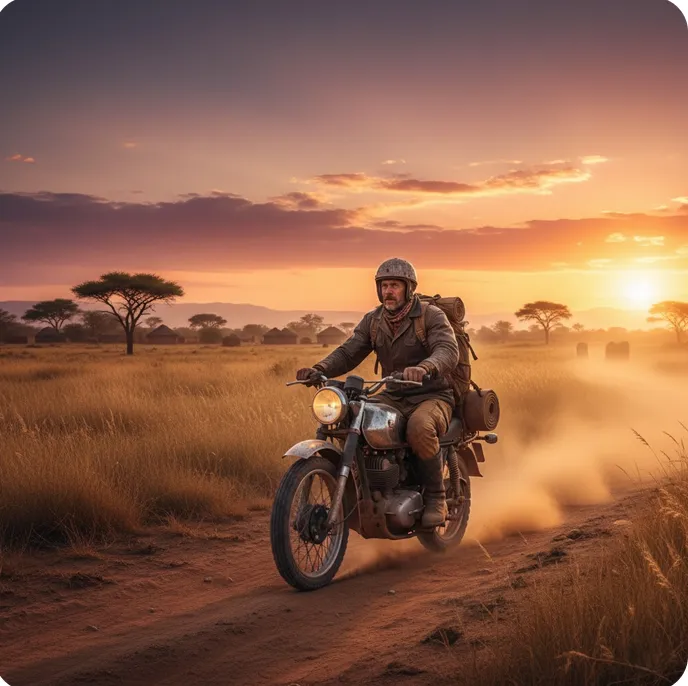
Beneath the vast, unblinking eye of the East African sun, where the earth cracks into a parched mosaic and distant mountains shimmer like a mirage, a lone figure kicks up a plume of rust-colored dust. This is not a scene from an adventure film, but the daily reality of a man on a mission against a shadowy killer. Armed not with weapons, but with medical kits, rapid tests, and a deeply personal resolve, he navigates a labyrinth of dirt tracks on a trusty motorcycle, serving as a mobile lifeline for communities grappling with a disease the world has largely forgotten.
His story is one of remarkable circularity—a journey from patient to protector. As a child, he was ravaged by a fever so profound it felt, in his own words, “like being run over by an 18-wheeler.” His body swelled; his strength evaporated. In the absence of medical knowledge, his family turned to traditional healers, whose treatments left permanent scars upon his skin. Salvation, when it finally came in a hospital, was agonizing: a brutal regimen of dozens of injections over two months that ultimately saved his life but etched the battle into his memory.
Today, that survivor, Andrew, uses those same scarred roads to prevent others from enduring his ordeal. He works as a community mobilizer for a non-profit organization dedicated to neglected diseases, focusing his efforts on the remote borderlands of Kenya and Uganda. The enemy he fights is visceral leishmaniasis, known locally as Kala-azar or “black fever.” It is a parasitic disease transmitted by the bite of a tiny sandfly, and it is one of the most lethal parasitic diseases on the planet, second only to malaria.
The Silent Scourge: Understanding the "Disease of Poverty"
To understand Andrew’s work is to confront the brutal reality of a "neglected tropical disease." This classification is a damning indictment of global health equity. These are illnesses that predominantly affect the world’s poorest, most marginalized populations, attracting little research funding, scant media attention, and inadequate medical infrastructure. Visceral leishmaniasis is a poster child for this neglect.
How does it work? The parasite, Leishmania donovani, is introduced into the bloodstream by the female sandfly. From there, it launches a silent invasion of the body’s internal organs—the spleen, liver, and bone marrow. The “visceral” in its name refers to this assault on the vital viscera. The early symptoms are cruelly non-specific: prolonged, intermittent fever, profound fatigue, weight loss, and a swollen abdomen as the spleen and liver enlarge. This ambiguity is deadly. In remote communities with little access to clinical diagnostics, these signs are often mistaken for severe malaria, typhoid, or tuberculosis. Without treatment, the infection progresses, leading to severe anemia, hemorrhaging, and secondary infections. The fatality rate for untreated cases is a staggering 95%.
The statistics are bleak yet underestimated. While the World Health Organization reports 50,000 to 90,000 new cases globally each year, experts agree this is a gross undercount due to poor surveillance in the very regions where the disease thrives. Over 70% of the global burden is shouldered by East Africa. Perhaps the most heartbreaking detail is its predilection for children; in some outbreaks, over half of all cases are in children under 15. It is a disease that steals futures.
But visceral leishmaniasis is more than a biological phenomenon. It is a disease of socioeconomic determinants. It thrives where poverty, malnutrition, and displacement converge.
- Housing: The sandfly breeds in specific environmental niches—rodent burrows, cracked mud walls, termite mounds (anthills), and areas of damp soil. Homes without sealed concrete floors or proper plastering offer ideal breeding grounds and resting places for the insects.
- Nutrition: Chronic malnutrition weakens the immune system, making individuals far more susceptible to a full-blown infection. For the immune-compromised, particularly those living with HIV, the risk is catastrophic; they are up to 100 times more likely to develop the disease if bitten.
- Livelihood and Mobility: In the dryland regions where Andrew works, communities like the Pokot are pastoralists. Their survival depends on moving vast herds across vast, arid distances in search of water and pasture. This nomadic lifestyle is a perfect storm: it exposes them to sandfly habitats in remote areas and makes consistent healthcare follow-up nearly impossible. As Andrew notes, “Sometimes when I'm returning to check on a patient, I find that they've moved.” His work then becomes detective work, tracking families across an immense and unforgiving landscape.
- Climate Change: Emerging research suggests environmental changes are exacerbating the problem. Deforestation, irrigation projects, and shifting rainfall patterns can alter microclimates, increasing humidity and temperature in ways that favor sandfly breeding and expand their geographical range.
A Clinic Beneath an Acacia Tree: The Front Lines of Detection
A typical day for Andrew begins not in an office, but under the spreading shade of an acacia tree in a village like Akorikeya. This is his makeshift clinic—a natural gathering point where men come to drink milky tea and share news. His tools are his trained senses, his hands, and a small case of rapid diagnostic tests.
His process is methodical and born of intimate community knowledge. He first observes, scanning the crowd, especially the children, for tell-tale signs of chronic illness: a pale complexion, listlessness, a distended abdomen. He then performs a physical examination, palpating the left side of the torso to feel for an enlarged spleen—a key indicator of advanced infection.
For those with symptoms—persistent fever, joint pain, nosebleeds—he employs the RK39 rapid test. A simple finger-prick yields a drop of blood; within ten minutes, the strip can reveal the presence of the disease’s antibodies. He also carries HIV tests, understanding the deadly synergy between the two diseases.
This community-based, active case-finding is revolutionary in a context where passive hospital reporting misses the vast majority of sufferers. By meeting people where they are, Andrew bridges the fatal gap between remote villages and distant health centers. When he identifies a positive case, his motorbike transforms into an ambulance. He often personally transports patients, sometimes for over 20 kilometers of rugged terrain, to the nearest treatment center, providing not just a diagnosis but a lifeline to care.
The Agony of the Cure: A Hospital’s Heavy Burden
That lifeline often leads to the Kala-azar Treatment Centre at Amudat Hospital, a critical facility serving the cross-border region. A visit here lays bare the brutal reality of current treatments. Before dawn, head nurse Priscilla Chebjira prepares her trolley. It is laden not with pills, but with syringes.
The current standard treatment in this region is a 17-day course of twice-daily intramuscular injections—a combination of sodium stibogluconate (SSG) and paromomycin (PM). That’s 34 painful shots. The drugs are toxic, with side effects comparable to chemotherapy. They can cause severe pain at the injection site, pancreatitis, liver toxicity, and potentially fatal heart arrhythmias. The wards echo with the cries of children receiving these agonizing jabs, their mothers (often barely more than children themselves) holding them down, a shared trauma compounding the illness.
This treatment paradigm highlights another layer of neglect: the lack of patient-friendly drug development. For decades, the needs of the affected populations, particularly children, were an afterthought. Children were routinely excluded from clinical trials for neglected diseases, meaning dosages and safety profiles were often extrapolated from adult data, a dangerous practice.
Doctors like Patrick Sagaki, who has treated Kala-azar here for over 15 years, work within these painful constraints. He speaks of the logistical nightmare of preferable, less toxic treatments. For instance, liposomal amphotericin B (L-AmB), used as a first-line treatment in India, requires refrigeration and intravenous administration—impossible infrastructure for many rural East African clinics. It remains a second-line option here, available only through complex donation programs.
Seeds of Hope: Innovation on the Horizon
Yet, within this stark landscape, hope is being cultivated through relentless advocacy and research. The non-profit Andrew works for, alongside partners, is spearheading efforts to change the paradigm. Their work recognizes that the fight must be waged on two fronts: improving treatments and preventing transmission.
A landmark clinical trial concluded recently, testing a new combination therapy: miltefosine (an oral drug) and paromomycin (injections). Crucially, this trial included a significant number of children. The results were promising: the new regimen demonstrated over 91% efficacy, matching the standard treatment but with critical advantages. It required one fewer injection per day, shortened the treatment course, and—most importantly—eliminated the toxic, heart-damaging SSG. This represents a monumental step toward a safer, more manageable cure.
However, as Joy Malongo, an access manager deeply involved in these efforts, soberly notes, even the best treatment is not a permanent shield. “Reinfections can be inevitable,” she states, if patients return to the same living conditions of poverty and exposure. Thus, the long-term solution must integrate medical intervention with socioeconomic development: improved housing, nutrition programs, and community education.
Andrew himself is a pivotal part of this educational front. He is a living testament, a trusted insider who can dispel myths and persuade communities to adopt preventive measures, like using insecticide-treated nets (even though sandflies are smaller than mosquitoes and can penetrate standard nets, specially designed nets are being promoted) and modifying their environment. He navigates delicate cultural practices, such as the Pokot’s reliance on anthills (which harbor sandflies) for harvesting edible ants, seeking sustainable compromises.
The Human Tapestry: Faces of Resilience
Behind the statistics and science are human stories, like that of Chemket Selina. Now a mother in her twenties, her age marked by seasons rather than calendars, she was diagnosed by Andrew as a teenager after suffering for a month with a burning fever. He carried her to the hospital on his motorbike. She remembers the pain of the injections but, echoing a common local belief interpreted by Dr. Sagaki, associated that pain with potency—a sure sign the medicine was fighting the disease.
Today, she worries for her four children. Her family’s existence is a testament to resilience amidst scarcity, eating once a day what they can forage and grow. When Andrew visits to check on her family, his clean bill of health is a temporary reprieve in a life of constant vulnerability. Her story illustrates the complex interplay of belief, poverty, and survival that defines this region.
The Road Ahead: Elimination is Possible
The challenge is immense, but not insurmountable. Dr. Sagaki points to countries like Bangladesh as beacons of hope. There, through sustained government commitment, community awareness, and accessible treatment, case numbers have plummeted. It proves that visceral leishmaniasis elimination is a feasible goal with the right, integrated strategy.
This strategy must be multi-pronged:
- Accelerating Access to Better Treatments: Getting new, safer drug combinations like miltefosine and paromomycin approved, affordable, and into remote clinics.
- Scaling Up Vector Control: Innovating and deploying effective insect control methods suited to local ecology and lifestyles.
- Strengthening Surveillance: Empowering more community mobilizers like Andrew to actively find cases before they become fatalities.
- Addressing Root Causes: Integrating disease control into broader programs for poverty alleviation, food security, and housing.
Andrew Ochieng’s motorbike journey is more than a commute; it is a symbol of a tireless, human-centric approach to healthcare. Each mile traveled, each spleen palpated under a tree, each child carried to help, represents a defiance of neglect. He is bridging the cavernous gap between a forgotten disease and the hope for a cure, between remote suffering and global science. His story, from a scarred survivor to a healing scout, reminds us that the fight against diseases like Kala-azar is not just about medicine in a vial. It is about the will to reach the unreachable, the courage to confront a silent killer, and the unwavering belief that no community should be left to suffer in the shadows. The path to elimination is long and dusty, but as long as the sound of his motorcycle engine echoes through the bush, hope is riding pillion.