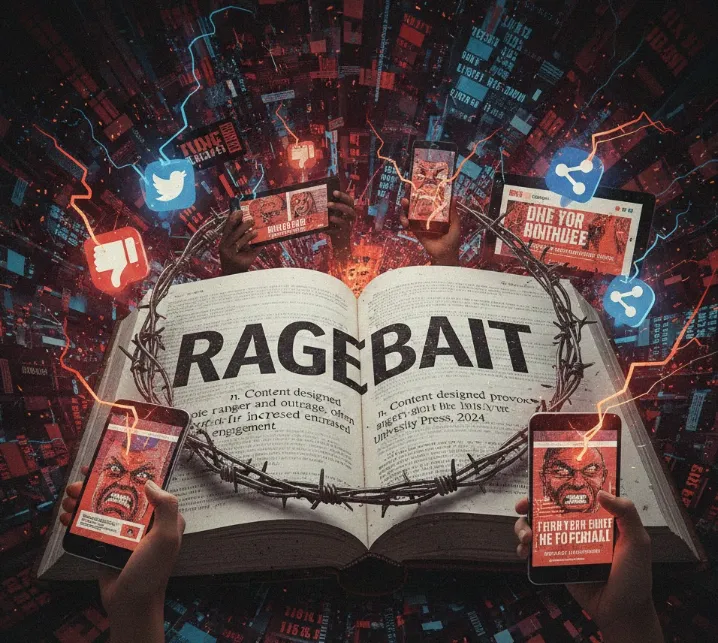
Let’s talk about the vocabulary of our time. Every year, linguistic authorities make a pronouncement that often feels less like an announcement and more like a cultural diagnosis. This year’s pick? A two-syllable term that perfectly encapsulates the emotional undercurrent of our digital lives. It’s the phrase that describes the content that makes your thumb pause, your jaw tighten, and your fingers itch to type a furious reply before you’ve even finished reading the headline.
That’s right: the concept of deliberately provocative online material designed to generate outrage, clicks, and engagement has been crowned the defining word of 2025.
It’s a choice that feels less like a celebration and more like a moment of collective recognition. We’ve all scrolled past it. The hyperbolic headline that twists a minor fact beyond recognition. The social media post crafted not to inform, but to incite. The video thumbnail featuring a deliberately exaggerated reaction face. It’s the digital ecosystem’s most potent fuel, and we’ve all learned to speak its language.
The Anatomy of a Click
Why has this concept risen to such prominence? The answer lies in the very architecture of our attention economy. Algorithms, the invisible curators of our daily experience, learned long ago that nothing drives “engagement” quite like strong emotion. And while joy is shared, outrage is amplified. It’s commented on, debated, and shared with a “Can you believe this?!” caption. The business model of sheer visibility became intertwined with the practice of emotional provocation.
This isn’t about genuine debate over important issues. That’s civic discourse. This is about the manufactured kind—the content where the controversy is the point, not a byproduct. It’s the spark that reliably ignites the kindling pile of our existing frustrations.
The Cultural Hangover
The recognition of this, term speaks to a cultural fatigue. We’re becoming archeologists of our own anger, learning to ask: “Is this worth my energy, or am I being played?” The word gives us a label for that sinking feeling when you realize you’ve just spent 20 minutes in a comments section, your heart racing, all over a scenario that was likely exaggerated for profit.
It names the tactic, and in doing so, helps us disarm it. To call something “rage bait” is to shift the power. It moves the focus from the faux-controversy itself to the mechanics behind it. It’s the linguistic equivalent of seeing the strings on the puppet.
Navigating the Provocation Economy
So, what do we do with this official acknowledgement of our digital reality? It serves as a powerful prompt for mindfulness.
- Pause Before You Propagate. Feel that surge of indignation? Take a breath. Ask: “What is this content really asking of me?” Is it asking for thoughtful consideration, or is it simply begging for your outrage?
- Starve the Engine. Engagement—even angry comments and hate-shares—is the currency. Sometimes, the most powerful response is not a fiery reply, but dead silence and a continued scroll.
- Seek the Signal in the Noise. Double down on seeking out nuanced sources, complex discussions, and content that informs rather than inflames. Support the creators and platforms that build rather than bludgeon.
The elevation of this term to the annual linguistic podium isn’t an endorsement of the practice. It’s a mirror. It reflects a year, and indeed an era, where our attention is the most valuable commodity, and our emotional responses are the target.
By giving it a name, we’re not just describing a trend; we’re taking the first step in reclaiming our cognitive space. We’re learning to see the hook before we bite. And in 2025, that might just be the most valuable skill of all.
What word do you think will define 2026? Perhaps it will be the term for the antidote we’re all desperately seeking.