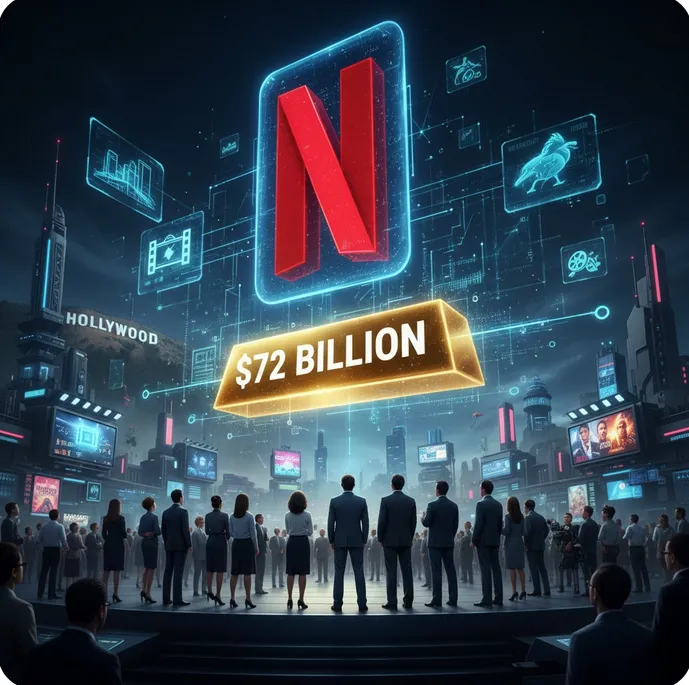
For years, analysts, fans, and industry insiders have speculated about which media giant would make the next transformative move in the entertainment landscape. Few predicted the seismic shift that arrived this week: Netflix — the world’s most influential streaming platform — has struck a landmark deal to purchase the film and streaming assets of Warner Bros Discovery for a staggering $72 billion.
In a decade defined by technological upheaval, studio mergers, collapsing cable empires, and new battles for cultural dominance, this acquisition may very well become the most consequential media deal of the century.
Although the agreement still awaits regulatory approval, the implications are massive and already reverberating through Hollywood. The move instantly positions Netflix not just as a streaming service, but as a mega-studio with its hands on some of the most valuable franchises, characters, and global entertainment brands ever created.
But what does this really mean for the industry, for creative workers, and for the millions of subscribers who tune in each night? Let’s dive deep into the story, the context, and the potential long-term ripple effects of Netflix’s boldest chapter yet.
A Turning Point Decades in the Making
When Netflix transitioned from mailing DVDs to launching a streaming platform in 2007, the company sparked the first major disruption in modern media. As cord-cutting took hold, traditional studios scrambled to build their own platforms. Disney rolled out Disney+. NBCUniversal launched Peacock. Warner Bros created HBO Max. The streaming wars escalated to a frenzy.
Yet amid a crowded field, Netflix remained the frontrunner — not because it had the largest library of beloved classics, but because it invested relentlessly in original content and global expansion.
Now, Netflix is entering an entirely new era: the ownership of foundational Hollywood properties that have shaped pop culture for generations.
Warner Bros isn’t just another studio. Its 100-year legacy includes:
- The entire Harry Potter film franchise
- Game of Thrones and its expanding universe
- DC films (though not all DC rights are included in this particular sale)
- A treasure trove of classics from its unmatched production history
- HBO’s premium slate of prestige programming
With this acquisition, Netflix goes from simply distributing films to becoming a guardian of cultural institutions that span millions of fans and dozens of countries.
Why Warner Bros Became the Battleground
For the past two years, Warner Bros Discovery has been caught in a transitional period marked by reorganizations, debt, shifting strategic priorities, and uneven streaming performance. While HBO Max featured acclaimed flagship series, the platform struggled financially.
When Warner Bros quietly began inviting suitors, competitors such as Comcast and Paramount Global stepped into the ring. But Netflix — with its enormous market reach and unmatched global subscriber base — emerged as the strongest bidder.
The price tag? $72 billion in equity value, with an overall enterprise value hovering above $82 billion.
Notably, this deal only includes Warner Bros’ film and streaming assets, not its entire cable network empire. Channels like CNN, TNT Sports, and Discovery’s European networks will spin off into a separate entity.
Still, what Netflix is buying is enormous: the libraries, the rights, the production infrastructure, and the long-established prestige of Warner Bros’ content ecosystem.
Netflix’s Vision: “Defining the Next Century of Storytelling”
Netflix co-CEO Ted Sarandos has already framed the acquisition as a long-term bet — one that could secure the company’s cultural dominance well into the future.
Sarandos emphasized that the union of Warner Bros’ timeless catalog and Netflix’s global innovation could help “shape the next chapter of entertainment” for audiences everywhere.
In essence, Netflix doesn’t just want to be the platform where you watch TV — it wants to be the creative power behind the defining worlds, characters, and stories that future generations will grow up with.
Meanwhile, co-CEO Greg Peters highlighted a cautious but optimistic stance regarding HBO’s brand identity. HBO has built decades of credibility in premium television, and Netflix appears committed to preserving that legacy, though the specifics of how HBO programming will be integrated are still unknown.
Will HBO Max Survive? What Happens to the App?
One of the burning questions is the fate of the HBO Max platform.
While Netflix executives have hinted at maintaining the HBO brand, the destiny of the standalone app remains unclear. Some possibilities:
1. HBO Max is absorbed entirely into Netflix
A likely scenario, with HBO shows available directly on Netflix’s interface.
2. HBO becomes a premium add-on within Netflix
A model similar to Prime Video channels.
3. HBO remains separate
Less likely, but not impossible if regulators raise concerns about market consolidation.
What’s clear is that Netflix sees value in HBO’s reputation for excellence — yet the economics of maintaining two big platforms may not be feasible.
How This May Reshape the Streaming Wars
This deal instantly reshuffles the hierarchy of global media competitors.
Netflix: From disruptor to empire builder
Netflix now owns a legacy studio rivaling Disney in cultural influence.
Warner Bros Discovery: Leaner but divided
With networks spinning off and film assets sold, the company becomes a smaller, more focused broadcaster. It will likely prioritize news, lifestyle programming, and sports under the new "Discovery Global" banner.
Disney: The pressure intensifies
Disney remains a titan, but its rivals are no longer just other legacy studios — Netflix now stands shoulder-to-shoulder.
Amazon and Apple: The tech titans to watch
Both companies have the cash to make similar monumental moves.
Paramount: The missed opportunity
Paramount reportedly made a bid to acquire the whole of Warner Bros Discovery. Now, the company may face increased competitive pressure as streaming consolidation accelerates.
The Critics: Why Some Believe the Deal Is Dangerous
Not everyone is cheering this merger.
The Writers Guild of America — representing thousands of film and TV writers — has already called on regulators to block the transaction. Their concerns include:
- Job cuts
- Lower wages
- Fewer independent production opportunities
- Decreased variety of content
- Higher consumer prices
This echoes broader fears in Hollywood that consolidation results in fewer buyers, fewer greenlit projects, and less negotiating power for creative labor.
Cinema organizations have also sounded alarms. Michael O'Leary of Cinema United warned that such consolidation could damage the theatrical ecosystem, particularly small-town theaters that rely heavily on big studio releases.
Many analysts agree that regulators will closely scrutinize the deal, especially given the current political climate and increased sensitivity toward corporate concentration.
The Theatrical Promise: Netflix’s Surprising Olive Branch
Interestingly, Netflix has promised that Warner Bros films will continue to debut in theaters — a notable shift for a company once criticized for avoiding the traditional theatrical window.
Some see this as an attempt to reassure Hollywood stakeholders. Others believe Netflix recognizes the long-term value of cinema runs, which often build prestige, strengthen franchises, and create cultural events.
Maintaining theatrical releases could also placate regulators, who may view the move as a pro-competition gesture.
Combining Two Giants: A Massive Logistical Challenge
The acquisition is enormous — and incredibly complicated.
Netflix estimates between $2–3 billion in cost savings by eliminating redundancies. But merging corporate cultures, realigning technology systems, restructuring teams, and managing global rights libraries are challenges that could take years.
Some observers worry Netflix may face internal strain or make painful cuts to streamline operations. Others believe the company’s experience managing global production gives it a unique advantage in orchestrating such a massive integration.
Regardless, a deal of this size will reshape internal workflows across both companies.
How Could This Change the Entertainment You Watch?
For everyday viewers, the biggest impacts may include:
1. More iconic franchises on Netflix
Think Harry Potter marathons, Game of Thrones spin-offs, and classic WB films available in one place.
2. Possible price increases
Analysts expect Netflix to raise subscription prices, particularly if HBO content is included.
3. Fewer total shows and movies produced
A merged company usually trims the number of overlapping projects.
4. Higher production budgets for tentpole content
Expect more mega-series, fantasy epics, and big-budget cinematic universes.
5. Streamlined user experience
Instead of juggling multiple apps, users may enjoy consolidated access to premium titles.
However, with any large-scale consolidation, some diversity of content may be lost, as niche projects often get deprioritized during cost-cutting phases.
Will Regulators Approve the Deal? The Big Question Mark
The U.S. government, along with international competition authorities, will ultimately decide whether the Netflix–Warner Bros union becomes reality.
Arguments in favor of approval:
- Increased global competitiveness against foreign platforms
- Stronger theatrical support compared to recent years
- Major cost efficiencies that could, theoretically, benefit consumers
Arguments against approval:
- Too much power in the hands of a single streaming giant
- Negative impact on creative labor markets
- Potential to raise streaming prices beyond consumer-friendly levels
No one can say for sure how the decision will fall, but experts are already calling this one of the most scrutinized media mergers in history.
What Happens Next?
Warner Bros must first complete its internal reorganization, splitting off its networks division into the newly formed Discovery Global. Only after that restructuring is finalized can Netflix officially close the deal.
Over the next year, we can expect:
- Regulatory hearings
- Industry lobbying (both supportive and oppositional)
- Detailed integration plans from Netflix
- Announcements about HBO’s future
- Shifts in strategies from competing studios
Whatever happens, one thing is undeniable: the landscape of modern entertainment will never be quite the same again.
Conclusion: The Biggest Entertainment Shake-Up of Our Generation
The Netflix–Warner Bros agreement is more than a blockbuster financial deal — it is a fundamental reimagining of how stories are funded, distributed, and shared across the world.
Netflix now stands not just as a dominant streaming service, but as a cultural steward of some of the most important entertainment franchises of the last century. If regulators sign off, the company will hold unparalleled influence over the direction of film, television, streaming, and cinematic universes for decades to come.
Whether this transformation ushers in a new golden age of storytelling or accelerates troubling patterns of corporate consolidation remains to be seen. For now, the industry watches closely as Netflix steps boldly into a role that may define entertainment for generations.