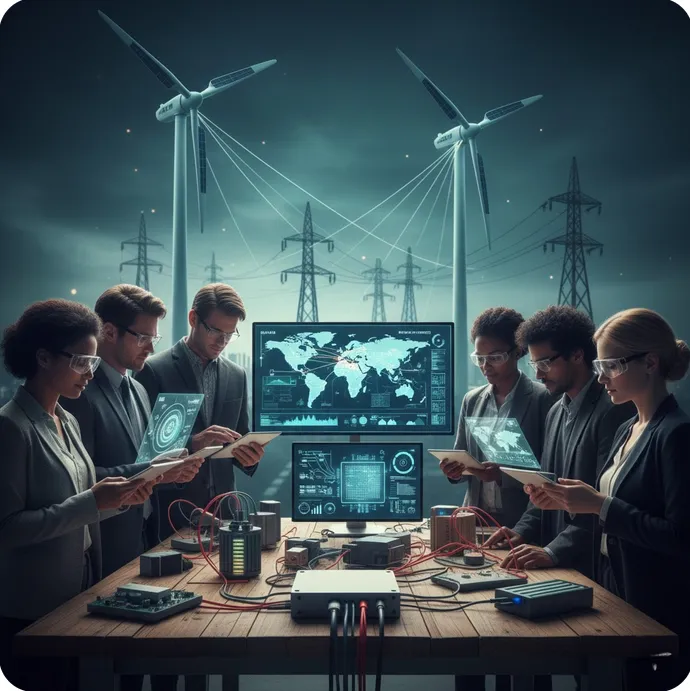
Over the past decade, technology has evolved at a pace faster than any era in history—but what’s unfolding right now is unlike anything the world has seen before. Artificial intelligence is no longer a futuristic concept or a science-fiction storyline. It has become an engine—arguably the engine—driving global industry, transforming economic models, and reshaping the workforce.
We are at an inflection point where AI isn’t just improving existing technologies; it is beginning to rewrite the underlying rules of production, energy consumption, and digital communication. For investors, policy makers, and innovators, the stakes have never been higher.
While massive corporations like Nvidia, Google, Amazon, and Microsoft capture most of the headlines, a deeper, quieter revolution is happening just beneath the surface. A group of emerging companies—many scarcely known outside niche tech circles—are providing the components, infrastructure, and scientific breakthroughs that allow AI systems to expand at unprecedented speed.
Some of these companies may become the essential “plumbing” of the AI economy, the hidden layers without which the entire digital ecosystem would collapse. Others are exploring advanced energy systems necessary to sustain the overwhelming power demands generated by next-generation computing.
This article examines:
- The scale and trajectory of the AI boom
- Why certain small and mid-sized companies are positioned at the center
- The explosive energy demands reshaping the tech landscape
- The idea of a coming “AI supercycle” and what it means for markets
- The emerging frontier of fusion-like energy research that could fuel the next era of computation
- How large-scale AI initiatives from leaders like Elon Musk are influencing the direction of related industries
While no one can promise guaranteed returns, clear patterns are emerging—patterns that help explain why analysts, researchers, and technologists believe we are heading into one of the biggest industrial expansions of the century.
The AI Boom: A Multi-Trillion-Dollar Transformation
A few years ago, AI tools could classify photos, translate languages, and recommend songs. Today, they are writing software, designing blueprints, diagnosing disease, generating lifelike video, and analyzing enormous datasets in seconds.
This isn’t just another technology wave—it’s a structural overhaul akin to the electrification of cities or the invention of the microprocessor.
Multiple research firms estimate that AI could contribute anywhere from $10 trillion to more than $20 trillion to global GDP over the next decade. The entire modern economy is being reconfigured around:
- Data centers
- Cloud computing
- Neural processing chips
- Autonomous robotics
- High-density energy infrastructure
- And the massive digital workloads needed to power these systems
But even with corporate giants taking the lead, the AI ecosystem is too vast, too complex, and too diversified to be dominated by a handful of players. That’s why a new wave of smaller companies is emerging—each one controlling or innovating around essential technologies that enable AI’s exponential growth.
The New “Picks and Shovels” of the AI Era
In the 19th century gold rush, the biggest fortunes weren’t made by miners—they were made by the manufacturers selling picks, shovels, and tools to the miners.
The same dynamic is unfolding today.
AI is the gold.
Small tech innovators are making the tools.
Behind every large language model, every autonomous system, every training cluster, and every inference engine lies a hidden supply chain:
- Specialty chipmakers
- Optical networking firms
- Cooling technologies
- Power grid optimization companies
- Memory component producers
- Data transfer and storage pioneers
Most people never hear their names. Yet AI developers depend on them just as miners depended on their tools.
Why these lesser-known companies matter
AI workloads grow at a compound rate far exceeding the growth of traditional software demand. Training large models requires:
- Thousands of high-performance chips
- Continuous power availability
- Cooling systems that can handle extreme heat
- Transmission lines capable of supporting unprecedented power draw
- Memory bandwidth far beyond consumer-level components
This creates a “support ecosystem” worth potentially trillions of dollars in the coming years. These companies might not appear on consumer-facing billboards, but they underpin everything.
Energy: The Hidden Crisis at the Heart of AI’s Growth
One of the most misunderstood aspects of the AI revolution is power consumption. The world tends to imagine AI as a purely digital phenomenon, floating in the cloud. But the cloud is not a cloud. It is millions of square feet of concrete buildings filled with servers—each one drawing electricity continuously.
As AI workloads multiply, the global grid faces pressures that no modern infrastructure was designed to handle.
Data centers are becoming energy giants
A single advanced data center can consume as much electricity as a mid-sized city. With the race to train larger and larger AI models, energy usage is skyrocketing.
Over the next decade:
- AI data centers may consume 10–20× more energy than they do today
- Training a single frontier model can require millions of kilowatt-hours
- Energy demand from computing may outpace the growth of renewable supply
- Utilities are scrambling to plan new generation capacity
This is where another class of companies—often overlooked by market watchers—comes into play: energy infrastructure providers.
These are not chipmakers, but they profit every time a chip powers up. They act as the toll collectors of the AI economy. Every watt consumed passes through them. Every hour of GPU runtime depends on their grid-level technologies, distribution systems, and generation facilities.
Some analysts argue that the biggest winners of the AI revolution may not be tech companies at all—but the companies that control the electricity flowing into tech companies.
The Search for a New Energy Breakthrough
As demand for computing power grows, researchers are exploring new forms of energy production capable of sustaining AI at planetary scale. This field, still experimental but rapidly advancing, involves attempts to mimic the extreme energy reactions that power the sun.
Various forms of fusion-like technologies—collectively known as “advanced nuclear,” “fusion research,” or “next-gen energy capture”—have attracted billions from private investors, including some of the world’s wealthiest technology founders.
Why? Because without a dramatic leap forward in energy production, AI’s long-term potential could be constrained.
The idea that humanity is trying to recreate the energy density of the sun isn’t science fiction—it’s happening now in labs across the world.
If even one breakthrough system succeeds, it could supply:
- Clean baseload power
- Vast output suitable for data centers
- High-density energy enabling more powerful AI models
- A next-generation grid that doesn't buckle under demand
Companies at the forefront of this research could define the next century of technology.
Innovation at the Edges: Small Companies with Big Impact
While megacorporations dominate the headlines, a handful of smaller firms have captured the attention of analysts and researchers for their role in supplying:
- Novel semiconductor materials
- Optical interconnects
- Photonic computing elements
- Advanced cooling systems
- Next-generation power converters
- Niche AI model training tools
These aren’t billion-dollar titans—yet. But their technology is essential.
Several factors make these companies so strategically positioned:
1. They specialize in components that don’t have many substitutes
If a large AI developer needs a particular memory module or a proprietary chip interconnect, and only two companies produce it, demand becomes extraordinarily concentrated.
2. They own critical patents
Patents can be more valuable than factories. A company with a protected technology may find itself courted by every major player in the industry.
3. They operate in sectors where big companies prefer to outsource
Large tech firms often rely on smaller specialists to handle delicate or experimental components. This creates long-term, multi-year supply relationships.
4. Their markets expand automatically as AI expands
Even if they don’t compete in the consumer arena, their sales grow because they are embedded in AI’s infrastructure layer.
How Elon Musk and Other Tech Leaders Are Accelerating Demand
High-profile founders like Elon Musk, Sam Altman, and Jensen Huang are pushing the boundaries of AI development—and the speed at which they do so creates massive ripple effects across supporting industries.
Musk’s various ventures—spanning energy storage, electric vehicles, automation, and advanced AI research—are interconnected in ways that amplify demand for key technologies. Even when his companies aren’t directly manufacturing certain components, they consume them in huge volumes.
This creates a rising tide that lifts:
- Semiconductor enablers
- Battery material suppliers
- Energy infrastructure partners
- Robotics manufacturers
- Software toolchain companies
When a major tech figure announces a breakthrough, demand for certain upstream technologies surges almost immediately.
This pattern will likely intensify, not fade.
The AI Supercycle: A New Phase of Technological Expansion
The combined impact of:
- exponential model sizes
- rising semiconductor demand
- massive data center build-outs
- global investment in energy infrastructure
- and ecosystem-wide innovation
…suggests we are entering a new economic cycle fueled by AI.
In this phase:
- Capital spending on AI hardware may exceed all previous tech cycles
- Data center construction could become one of the largest real estate expansions in modern history
- Traditional energy utilities may evolve into AI-era power suppliers
- Specialty tech firms may become indispensable partners to large corporations
- Nations may compete for access to computing capacity as if it were oil
This isn’t hype—it is the natural outcome of a technology that requires unimaginable computational resources.
We are watching the early stages of a transformation that will likely shape the next twenty to thirty years of global economics.
The Road Ahead
As AI continues to accelerate, the companies poised to benefit will not be limited to the usual suspects. Instead, the ecosystem will expand in every direction—chips, cooling, storage, power, robotics, software, and emerging scientific breakthroughs.
Small innovators could become central players.
Energy infrastructure will become one of the defining battlegrounds.
AI companies will increasingly rely on a vast, interconnected supply chain.
For those following the industry—whether as technologists, policymakers, or investors—the key is understanding the deeper architecture behind AI’s explosive growth.
The most significant opportunities often emerge not from the headline makers, but from the companies building the foundations of the future.