Every year, families across the UK bundle up, brave the cold, and head out in search of Christmas magic. For some, it’s the familiar comfort of pantomimes. For others, it’s festive markets or long-standing light trails. In recent years, though, a new type of spectacle has captured the imagination of holiday-goers: drone shows.
Promising environmentally friendly displays, dazzling formations, and a modern alternative to fireworks, drone performances have risen in popularity as technology improves and event organizers look for novel ways to enchant audiences.
But not all attempts at festive wonder go according to plan.
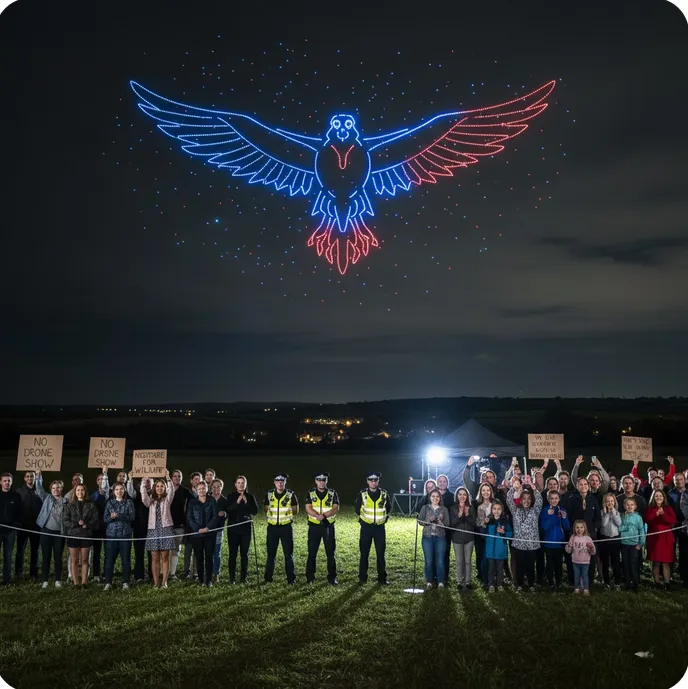
In late November 2025, a Christmas drone show in West Sussex—marketed as a grand, high-tech extravaganza—left thousands of attendees stunned for all the wrong reasons. The event, organized by Lumina Sky Theatre and advertised as a breathtaking aerial display featuring 600 synchronized drones, quickly became a talking point nationwide after visitors described the show as “awful,” “horrific,” and “nothing like what was promised.”
Weeks later, frustration continues to simmer as customers discover that refunds will not be issued, despite the widespread disappointment and public outcry.
This is the story of how a highly anticipated holiday event spiraled into a customer service disaster, why attendees are fighting back, and what the situation reveals about the growing pains of the drone entertainment industry.
The Big Promise: A Holiday Show Like No Other
When Lumina Sky Theatre first began promoting their Rudolph the Red-Nosed Reindeer Drone Show, the marketing pitch was irresistible:
- Hundreds of drones
- Smoothly choreographed animations
- Festive scenes unfolding in the sky
- A visual experience “unlike anything seen in the region”
Families expected to see glowing reindeer, snowflakes swirling in digital formations, and soaring Christmas imagery illuminating the night.
In short: people believed they were buying tickets to a futuristic fireworks replacement—an event blending tech, art, and holiday nostalgia.
More than 1,700 ticket-holders committed their money, their evening, and their trust.
But when spectators gathered at the South of England Showground in Ardingly on 30 November, many sensed trouble immediately.
The weather was clear. Crowds were buzzing. Children clutched hot chocolates, waiting for Rudolph to “fly.” The moment was set for a festive memory… until the drones actually took off.
The Night Everything Went Wrong
Instead of a sky full of swirling figures, many attendees reported seeing just a tiny cluster of drones—far fewer than the 600 promised.
Where the promotional imagery had shown crisp, detailed shapes, visitors described seeing unclear outlines, blurry animations, and formations so small or faint that people had to squint to make sense of what they were looking at.
One attendee, Sean Tong, claimed he could only identify around 50 drones—a fraction of what had been advertised.
Some spectators attempted to capture the show on their phones, but the shapes were so unclear that many clips looked like scattered dots rather than organized images.
When photos started circulating online, they fueled even more frustration. Images that were meant to evoke Christmas warmth ended up becoming examples of poor execution: misaligned figures, dim lights, and tiny formations dwarfed by the night sky.
For many families, the disappointment was immediate. Some children asked parents if the show had even started yet. Others wondered aloud if this was “the real show or just a test.”
The general consensus? The show simply wasn’t ready for the public.
The Backlash Begins: Facebook Groups and Radio Call-Ins
The backlash was swift. Within hours, frustrated visitors began rallying online.
A Facebook group demanding refunds quickly swelled to nearly 1,700 members, many sharing similar stories:
- Expensive tickets that didn’t deliver value
- Overpriced refreshments
- Underwhelming visuals
- Technical glitches that were never fully explained
One attendee wrote:
“Everything they promised was either missing, poorly done, or not worth the money. Why would anyone want to experience that again?”
Another added:
“The show was so bad I wouldn’t return even if it were free.”
Parents, especially, felt misled—not just about the visual quality, but about the event atmosphere in general. Many believed they had paid holiday-season prices for something that resembled a test run rather than a finished performance.
Complaints poured into BBC Radio Sussex, where callers described the event as a “letdown,” “shockingly poor,” and “not what we were sold.”
The conversation shifted from disappointment to accountability.
Did organizers overpromise? Underplan? Oversell? Or simply run into technical issues beyond their control?
Lumina Sky Theatre Responds — But Not Everyone Is Satisfied
Shortly after the backlash began, Lumina Sky Theatre released a public apology, stating that the night had been affected by “technical difficulties.” They encouraged attendees seeking a refund to contact the company directly.
But as days passed, customers found the refund process slow and unclear. Some said their messages were ignored. Others were told resolutions were “being reviewed.”
Then came the announcement that deepened the frustration:
Lumina Sky Theatre would not issue refunds at all.
Citing the high costs involved in staging the event, the company explained that they were “not in a position” to reimburse customers.
Instead, they offered a replacement event:
A private show scheduled for 28 December at Lingfield Park Racecourse in Surrey. The event would include:
- Free parking
- A 50% discount on fairground rides
- A Michael Bublé tribute performance
- A fully executed drone show “as originally intended”
While Lumina framed this as a good-faith attempt to make things right, many customers were unimpressed.
A common question echoed online:
“If they can afford to host a whole new event… why can’t they refund the first one?”
Others voiced logistical concerns:
- Extra travel time
- Conflicts with holiday schedules
- Paying again for food, drinks, or rides
- Uncertainty about whether the new show would be any better
The offer, meant as a solution, instead reignited anger.
Why Refund Disputes Hit So Hard During the Holidays
The situation touches a nerve because holiday events hold emotional weight.
Families often budget carefully for seasonal outings. A disappointing experience isn’t just a financial inconvenience—it feels like a broken promise during a time when people seek joy, tradition, and memory-making.
For many, the Ardingly show wasn’t just a night out. It was:
- Their children’s big Christmas surprise
- A planned family tradition
- A treat replacing fireworks or other costly outings
When an event heavily marketed as magical falls flat, the emotional impact extends beyond money.
This is why so many attendees continue pushing for refunds, calling the replacement offer inadequate and the company’s response tone-deaf.
The Broader Picture: Are Drone Shows Still Too Unpredictable?
Drone shows, while impressive when executed well, are complex.
They rely on:
- Stable GPS
- Clear communication between hundreds of drones
- Strong wireless signals
- Precise choreography
- Favorable weather
- Well-maintained hardware and software
- Experienced technical teams
Even under perfect circumstances, glitches can occur. A single malfunctioning drone can disrupt a formation. Too many malfunctioning drones can collapse an entire scene.
Because this technology is still evolving, drone shows remain more vulnerable to failure than fireworks, which have been perfected over decades.
The West Sussex debacle raises a larger industry question:
Are companies overselling the reliability of drone shows before the technology is ready for mass holiday events?
Audiences accustomed to cinema-quality animation expect perfect execution—not pixelated shapes drifting apart or only a portion of drones functioning.
As drone companies expand rapidly to meet demand, not all are equipped to deliver consistent, large-scale results.
Event Mismanagement or Unlucky Technical Failure?
Some attendees believe Lumina Sky Theatre’s problems go beyond technical difficulty.
Complaints suggest issues with:
1. Overpromising in marketing
The promise of “600 drones” set high expectations that were not met.
2. Communication gaps
Crowds were left confused about what went wrong.
3. Poor backup planning
No contingency plan was announced that night, leaving people unsure if the show was playing correctly.
4. Inadequate customer support
Requests for refunds went unanswered, and policies seemed to shift post-event.
5. Event atmosphere problems
Many called the event overpriced in general—even beyond the drone show failure.
The cumulative effect eroded trust between the organizers and the attendees.
What Can Consumers Learn From This?
As drone shows become more common, consumers may want to be more cautious about expectations.
1. Drone shows are still relatively new.
Failures are possible—even at professional levels.
2. The number of drones matters.
Smaller shows (under 100 drones) often look faint or blurry in large outdoor spaces.
3. Weather and technical reliability are unpredictable.
4. Refund policies should be reviewed in advance.
Many people did not realize there was no guaranteed refund clause.
5. Social proof matters.
Future customers may seek reviews before booking drone-based events.
Is the Replacement Event Enough to Repair Trust?
Lumina Sky Theatre hopes that the new Surrey event will serve as a “second attempt” to deliver the show customers deserved.
The additional perks—discounted rides, free parking, live entertainment—are clearly designed to frame the evening as a goodwill gesture.
But whether it works depends entirely on:
- How many people can attend
- Whether the new show delivers as promised
- Whether attendees feel respected
- Whether public perception shifts
At the moment, the community feedback is mixed at best.
Some attendees say they’re willing to give the company a second chance, hoping the redo will be magical.
Others refuse to go, feeling the company should have taken responsibility by issuing refunds, not offering another event.
The Future of Holiday Drone Displays
Despite the controversy, drone shows are likely here to stay. Their advantages—eco-friendliness, repeatability, reduced noise pollution, and creative flexibility—make them ideal replacements for fireworks in many settings.
But incidents like the Ardingly show highlight the growing pains of an emerging industry.
To succeed long-term, drone show organizers must:
- Match advertising to reality
- Invest in stronger technical infrastructures
- Provide clear refund policies
- Communicate issues transparently
- Ensure backup plans for failures
- Focus on customer satisfaction
Until then, consumers may remain cautious—and stories of failed shows will continue circulating online.
Final Thoughts
The West Sussex Christmas drone show was meant to create unforgettable festive memories—but it ended up becoming unforgettable for the wrong reasons.
The disappointment felt by hundreds of families reflects a deeper issue: when expectation meets reality in the world of emerging entertainment, the gap can be wide and painful.
Lumina Sky Theatre may still redeem itself with the Surrey replacement event. But the sting of the initial failure and the refusal to issue refunds has already left a lasting impression on many who attended.
In the end, this debacle serves as a reminder that while technology can create magic, it can also magnify mistakes—and in the era of social media, even one misfired spectacle can spark nationwide debate.