On a night when eight goals flew in and Old Trafford briefly rediscovered its taste for chaos, the loudest message didn’t come from the pitch.
It came from the stands.
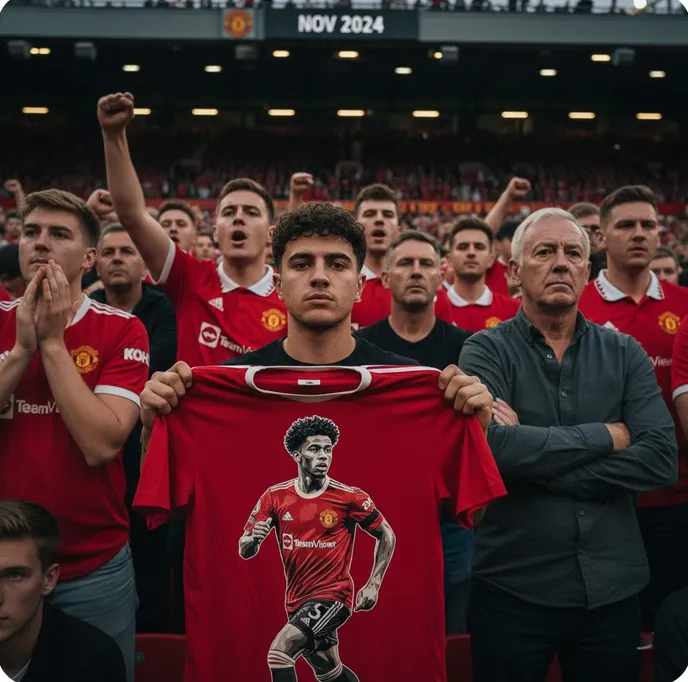
As Manchester United and Bournemouth traded blows in a breathless 4–4 draw, a simple black T-shirt worn by a spectator quietly stole attention long after the final whistle. Printed across the chest were three words that instantly rippled across social media and fan forums alike:
“Free Kobbie Mainoo.”
The wearer was not a random supporter. He was Jordan Mainoo-Hames, the half-brother of Kobbie Mainoo himself. And in one bold fashion statement, he reignited a debate that has been simmering for months—about youth development, trust, ambition, and what Manchester United really wants to be in 2025.
This was not just about a midfielder. It was about philosophy, power, and the uncomfortable truth that one of Europe’s most iconic football institutions is still wrestling with its identity.
A Night of Drama—and a Different Kind of Protest
The match itself should have been the story.
Eight goals. Momentum swings. Defensive collapses. Emotional whiplash. The sort of Premier League spectacle that leaves fans exhausted but entertained.
Yet amid the noise, something quieter but more provocative took shape in the crowd. The T-shirt wasn’t waved or brandished. It wasn’t part of an organized protest. It simply existed, visible enough to be noticed, personal enough to sting.
Because this wasn’t an abstract slogan. It was a plea on behalf of a real player—a 20-year-old midfielder who many supporters believe should already be central to United’s future.
And that’s what made it so powerful.
Kobbie Mainoo: From Academy Gem to Sideline Figure
Not long ago, Kobbie Mainoo was viewed as one of Manchester United’s brightest internal success stories.
A technically gifted midfielder with composure beyond his years, Mainoo represented the kind of player United fans love to champion: homegrown, intelligent, fearless on the ball. His rise through the academy system felt like a reminder of the club’s storied past—a lineage that stretches from the Busby Babes to the Class of ’92.
Yet this season, that narrative has stalled.
Despite flashes of quality and clear interest from top European clubs, Mainoo has struggled to secure consistent Premier League starts. His involvement has been sporadic, measured in substitute appearances and limited minutes rather than extended runs.
Against Bournemouth, he entered the match with roughly half an hour remaining—receiving a warm, almost cathartic reception from the crowd. The applause wasn’t just encouragement. It felt like affirmation.
Fans were reminding him—and perhaps the manager—that they still believe.
The Manager’s Dilemma: Trust, Timing, and Tactical Conviction
Head coach Ruben Amorim has found himself at the center of this storm.
Since taking charge, Amorim has been clear about one thing: he values structure, discipline, and players fitting specific tactical roles. He has also repeatedly pushed back against the idea that he doesn’t trust United’s academy products.
From his perspective, selections are pragmatic, not personal. Youth must earn their place. Talent alone isn’t enough.
But football, especially at a club like Manchester United, is rarely judged solely on logic.
Supporters see a gifted midfielder left waiting. They see a player already good enough to attract interest from clubs like Napoli. They see a pathway that once felt clear now blocked by hesitation.
And when Amorim speaks publicly—carefully, measured, but sometimes bluntly—his words are parsed for hidden meaning.
When he suggests young players are “struggling” elsewhere, or not starting consistently at youth level, those comments echo far beyond press rooms.
They land in dressing rooms. In agent conversations. On social feeds.
A Summer That Changed Everything
The tension didn’t appear overnight.
During the summer transfer window, Mainoo was reportedly open to exploring opportunities away from Old Trafford. Not because he lacked loyalty, but because he wanted football—minutes, responsibility, growth.
Napoli emerged as one of the most serious suitors. For a young midfielder, the appeal was obvious: Champions League exposure, a tactical league that values intelligence, and a clearer route into a starting role.
Manchester United said no.
From a business standpoint, the decision made sense. Mainoo is on relatively modest wages. Replacing him—especially mid-season—would be costly. Letting him go, even temporarily, would risk weakening squad depth while inflating future recruitment costs.
From a footballing standpoint, however, the refusal left Mainoo in limbo.
Too valuable to lose.
Not trusted enough to start.
Caught between promise and patience.
When Family Speaks, Clubs Listen
Players express frustration in many ways.
Some give interviews. Others post cryptic messages online. A few simply stop performing.
In this case, the message came from family.
Jordan Mainoo-Hames’ T-shirt wasn’t aggressive or profane. It didn’t attack the manager or the club. It didn’t demand a transfer outright.
It asked for freedom.
Freedom to play.
Freedom to develop.
Freedom to fulfill potential.
That it came from someone so close to the player added emotional weight. Families see the hours unseen: the training sessions, the self-doubt, the conversations late at night about whether patience is still worth it.
Clubs don’t just manage players—they manage ecosystems of agents, families, supporters, and expectations. When a relative feels compelled to make a public statement, it’s usually because private frustration has reached a breaking point.
Applause as a Verdict
The reaction inside Old Trafford said as much as the T-shirt.
When Mainoo stepped onto the pitch, the response was immediate and loud. Fans didn’t need prompting. They didn’t wait for a touch on the ball.
They clapped because they wanted him there.
In modern football, crowd reaction is a form of feedback. It’s not always rational, but it’s deeply influential. Managers insist they ignore it. Few truly do.
The applause wasn’t a rebellion against Amorim. It was a reminder of what supporters value: youth, courage, continuity, and identity.
A Broader Pattern: Youth Under Scrutiny
Mainoo’s situation doesn’t exist in isolation.
In recent weeks, comments about other young players have also stirred discomfort within the club. Teenagers performing well on loan or at youth level have found themselves publicly questioned, even when statistics and accolades suggest progress.
When those players responded—subtly, via social media posts highlighting achievements—it underscored a widening gap between internal messaging and external perception.
These moments matter.
Academies thrive on belief. Young players accept hard truths, but they also crave recognition. When criticism feels dismissive rather than constructive, it can damage trust.
For a club that prides itself on youth development, perception is everything.
The Changing Nature of Player Power
This episode also reflects a broader shift in football culture.
Young players today are more aware of their value. They have access to data, representation, and global platforms. They see peers flourishing elsewhere and understand that career windows are finite.
Patience, once a virtue, is now a risk calculation.
If opportunities don’t come, alternatives are explored.
Managers still hold authority, but they operate in an environment where every decision is scrutinized in real time by fans, analysts, and the players themselves.
A T-shirt, once just fabric, becomes a headline.
Is This a Crisis—or a Necessary Conversation?
It would be easy to frame this as drama, dissent, or disrespect.
But it might be something else entirely: a conversation the club can no longer avoid.
What is Manchester United’s pathway for young players?
Is it symbolic or practical?
Is patience rewarded—or tested indefinitely?
Is the academy a selling point or a strategic cornerstone?
These questions don’t demand immediate answers, but they demand clarity.
Because players like Kobbie Mainoo won’t wait forever.
The Manager’s Open Door—And the Weight of Silence
To his credit, Amorim has repeatedly stated that he is open to dialogue. He has invited players to speak to him, to express concerns, to seek understanding.
That openness matters.
But communication works both ways. When players—or their families—feel unheard, silence becomes its own message.
A public gesture, however uncomfortable, is sometimes a last resort.
Where Does This Leave Kobbie Mainoo?
As the season progresses, the stakes rise.
Every appearance—or absence—will be interpreted through the lens of that T-shirt. Every selection decision will be dissected. Every rumor will feel louder.
United may yet reintegrate Mainoo fully, trusting him with starts and responsibility. If that happens, the episode will fade into trivia—a footnote in a successful career.
If not, it may be remembered as an early warning.
A moment when frustration became visible.
When potential met hesitation.
When a family spoke because the football hadn’t.
A Club at a Crossroads
Manchester United is not short on resources, ambition, or talent.
What it sometimes lacks is alignment—between history and strategy, between promise and opportunity.
The “Free Kobbie” moment wasn’t an attack. It was a mirror.
And what it reflected was a club still deciding whether it truly believes in the players it produces—or merely in the idea of them.
Final Thoughts: More Than a Shirt
Football is full of symbols.
Armbands.
Banners.
Chants.
Silence.
Occasionally, a T-shirt says it all.
Whether Manchester United chooses to listen may define not just Kobbie Mainoo’s future—but the credibility of the pathway they claim to protect.
Because in the end, freedom in football doesn’t always mean leaving.
Sometimes, it simply means being trusted.