For years, BMW has been hinting—sometimes subtly, sometimes in big, flashing-lights presentations—that a dramatic shift was coming to its electric vehicle lineup. The company called this new philosophy Neue Klasse, a term with deep historical roots stretching back to the models that saved BMW in the 1960s. Back then it signaled a complete reinvention of the brand. Today it does the same, but this time the transformation is driven by electrons, software, and a fundamental rethinking of what a vehicle platform ought to be in an electric era.
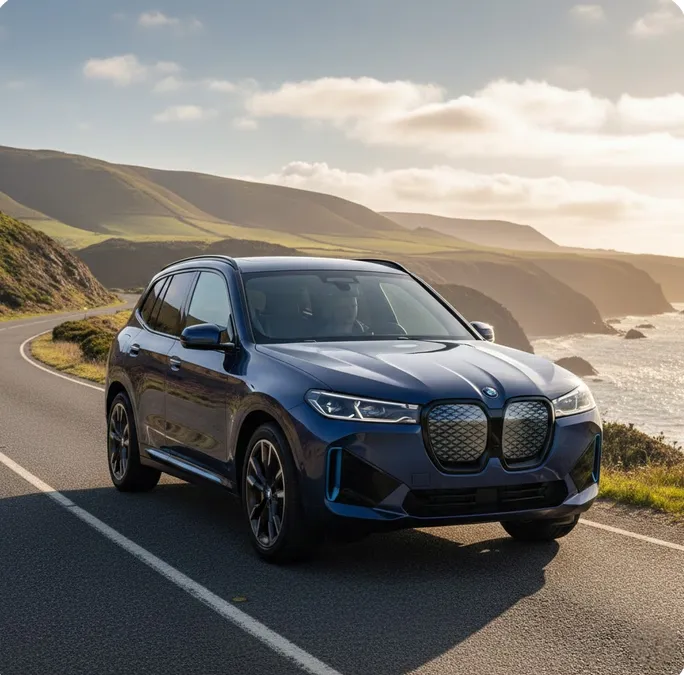
After months of teasers, camouflaged prototypes, secret briefings, and carefully staged technology showcases, the first complete product of this next-generation EV architecture is finally here: the 2026 BMW iX3. And after spending a full day behind the wheel, exploring its tech, navigating rural two-lanes, cruising interstates, and immersing myself in its software ecosystem, I can say the hype wasn’t misplaced. The iX3 is more than just another electric crossover—it’s the clearest expression yet of where BMW believes the future of driving is heading.
If that sounds dramatic for what’s essentially a family SUV, well… sometimes revolutions come wrapped in practical sheet metal.
Neue Klasse: BMW’s EV Reset Button
To understand why the iX3 holds so much significance, you have to look under the skin. Most of BMW’s previous electric cars—the i4, i7, iX, and so on—were built on platforms originally created to accommodate internal combustion engines. In other words, they were multi-purpose layouts adapted to handle electric components. They worked, and in many cases worked impressively well, but they were inherently compromises.
Neue Klasse is different.
BMW designed this new platform exclusively for EVs. No fuel tank tunnels. No transmission constraints. No need to shoehorn battery packs into whatever space happened to be available. Everything, from the body structure to the software stack to the electrical architecture, was reinvented to prioritize efficiency, driving quality, and seamless integration of advanced features.
And the iX3 is the very first model to emerge from the process.
Although similar in size to the current gasoline X3—one of BMW’s most popular vehicles—the all-electric iX3 is built on entirely different proportions. The battery pack lies flat beneath the floor, lowering the center of gravity, while newly developed electric motors sit at the front and rear. This gives the car a balanced feel even before you start driving.
The numbers are impressive:
- 108.7 kWh usable battery
- Dual-motor all-wheel drive
- 463 hp and 476 lb-ft of torque
- Estimated range: ~400 miles (pending EPA certification)
- Fast-charging up to 400 kW
- First BMW with a built-in North American Charging Standard (NACS) port
What’s more important than the numbers is the architecture itself. With more efficient motors, next-gen power electronics (including silicon-carbide inverters), and a 800-volt electrical backbone, the iX3 is optimized for both performance and charging efficiency. If you can find a high-powered charger, you’ll be able to replenish enormous amounts of range in surprisingly little time.
But specs only tell part of the story, because what truly differentiates this vehicle is how everything comes together in the real world.
Inside the iX3: A Tech Playground That Somehow Isn’t Overwhelming
Step into the cabin and the first thing your eyes land on isn’t the seats or the shape of the dashboard—it’s what stretches across it.
BMW calls it the Panoramic Vision display, and that name doesn’t really prepare you for the effect. Instead of a traditional instrument cluster and a separate central screen, the iX3 uses a single, ultra-wide display that spans from the left pillar all the way across to the passenger-side. It’s not a regular screen either—it’s more like a next-generation heads-up display projected across the bottom of the windshield.
The display shows the essentials (speed, navigation, warnings) on the left, but the real innovation lies in the customizable segments across the wider field. Want to put music visualization on the far right? You can. Prefer to show trip efficiency data in the middle? Also possible. Want nothing at all except a minimal speed readout? One tap and everything else fades away.
Above this already futuristic arrangement sits a separate 3D heads-up display, capable of projecting layered information—road markings, directional arrows, driving cues—onto the windshield at different depths. It’s like AR navigation without the gimmicks.
Then, almost as an afterthought, BMW includes a 17.9-inch main touchscreen, a sharply angled geometric panel that floats in the center. In almost any other vehicle this would be the star attraction, but in the iX3 it plays a supporting role. You interact with it frequently, yet it never dominates the cabin because the Panoramic Vision display carries the heavy lifting.
And surprisingly… it works
It’s easy for futuristic dashboards to feel like tech for tech’s sake, but the iX3’s interface ends up being intuitive. It takes a few minutes to familiarize yourself, but once you do, everything flows.
There’s a clear emphasis on keeping your eyes forward:
- Key information is always projected above the dashboard.
- Controls are never more than a few taps away.
- The car gently nudges you to use voice commands where appropriate.
The software running everything is BMW’s latest iteration of its iDrive system. The company has been gradually refining iDrive for over two decades, and in this version you can feel the polish. Animations are crisp, loading times are instant, and transitions feel natural.
A deeper link to your phone
The companion smartphone app now offers features beyond the usual remote lock/unlock or charging status.
You can:
- Remotely maneuver the car out of a tight space while standing outside it
- Access 3D interior and exterior camera views
- Set up individual playlists or experiences for each passenger
- Preload your navigation and climate preferences before you even reach the car
It feels like BMW is finally merging its EV hardware with a digital ecosystem robust enough to match what Tesla pioneered years ago.
But technology alone doesn’t make a great vehicle. That comes down to driving.
Safety Systems That Feel Less Like Babysitters and More Like Co-Pilots
Today’s cars are full of safety systems—lane-keeping, adaptive cruise control, hands-free modes—but many of them are intrusive or awkward. You nudge the wheel and the system shoves back. You try to change lanes and suddenly alarms scream because the software didn’t expect it. You tap the brakes and your hands-free system disengages entirely.
BMW set out to make these systems intuitive instead of imposing, and after experiencing the new suite firsthand, the difference is dramatic.
No more fighting the wheel
When the Highway Assistant (BMW’s hands-free driving mode) is active, taking over is effortless. Just grab the wheel and the car yields instantly. There’s no tug-of-war, no jerkiness, no alarms, no punishment for wanting manual control.
Then—this is key—if you release the wheel again, the system quietly resumes. It doesn’t chastise you. It doesn’t flash warnings. It simply adapts.
Lane changes are a breeze
There are two ways the car can switch lanes:
- Automatic lane change:
- The car prompts you.
- You glance at the mirror.
- It verifies your intention through eye tracking and executes a smooth lane change.
- Driver-initiated lane change:
- You steer into the next lane.
- The car notices and automatically activates the turn signal on your behalf.
Small touch, big impact.
Even braking is collaborative
Unlike many hands-free systems, BMW’s stays active even when you brake lightly. You can slow down for traffic, come to a stop, then let the system resume once conditions allow—all without turning anything back on.
It’s the first time an advanced safety suite has felt like a teammate rather than a backseat driver.
On the Road: Finally, an EV That Feels Like a BMW
All the technology would mean little if the driving experience were bland. Thankfully, this is where the iX3 shines even brighter.
On highways, the ride is smooth, quiet, and composed—exactly the kind of serenity you’d expect from a premium EV. But it’s on winding two-lane country roads that the vehicle really reveals its personality.
Dual motors with dual character
Out of the box, the iX3 defaults to “Personal” mode—essentially the everyday driving profile. In this setting, the vehicle feels grounded and predictable. You can fling it through corners or cruise calmly, and it absorbs your inputs with confidence.
Switch to Sport, though, and things get interesting.
Under hard acceleration, the rear motor takes a more dominant role, giving the iX3 the playful tail-happiness that’s been missing from many modern BMWs. It’s subtle, not wild—but it’s undeniably enjoyable. It reminds you of the company’s roots in rear-wheel-drive dynamics.
Acceleration is strong without being neck-snapping. This isn’t a drag-strip-focused EV, and that’s refreshing. Instead, the powertrain is tuned for daily usability and consistency rather than gimmicky 0–60 battles.
Steering: A return to BMW’s golden era
The steering is perhaps the biggest surprise.
It’s:
- Direct
- Well-weighted
- Genuinely communicative
EVs often suffer from “numb steering syndrome,” but the iX3 avoids that trap. BMW found a balance that feels modern yet echoes the brand’s legacy.
Ride and handling balance
The suspension setup deserves recognition too. It never feels harsh, but it also doesn’t fall into the overly soft territory common among luxury EVs. The iX3 remains composed on rough pavement while still cornering with the agility you’d expect from something wearing a BMW badge.
Overall, driving the iX3 feels like driving a BMW first and an EV second—and that’s something enthusiasts have been waiting a long time to say.
Styling: A Design That Grows on You
BMW’s recent design language has been… controversial. Oversized grilles, sharp angles, and bold proportions have divided fans. The iX3 continues the edgy theme, and some buyers will undoubtedly hesitate at first glance.
But the longer you spend with it, the more the design makes sense.
The rear is especially well executed, with sleek lighting and a wide stance that communicates confidence. The side profile is clean and muscular. The front end, while still aggressive, is more refined than some of BMW’s recent experiments.
This isn’t a design that tries to hide its EV identity—it embraces it. Whether that’s a plus or minus depends on personal taste, but after a day of living with it, the aesthetic began to click.
The Price Question
BMW has hinted that the iX3 will start “around $60,000,” and that’s where things get complicated.
A gas-powered X3 can be had for roughly $10,000 less, and with federal EV incentives no longer widely available, that gap becomes a real consideration for shoppers.
However—and this is a big however—once you drive the iX3, it becomes clear that the comparison isn’t entirely fair. Despite sharing a name with the gasoline model, the two vehicles feel fundamentally different.
The iX3 is:
- Quieter
- Quicker
- More technologically advanced
- More refined in the cabin
- More modern in safety and user experience
- Cheaper to operate over time
For buyers who can stretch into the price range, the value is compelling.
Is the iX3 Good Enough to Break Today’s EV Sales Slump?
Electric vehicle sales have slowed in recent years. Buyers are more cautious, concerns about charging availability persist, and many feel overwhelmed by the rapid pace of change in the EV landscape.
But the iX3 might be well positioned to break through that hesitation.
It offers:
- Enough range to eliminate anxiety
- Charging speeds that dramatically reduce downtime
- Driving dynamics that outperform direct competitors
- A user experience that feels genuinely next-generation
- A safety system that works with you, not against you
The iX3 is not trying to be futuristic for the sake of futurism. It’s not loaded with gimmicks. Instead, it attempts to make EV ownership seamless and enjoyable—and in many ways, it succeeds.
Final Thoughts: A New Benchmark for Electric SUVs
After a day with the iX3, one thing became clear: this vehicle marks a pivotal moment for BMW. With Neue Klasse, the company isn’t just adapting to the EV era—it’s redefining its place within it.
The iX3 combines:
- a refined driving experience
- innovative technology
- practical range
- true BMW handling
- future-ready software
- an elegant, if polarizing, design
It’s not perfect—pricing will challenge some buyers—but it feels like the start of something important. A new philosophy. A new direction. A new class, indeed.
If this is what BMW’s next decade of EVs looks like, the industry should take notice. The iX3 isn’t just another electric SUV—it’s the first step in BMW’s most ambitious reinvention in generations.
And if the rest of Neue Klasse builds on this foundation, the EV landscape is about to get very interesting.