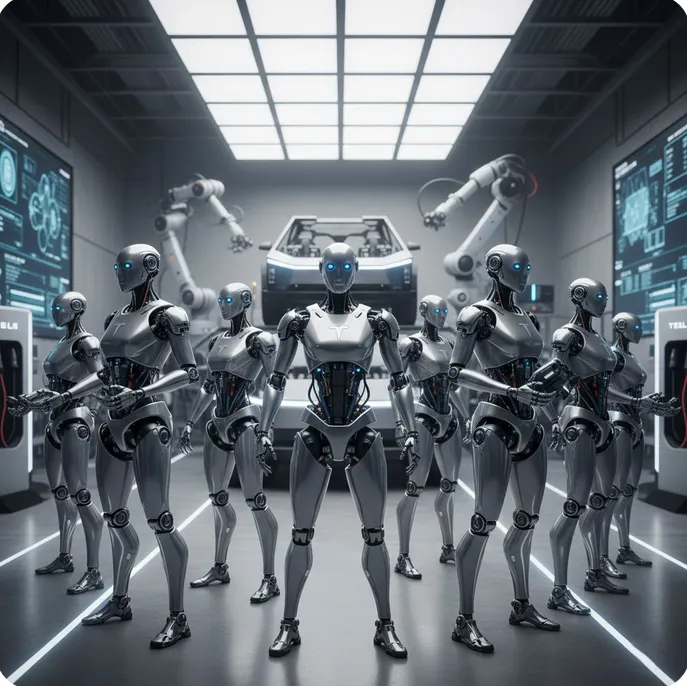
If you’ve been following Tesla, you’ve probably seen glimpses of Optimus, the company’s human-shaped robot. From Tesla showrooms and factory floors to high-profile public appearances—including a memorable cameo with Kim Kardashian—Optimus has become one of the most talked-about elements of Elon Musk’s futuristic vision.
But for Musk, Optimus is far more than a publicity stunt. Alongside Tesla’s autonomous vehicles and Cybertrucks, the humanoid robot is envisioned as a cornerstone of the company’s ambitions in artificial intelligence (AI). And with Musk’s recent $1 trillion pay package tied to ambitious AI milestones, the stakes could not be higher.
This blog explores why Tesla is betting big on humanoid robots, what makes Optimus different, the broader robotics landscape, and whether Musk’s vision might finally turn science fiction into reality.
Tesla’s Bold AI Ambition
Since first unveiling Optimus in 2022, Musk has made it clear that he sees the droid as a transformative product—potentially even more impactful than Tesla’s vehicles. The vision is audacious: deliver a million AI-powered humanoid robots over the next decade. If Musk succeeds, Optimus wouldn’t just serve as a high-tech gadget; it would position Tesla as a major player in AI and automation.
Musk has gone as far as to claim that Optimus could become “the biggest product of all time, bigger than cell phones”, and that the robot could accelerate Tesla’s work toward artificial general intelligence (AGI)—AI systems capable of human-level reasoning and adaptability. In other words, Optimus could help bridge the gap between industrial automation and truly intelligent machines.
The company has already started showcasing Optimus in public spaces, including its Hollywood diner, where it serves popcorn and burgers to customers. These appearances, while somewhat theatrical, highlight the practical applications Musk envisions: robots integrated into daily life, capable of performing a variety of physical and cognitive tasks.
The Case for Humanoid Robots
Why do Musk and others insist on a human-like form? After all, a machine doesn’t need legs or a head to be functional. Many robotics experts argue that wheeled robots are mechanically simpler, cheaper, and more efficient than bipedal designs. Walking robots require complex hardware, balance systems, and sophisticated control algorithms that make development slower and costlier.
Despite these challenges, humanoid robots offer psychological advantages. Humans naturally respond to machines that resemble us, a phenomenon studied extensively in robotics and cognitive science. Robots with arms, legs, and heads feel more approachable and intuitive for social interactions. This is particularly relevant for environments like homes, offices, and service industries, where human-like appearance may improve user acceptance.
Popular culture has reinforced this fascination. From C-3PO in Star Wars to Bender in Futurama and the Terminator, human-like machines have captivated audiences for decades. By mimicking human form, robots like Optimus tap into deep-seated cultural narratives, making them more appealing—even if the practical reasons for their design are limited.
The Growing Market for Humanoids
Tesla is not alone in pursuing human-shaped robots. Across Silicon Valley and beyond, companies are betting that humanoid machines could become a major segment of the AI and robotics market.
- Apple is reportedly exploring humanoid robotics, with analysts projecting potential revenue of $133 billion annually by 2040.
- Foxconn is deploying humanoid robots at its Nvidia factory in Texas.
- Boston Dynamics, famous for its hydraulic humanoid Atlas, has captivated audiences with robots performing gymnastics, flips, and even dance routines, demonstrating both agility and balance previously thought impossible.
Other companies are targeting the consumer market. For example, Neo, a humanoid robot from tech firm 1X slated for launch in 2026, promises to handle household chores such as folding laundry, emptying dishwashers, and fetching items. Priced at $20,000, Neo’s functionality is currently augmented by a human operator using a VR headset—a reminder that fully autonomous humanoids are still a work in progress.
Industry analysts note that falling component costs, advances in AI, and improvements in robot dexterity are rapidly increasing the feasibility of humanoids in everyday settings. Forrester’s Brian Hopkins predicts that by 2030, humanoid robots could disrupt multiple industries, from warehouses and restaurants to elder care and security.
Musk’s AI Strategy and Optimus
Musk views Optimus as more than just a physical robot. It is also a platform for training AI systems in the real world. Unlike software-only AI models, robots can interact with their environment, manipulate objects, and learn from physical experiences. This hands-on data collection could accelerate Tesla’s progress toward AGI, an area where the company competes with major AI firms like OpenAI.
Tesla’s strategy hinges on scale. Musk’s $1 trillion pay package includes performance milestones tied to delivering one million robots within ten years. Meeting this goal would require mass production at Tesla’s factories and unprecedented integration of AI and robotics. If successful, Optimus could become a transformative product that reshapes both the robotics and AI industries.
Challenges Ahead
Despite the excitement, there are formidable obstacles. Building a robot with human-level dexterity, balance, and intelligence remains a monumental technical challenge. Even Boston Dynamics’ Atlas, which has been perfected over decades, is still limited in autonomy and practical household application.
Critics often highlight the “uncanny valley” effect: humanoid robots that are almost human-like can appear eerie or unsettling. Balancing realism with approachability is a psychological and design challenge Tesla must address, especially if Optimus is to operate in homes.
Additionally, public readiness is a question. Sam Altman, CEO of OpenAI, has suggested that the world is not yet ready for humanoids, even as he acknowledges the technological momentum behind them. Safety, regulation, ethics, and social acceptance are all critical factors in the mainstream adoption of robots like Optimus.
Humanoids in Industry and Daily Life
The potential applications for humanoid robots are vast. In industrial settings, they could supplement human workers, performing repetitive or dangerous tasks with precision. In homes, robots could assist the elderly, help with household chores, or provide companionship.
In healthcare, humanoid robots might offer support in rehabilitation, monitor patient vitals, or assist caregivers. Service industries—from restaurants to retail—could use humanoids to interact with customers, manage inventory, or provide guidance.
For Tesla, these applications are both a revenue opportunity and a strategic way to gather AI training data. Every task Optimus performs can inform and improve Tesla’s AI systems, creating a feedback loop where the robot becomes smarter with every interaction.
Tesla’s Place in the Robotics Race
The robotics landscape is crowded, but Tesla’s unique combination of capital, manufacturing expertise, and AI research positions it to potentially leapfrog competitors. Musk’s public influence also helps generate attention and hype, attracting talent and investment.
Companies like Boston Dynamics excel in research, Apple has resources for consumer adoption, and Foxconn can deploy robots in factories—but Tesla aims to bridge all these areas: consumer, industrial, and AI-driven research. The payoff could be enormous if Optimus achieves both scale and capability.
Science Fiction to Reality?
While many of Optimus’ current appearances are showpiece demonstrations, the trajectory is clear: humanoid robots are moving from science fiction toward practical reality. As AI continues to advance and robotics hardware improves, Tesla’s vision of robots integrated into homes and workplaces becomes increasingly plausible.
Musk’s confidence, bolstered by his financial and technological resources, suggests that Optimus could be more than a novelty. It could be a milestone product, reshaping industries and altering how humans interact with machines.
The Road Ahead
The next decade will be crucial for Tesla and the robotics industry at large. Success depends on several factors:
- Technological breakthroughs in AI, sensor systems, and mechanical design.
- Mass production capabilities to meet ambitious delivery targets.
- Public acceptance and societal readiness for humanoid machines.
- Regulatory frameworks ensuring safety, ethics, and legal compliance.
If these elements align, Tesla could establish Optimus as a household name—a robot that is not just functional but also culturally significant, blending utility with familiarity in human-like form.
Conclusion
Elon Musk’s Optimus represents a bold bet on the future of robotics and AI. By combining human-like design with intelligent systems, Tesla hopes to create robots that are practical, versatile, and capable of learning from real-world interactions. While challenges abound—from engineering hurdles to public readiness—the vision is ambitious and far-reaching.
As humanoid robots edge closer to reality, Tesla is positioning itself not just as a carmaker or AI company, but as a pioneer in the next frontier of human-machine interaction. Optimus may still be in its early stages, but its potential impact on homes, industries, and AI development could be profound.
In the coming years, the question won’t just be whether robots can walk and talk—it will be whether they can integrate into society in meaningful, safe, and transformative ways. Tesla, and Musk’s vision, will be at the center of that unfolding story.