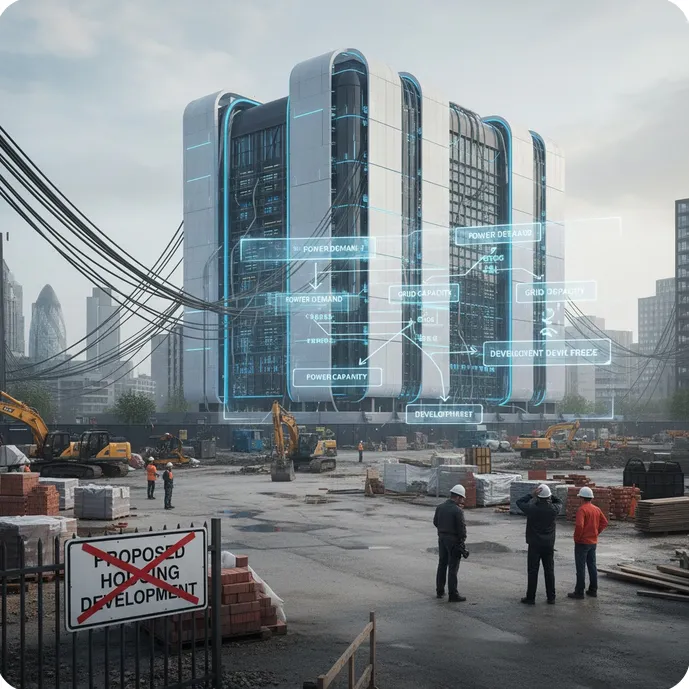
London has long been a place of incredible momentum—architectural, cultural, economic, and technological. The city evolves in waves, often several at once, sometimes harmoniously, sometimes at odds with one another. But in recent years, one collision has become especially visible: the clash between the city’s booming digital infrastructure and its desperate need for new homes.
A recent report from the London Assembly’s Planning and Regeneration Committee has brought this tension to public attention with unusual clarity. According to their findings, London’s modern appetite for digital power—specifically, the growth of huge, power-hungry data centres—has stretched parts of the capital’s electricity grid to breaking point. And the effect has been dramatic: some planned residential developments have been delayed not because of planning disputes or construction issues, but simply because there wasn’t enough electricity available to support them.
Yes, in one of the wealthiest cities in the world, some new homes are being held up because the internet is using too much power.
This is the story of how London reached a strange turning point in its urban development—where the needs of the digital economy have begun to directly compete with the basic need for housing—and what might happen next.
London’s Digital Backbone: What Data Centres Actually Do
Before diving into the conflict, it’s worth understanding what data centres are and why they matter.
Data centres are the beating heart of modern digital life. They are giant, climate-controlled warehouses packed with racks of servers that store data, run software, train artificial intelligence models, facilitate cloud computing, and process billions of online transactions every day. If you’ve streamed a movie, asked a chatbot a question, uploaded a photo, or simply watched your favourite football highlights, you’ve relied on a data centre.
These buildings run 24/7, can’t lose power even momentarily, and require robust infrastructure to operate safely and at scale.
The kicker? They consume unimaginable amounts of electricity.
According to the London Assembly report, the energy draw of a single, typical large-scale data centre is similar to that of around 100,000 households. Multiply that by hundreds of such facilities, and the energy needs reach levels that Europe’s oldest capital cities were never originally designed to handle.
London, as it stands today, hosts roughly half of all new UK data centres, with more on the way. The Docklands area alone has become Europe’s densest cluster of server facilities—a digital metropolis inside the urban metropolis.
But this growth is not without consequence.
The Housing Crisis Meets the Data Boom
London’s housing crisis isn’t new. The shortage of affordable homes, high rents, long waiting lists for council properties, and urban sprawl have been chronic problems for years. But what is new is the revelation that electricity availability has now entered the equation as a barrier to building new homes.
The London Assembly report shed light on a concerning moment back in 2022, when developers in west London boroughs—Ealing, Hillingdon, and Hounslow—received news that shocked even seasoned planners. They were told that new developments could face delays until 2037 simply to be connected to the electricity grid.
Not because the technology didn’t exist.
Not because the lines couldn’t be installed.
But because the grid was already at full capacity, heavily burdened by the rising number of data centres in the region.
This triggered immediate fears. Would these boroughs have to stop approving new housing entirely? Would thousands of already-planned homes end up trapped in limbo? And what did it mean for a city already grappling with one of the worst housing shortages in its modern history?
Ultimately, emergency interventions from Ofgem, the National Grid, and the Greater London Authority prevented the worst-case scenario. Some short-term adjustments freed up enough capacity to keep the most urgent housing projects moving.
But the message was clear: London had stumbled into a future where data and housing were now competing for the same resource—electricity.
And data centres seemed to be winning.
Why West London Became a Flashpoint
The situation didn’t come out of nowhere. West London has become a hotspot for data centre development thanks to several advantages:
- Proximity to the Docklands hub, which hosts major international internet exchanges
- Access to large industrial spaces once used for older forms of manufacturing
- Transport links that simplify movement of equipment and staff
- Business-friendly local authorities
- Growing demand for AI processing capacity, which requires massive electrical power
As AI adoption accelerates, so does the need for server farms. And in an era where companies expect near-instant data processing and low-latency communication, new data centres are being positioned ever closer to major population hubs.
But this has meant that in districts where new housing is desperately needed, vast amounts of power are being earmarked for buildings that people will never live in.
Andrew Dakers, head of West London Business, recently explained that the National Grid is working to add 7 gigawatts of extra electricity capacity to the region—roughly the output of several major power stations. But this expansion isn’t expected to be fully ready until 2037.
Developers say that’s far too late.
The housing demand is immediate, and affordability has reached crisis levels.
Digital infrastructure is essential—but so are homes.
How Did We Get Here? The Roots of the Energy Crunch
London’s grid wasn’t built for the AI era. Parts of its infrastructure date back many decades, designed when the biggest local energy demands came from manufacturing or heavy industry, not cloud computing clusters.
Meanwhile, the city’s population has risen dramatically, and modern housing itself requires more electricity—heat pumps, EV chargers, induction hobs, smart appliances, and high-efficiency air filtration all draw more power than older systems.
Overlay that with the explosive growth of AI workloads, and the result is predictable: the grid is struggling.
Even though data centres accounted for less than 10% of the UK’s total electricity use last year, the projections are startling. Between 2025 and 2050, that figure could increase by up to 600% as AI becomes more embedded in daily life.
In other words, today’s energy squeeze could become tomorrow’s crisis unless long-term planning catches up—and fast.
Housing Developers Speak Out
For builders and developers, the issue is straightforward: without guaranteed access to power, they can’t move forward.
Rhodri Williams from the Home Builders Federation recently emphasised a point that many in the industry have been making: the government must commit to substantial new investment in electricity infrastructure if it wants to meet its own national housing targets.
Electricity is no longer just a utility; it’s a prerequisite for growth.
The industry is now urging policymakers to make reforms that would ensure:
- predictable power allocation
- transparent planning guidelines
- separate categories for energy-intensive developments like data centres
- long-term investment strategies that don’t jeopardize housing supply
Right now, developers complain they are often being asked to compete with billion-pound tech firms for a resource that should be accessible to both industries.
And increasingly, they feel they are losing that competition.
Should Data Centres Be Classified Differently?
One of the biggest recommendations from the London Assembly committee is to give data centres their own planning category, separate from commercial or industrial use labels they typically fall under.
Why?
Because their energy requirements are so massive—and so different from other commercial buildings—that treating them like ordinary developments no longer makes sense.
A dedicated planning category could:
- require early-stage planning of energy usage
- formalize coordination with electricity providers
- create clearer zoning guidelines
- protect residential projects from being sidelined
Essentially, it’s an attempt to modernize planning law to reflect technological realities.
Whether the government will adopt this measure remains to be seen.
A Mayor’s Perspective: Balancing Two Competing Priorities
A spokesperson for London’s Mayor, Sadiq Khan, has acknowledged the challenge and indicated that future iterations of the London Plan will include more explicit policy guidance on data centre placement and energy considerations.
At the same time, the Mayor’s office has emphasized progress made in housing delivery. Before the COVID-19 pandemic, London saw more new homes completed than in any period since the 1930s, and council housing starts reached their highest levels since the 1970s.
But all of that progress is undermined if homes can’t actually be powered.
The message from the Mayor’s office is one of cautious cooperation—they support digital growth, but not at the expense of housing.
And yet, the question remains: can the city truly have both without drastic action?
The Bigger Picture: Cities Everywhere Face This Problem
London isn’t alone. Across the world, energy-hungry technology is reshaping urban development.
Dublin
Ireland temporarily halted new data centre planning approvals due to grid strain.
Amsterdam
The city imposed a moratorium on new centres until stricter sustainability guidelines were developed.
Northern Virginia
The world’s largest data centre cluster is now infamous for overwhelming local energy and land use systems.
Singapore
The government paused development for nearly two years to reassess environmental impact.
Cities everywhere are learning that data capacity and housing capacity are intertwined—because both depend on energy systems that were never built for this scale.
What Happens Next for London?
The future will depend on decisions made in the next few years. Possibilities include:
1. Modernizing the Grid
Mass investment, potentially into the billions, would be needed to build new substations, reinforce transmission lines, and install new capacity.
2. Smarter Zoning
Data centres may be steered away from residential bottleneck zones and toward areas better equipped to support them.
3. Introducing Strict Energy Controls
Policymakers might require data centres to offset their energy usage with local renewable sources or co-location with power-generating facilities.
4. Shifting Toward Green Data Centres
Cooling innovations, new server technologies, and low-power AI chips could reduce future demand—but only if adopted widely.
5. Coordinated National Strategy
The UK’s AI Energy Council is already exploring “bespoke options,” but coordination will require unified policy, not a patchwork of regional fixes.
Without these moves, the conflict between data centres and homes could deepen, leaving London at risk of failing on both fronts: digital competitiveness and housing supply.
Conclusion: A City at a Crossroads
London thrives when it adapts. It has reinvented itself repeatedly across centuries—industrial power, cultural capital, financial powerhouse, and now, a global tech hub.
But the next chapter will require balancing two fundamental needs:
- the need to build the digital infrastructure that supports the future economy
- the need to house the people who make that economy function
If data centres represent the engine of the modern world, homes represent the foundation. One cannot outrun the other forever.
The recent report is a warning—but also an opportunity. With the right planning, investment, and political will, London can remain a leader in both technology and livability.
But without action, the city may find itself facing a paradoxical crisis: possessing some of the most advanced digital infrastructure on Earth, but unable to offer enough homes—and enough power—for its people.