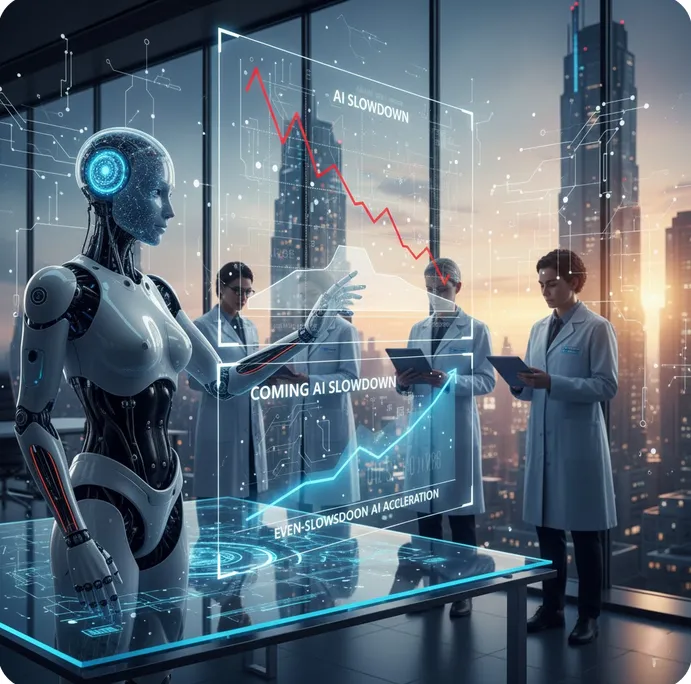
The world is buzzing with artificial intelligence. Conversations about AI dominate boardrooms, newsroom headlines, investment calls, and government discussions. The past few years have witnessed unprecedented enthusiasm — and fear — surrounding generative AI, foundation models, and the exponential scaling of computing power. Markets have surged, tech giants have invested trillions, and companies across every industry have scrambled to adopt the "next big thing."
But beneath the excitement lies a more complicated reality: explosive growth like this rarely lasts uninterrupted. Technologies that rise at breakneck speed often encounter periods of speculation, overinflation, or infrastructure bottlenecks. Many experts have begun warning that AI may be heading toward a bubble — one that could deflate sharply.
Yet according to Abhijit Dubey, the Global CEO of NTT DATA, one of the world’s largest IT and consulting firms, the story does not end with contraction.
In fact, he believes a temporary cooling-off period could set the stage for an even more powerful resurgence.
During a wide-ranging conversation that touched on global supply chains, labour markets, corporate adoption, and long-term AI trajectory, Dubey painted a picture of an industry on the brink of transformation — one that may undergo short-term turbulence before maturing into one of the defining technological forces of the century.
This feature-length article dives deep into:
- Why AI may be approaching a near-term bubble
- Why that bubble may burst quickly rather than drag on
- The conditions that will drive an even stronger rebound
- What AI’s rapid growth means for labour markets and hiring
- The widening global skills gap
- The tension between executive enthusiasm and real-world adoption
- The forces shaping AI’s next decade
Let’s unpack one of the most intriguing predictions about the future of AI — and what it means for businesses, workers, and society.
The AI Market Is Red-Hot — But That Heat Can’t Last Forever
The last major technology boom of similar scale was the rise of the internet itself. But even that historical moment feels conservative compared to AI’s meteoric rise.
Consider the forces currently driving the frenzy:
- Companies rushing to develop proprietary foundation models
- Semiconductor shortages affecting nearly every industry
- Hyperscalers racing to build gigantic AI data centres
- Dramatically rising valuations for chipmakers, cloud providers, and AI start-ups
- Billions in new investment pouring into model training and advanced computing
- Public markets rewarding anything “AI adjacent”
This has created a perfect storm — a moment where expectations soar faster than infrastructure can sustain.
According to Dubey, this imbalance between demand and supply is one of the clearest indicators that the AI ecosystem is moving through a hyper-accelerated cycle, one that resembles past tech booms but is likely to evolve differently.
Why NTT DATA’s CEO Predicts an AI Bubble — But a Short One
The idea of an AI bubble is becoming an increasingly common topic in financial circles. But Dubey stands out because he doesn’t believe the market is headed for a painful crash or years of stagnation.
Instead, he believes:
1. Demand has outpaced infrastructure too quickly.
The interest in adopting AI has exploded far more quickly than the physical and technological foundation required to support it. This includes:
- AI-ready data centres
- Advanced networking hardware
- Sizable GPU clusters
- Skilled labour
- Reliable supply chains
These infrastructural elements typically scale gradually. But AI demand has accelerated exponentially — causing temporary imbalances.
2. Supply chains are already stretched long into the future.
Dubey notes that the global supply of advanced GPUs, memory chips, and related components is “spoken for” for at least 2–3 years. Chipmakers are running at full capacity. Hyperscalers (Amazon, Google, Microsoft, and others) are soaking up unprecedented quantities of hardware.
The consequence?
A shortage-driven spike that isn’t sustainable in the near term.
3. Valuations mirror hype, not adoption.
While AI companies and semiconductor manufacturers have seen their stock prices skyrocket, real-world adoption has been far more modest. Many enterprises are still in exploratory stages. Most employees use AI tools only occasionally. Industries like healthcare, logistics, manufacturing, and finance are embracing AI slowly and carefully.
This mismatch fuels bubble dynamics.
4. The cooling-off period will be brief.
Unlike the dot-com era, Dubey believes the AI cycle operates on a different timeline:
- The technology is real and already deeply functional.
- Infrastructure is being built at a pace never seen before.
- Corporate demand continues rising, not falling.
- AI is becoming embedded in long-term digital strategies.
This means any contraction will be temporary — a normalisation, not a collapse.
After the Bubble: A Second, Stronger Wave of AI Growth
Dubey’s most powerful insight is that the deflation of the AI bubble will not signal the end of AI’s momentum but rather a transition into a more sustainable long-term phase.
Here’s what he expects:
1. Corporate adoption will finally catch up.
Right now, companies feel pressure to adopt AI — but many are still learning:
- How to use it effectively
- How to implement it safely
- How to integrate it into workflows
- How to regulate employee usage
- How to measure ROI
As these questions get answered, real adoption will accelerate, enabling AI tools to create measurable business impact.
2. Infrastructure will finally meet demand.
By 2027–2028, ongoing investments in:
- Chip manufacturing
- Data-centre capacity
- High-speed networking
- Edge computing
- AI-specific hardware
will significantly expand global AI compute resources.
This will allow AI to scale with unprecedented efficiency.
3. Pricing power will shift, but the market will stabilise.
Currently, hardware manufacturers hold enormous power. Prices for GPUs, memory chips, and compute infrastructure have surged.
As supply expands, pricing will normalise — removing barriers for companies waiting to adopt AI at scale.
4. Product cycles will accelerate.
Once companies are no longer bottlenecked by hardware shortages, they’ll be able to deploy:
- Multimodal assistants
- Automated workflows
- Advanced analytics platforms
- Industry-specific AI solutions
- Embedded intelligent tools
This will create an innovation explosion that fuels a second major wave of AI growth.
Labour Market Shockwaves: The Workforce Will Feel the Shift
One of the most controversial aspects of the global AI revolution is its impact on employment. Dubey acknowledges this reality openly.
AI will reshape the labour market — but over decades, not months.
He sees three measurable phases:
1. The Immediate Phase (0–5 years)
AI influences job requirements but doesn’t eliminate huge numbers of positions.
- Companies slow hiring.
- Roles shift from manual tasks to oversight tasks.
- AI tools become routine.
- Recruiting focuses on digital literacy and adaptability.
This is already visible. Across many industries, CEOs ask how AI adoption can help them reduce staffing needs — or at least slow expansion.
2. The Transitional Phase (5–15 years)
AI becomes deeply embedded in everyday workflows.
- Some tasks become obsolete.
- Entirely new jobs emerge.
- The skills gap widens dramatically.
- Companies rethink organisational design.
NTT DATA itself has begun adjusting hiring priorities to reflect this new environment.
3. The Displacement Phase (15–25 years)
Dubey predicts some degree of job dislocation — but gradual, not sudden.
Tasks that rely heavily on repetitive information processing could be transformed or automated, while roles requiring strategy, creativity, empathy, and oversight will grow.
“How Soon Can I Cut 30% of My Team?” — The Corporate Pressure to Automate
One of the most striking insights into the current AI landscape comes from May Habib, the CEO of an AI writing and productivity company.
Her observation highlights a tension:
Executives see AI as a way to:
- Reduce headcount
- Improve margins
- Streamline operations
- Increase productivity
This mindset drives adoption — but often faster than employees can adapt.
Some leaders view efficiency gains as a path to automation-driven cost savings. But this approach risks creating friction within organisations where employees feel they must compete against tools rather than collaborate with them.
This makes the ethical deployment of AI more urgent and strategic.
Are Workers Actually Using AI? Not Nearly as Much as Leaders Think
A fascinating contradiction is emerging.
Executives often proclaim that:
- AI is transforming their companies
- Employees use AI constantly
- Productivity has skyrocketed
But PwC’s recent global workforce study tells a different story.
Daily use of generative AI remains far lower than expected.
While many corporate leaders envision AI transforming their organisations, most employees still:
- Use AI occasionally or not at all
- Lack training resources
- Don’t feel confident in AI tools
- Aren’t required to integrate AI into daily workflows
- Don’t fully understand what AI is capable of
The divide between leadership expectations and real-world adoption continues to widen.
The skills gap grows
PwC notes a sharp disparity:
- 75% of senior executives have access to AI training
- Only around 50% of non-managers receive similar resources
This uneven distribution could create long-term performance inequities and limit organisational transformation.
The Wage Premium for AI Skills Is Exploding
In one of the largest jumps ever recorded, the wage premium for AI-competent workers has surged to 56%, more than double the prior year’s figure.
This signals:
- Rising competition for AI-literate talent
- A shortage of specialised workers
- Increased pressure on companies to train internally
- A reshaping of global labour markets
As AI becomes unavoidable in everyday business operations, employees with even moderate AI skills will continue commanding premium compensation.
What the Next 5–10 Years of AI Will Look Like
If Dubey’s predictions hold true, the AI landscape will move through three distinct phases:
Phase 1 (Now–2027): The Cooling-Off Period
- Infrastructure shortages persist
- Valuations fluctuate
- Limited availability of compute
- Early adoption remains inconsistent
- Companies refine their AI strategies
- Regulation increases
This phase is temporary but necessary for resetting expectations.
Phase 2 (2027–2032): The Acceleration
- Data centres expand dramatically
- Hardware supply finally meets demand
- Enterprises deploy AI at scale
- Industry-specific models flourish
- Highly capable assistants become standard
- AI-native workflows emerge
This marks the true beginning of AI’s business transformation.
Phase 3 (2032–2050): The Integration Era
- AI becomes fully embedded in society
- Governments regulate and adopt AI nationwide
- Economies reorganise around automation
- Human-machine collaboration becomes normal
- Entire new job categories emerge
This is where Dubey sees the long-term potential turning into economic reality.
Final Thoughts: A Short-Term Dip Before the Largest Tech Boom in History
The message from NTT DATA’s CEO is clear:
AI’s explosive rise may pause — but the future remains overwhelmingly bright.
A brief period of normalisation is not a warning sign. It is a recalibration.
One that will lead to:
- Better infrastructure
- Smarter corporate adoption
- More equitable access
- More capable models
- A stronger, more sustainable AI ecosystem
Artificial intelligence is not a passing trend. It is the next global infrastructure — as fundamental as electricity, the internet, and the cloud.
The bubble may deflate, but the rebound could usher in the most transformative technological era humanity has ever experienced.