Today, it’s hard to imagine a world without digital photography.
Every day, billions of images are captured effortlessly—on phones, tablets, laptops, drones, and cameras so small they disappear into our pockets. Photos are taken, edited, shared, deleted, and forgotten in seconds. The idea of waiting days or weeks to see a picture now feels almost absurd.
But just fifty years ago, photography was slow, chemical, and stubbornly physical. Images lived on film. They had to be developed in dark rooms, soaked in chemicals, and printed on paper. Photography was tactile, delayed, and unforgiving.
And yet, in the mid-1970s, inside a company whose entire empire depended on film, a young engineer quietly asked a question that would unravel everything:
What if you didn’t need film at all?
That question—simple, almost naive—led to the creation of the first handheld digital camera. Not by a startup, not by a tech giant, but by a 23-year-old electrical engineer working inside Kodak, the most powerful photography company on Earth.
This is the story of how digital photography was born—not through bold corporate vision, but through curiosity, frustration, and a device that looked more like a toaster than a camera.
Kodak Before Digital: A Perfect Machine Built on Film
To understand how revolutionary this moment was, you have to understand Kodak.
For much of the 20th century, Kodak wasn’t just a photography company—it was photography. Its brand touched nearly every part of the image-making process. Kodak sold the cameras, the film, the chemicals, and the paper. You took pictures using Kodak products, sent them to Kodak labs, and received Kodak prints in return.
It was one of the most vertically integrated businesses in modern history.
Kodak’s famous slogan, “You press the button, we do the rest,” wasn’t marketing fluff—it was a description of total control. Photography was designed to be easy for consumers and enormously profitable for the company.
By the time the 1970s arrived, Kodak was a cultural institution. It employed tens of thousands of people, dominated global markets, and symbolized American industrial confidence.
And yet, beneath this polished exterior, the seeds of disruption already existed.
A New Engineer With the “Wrong” Background
When Steve Sasson joined Kodak in 1973, he didn’t quite fit.
Most Kodak engineers worked on film chemistry, optics, or mechanical camera systems. Sasson, however, was trained as an electrical engineer. His world revolved around circuits, signals, and emerging semiconductor technologies.
As part of his onboarding, Kodak required new hires to learn photography from the ground up. Sasson dutifully attended photography classes, shot film, developed negatives, and worked in darkrooms.
He hated it.
Not because photography wasn’t fascinating—but because the process felt archaic.
You took a photo.
You waited.
You mixed chemicals.
You waited more.
You hoped it worked.
For Sasson, raised on science fiction and visions of futuristic technology, the delay felt wrong. Cameras captured light instantly—why couldn’t images be captured instantly too?
That question wouldn’t leave him alone.
Science Was Quietly Catching Up
The idea of electronic imaging wasn’t entirely new.
Scientists had known for decades that light could generate electrical signals. Early exposure meters used selenium cells that produced current when struck by light. Space agencies had already experimented with converting light into electronic data for satellites. Astronomers were capturing images digitally—though only with enormous, expensive equipment.
The missing link wasn’t knowledge—it was scale.
No one had combined these concepts into a compact, portable device that an ordinary person could hold in their hands.
Sasson realized that the pieces already existed:
- A new type of sensor called a charge-coupled device (CCD)
- Digital memory capable of storing data
- Microprocessors that could control systems
- Magnetic tape for storage
None of these technologies were mature. All were slow, bulky, and inefficient by modern standards. But together, they offered something radical.
A camera without film.
The Project Nobody Asked For
Sasson didn’t receive a formal assignment to invent digital photography.
Instead, he was given a vague directive common in research labs: explore how new electronic components might be used in imaging. It was open-ended, low-profile work—exactly the kind that allowed unconventional ideas to grow unnoticed.
Using spare parts, borrowed components, and a lot of improvisation, Sasson began assembling a prototype.
There was no blueprint.
No product roadmap.
No marketing department involved.
Just curiosity.
Building a Camera From the Future (With the Tools of the Past)
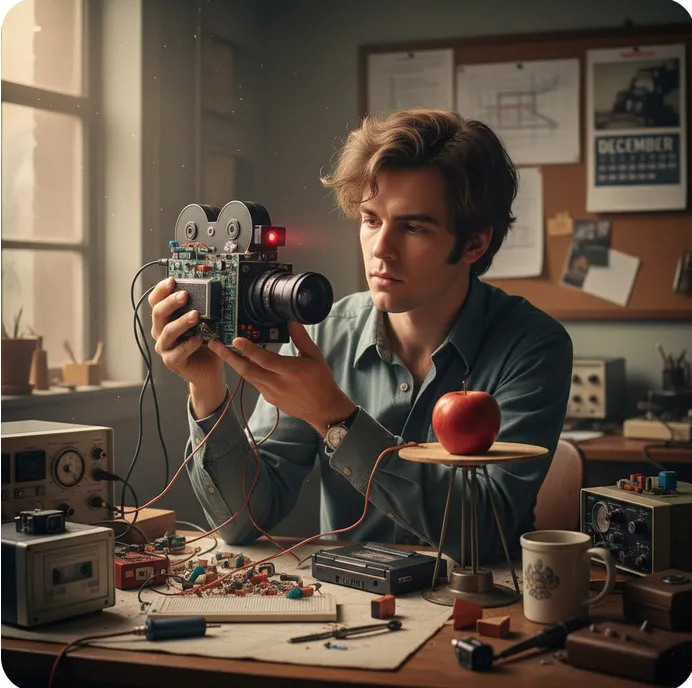
The device Sasson built in 1975 barely resembled a camera.
It was heavy—about the size of a small appliance.
It weighed roughly eight pounds.
It had exposed wires, circuit boards, and a lens mounted awkwardly on the front.
Colleagues joked that it looked like a toaster with a lens.
But it worked.
The camera captured black-and-white images at a resolution so low it’s hard to imagine today—just 100 by 100 pixels. Each photo took several seconds to record. Saving a single image required writing digital data onto a cassette tape.
And viewing the image? That took even longer. The tape had to be loaded into a separate system that converted the data into a display on a screen.
By modern standards, it was painfully slow, blurry, and impractical.
By historical standards, it was a miracle.
The First Digital Photograph
The first image Sasson captured was simple: a photo of a colleague taken in a lab.
It wasn’t sharp.
It wasn’t detailed.
But it was unmistakably a photograph.
And it existed without film.
No chemicals.
No darkroom.
No physical negative.
Just data.
Photography had crossed an invisible threshold.
Showing Kodak the Future—and Confusing Everyone
When Sasson demonstrated the device to Kodak executives, the reaction was polite but puzzled.
They were impressed by the engineering. They recognized the technical achievement. But they didn’t see a business case.
Why would anyone want a camera that produced images you couldn’t print easily?
Why would consumers abandon film?
Why disrupt a system that generated enormous profits?
These weren’t foolish questions—they were logical ones, given the context.
Film sales weren’t declining.
Digital storage was expensive.
Computers weren’t household items.
The digital camera was fascinating—but irrelevant.
Or so it seemed.
Innovation Inside a Giant Is a Dangerous Thing
Kodak didn’t suppress Sasson’s work. That’s an important myth to dispel. The company patented digital camera technology and continued researching electronic imaging for decades.
But innovation inside a dominant company faces a paradox.
If the new technology succeeds, it destroys the old business.
If it fails, it’s a distraction.
Kodak understood digital imaging technically long before most competitors. What it struggled with was timing, identity, and self-disruption.
Digital photography didn’t fail because Kodak ignored it.
It succeeded because the world eventually changed faster than Kodak could.
Why Digital Photography Was Inevitable
Several forces converged over the following decades:
- Computers became personal and affordable
- Storage costs collapsed
- Displays improved
- The internet created demand for shareable images
- Mobile devices made cameras ubiquitous
Digital photography wasn’t just a better version of film—it enabled entirely new behaviors. Instant feedback. Endless experimentation. Casual documentation of daily life.
Film photography had friction.
Digital photography removed it.
Once that happened, there was no going back.
The Irony of Kodak’s Legacy
Kodak didn’t invent digital photography by accident—but it also didn’t fully embrace the consequences of its invention.
Other companies—many born decades later—built businesses entirely around digital images. Camera manufacturers, smartphone makers, social media platforms—all benefited from a foundation laid in a Kodak lab.
Sasson’s prototype didn’t kill film overnight. But it made film optional. And once something becomes optional, its dominance is temporary.
The Human Side of a World-Changing Invention
Steve Sasson didn’t set out to destroy an industry.
He wasn’t trying to disrupt Kodak.
He wasn’t chasing fame.
He wasn’t building a startup.
He was an engineer annoyed by waiting for photos.
That’s often how revolutions begin—not with ambition, but with irritation.
His invention reminds us that transformative ideas often come from outsiders within organizations: people who don’t fully accept how things are supposed to work.
Why This Story Still Matters
In an age of AI, automation, and rapid technological shifts, the story of the first digital camera offers enduring lessons:
- Breakthroughs often look impractical at first
- Disruption rarely announces itself clearly
- The greatest threats to incumbents are ideas, not competitors
- Innovation doesn’t require permission—just curiosity
Most importantly, it shows that the future often arrives quietly, built by someone asking a question that feels slightly inconvenient at the time.
From a “Toaster With a Lens” to a World of Images
Today, every smartphone carries technology millions of times more powerful than Sasson’s original device. Yet the core idea remains the same: light converted into data.
Every selfie, satellite image, medical scan, and viral video traces its lineage back to that awkward prototype built in 1975.
A machine that didn’t fit.
An idea that didn’t make sense.
A future that arrived anyway.
Final Reflection: The Day Photography Changed Forever
Photography didn’t stop being magical when it went digital. It became invisible—woven into everyday life so seamlessly that we rarely stop to think about it.
But behind that invisibility is a moment worth remembering.
A young engineer.
A question no one asked him to answer.
A device that shouldn’t have existed.
And the quiet beginning of a digital world.