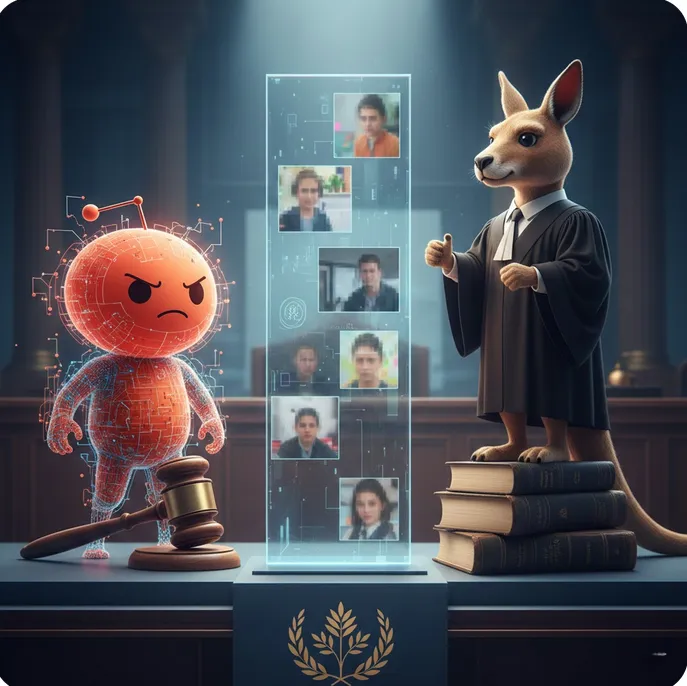
In late 2025, Australia found itself at the center of a global debate that has been quietly building for years: how far should governments go in regulating social media to protect children — and at what cost to privacy, free expression, and the open internet?
That debate escalated dramatically when Reddit, one of the world’s largest online discussion platforms, launched a legal challenge against Australia’s landmark social media age restriction law. The case, now headed for the country’s highest court, raises questions that extend far beyond one platform or one nation. At stake are the boundaries of state power in the digital age, the rights of young people to participate in public discourse, and whether age-based bans can realistically coexist with privacy and democratic freedoms.
This isn’t just a fight about teenagers and apps. It’s a test case for the future of online governance.
The Law That Sparked the Firestorm
Australia’s new legislation, often referred to as the Social Media Minimum Age law, prohibits children under the age of 16 from holding accounts on a list of major social platforms. The rule places the burden squarely on tech companies: they must take “reasonable steps” to prevent underage users from accessing their services or face severe financial penalties.
The fines are not symbolic. Companies that fail to comply could face penalties running into tens of millions of Australian dollars. For global platforms operating at scale, the message is clear: enforce the ban or pay dearly.
The Australian government has framed the law as a bold but necessary intervention. Officials argue that social media platforms are harming young people’s mental health, exposing them to harmful content, and eroding childhood itself. The law’s slogan — “Let Them Be Kids” — reflects a growing political consensus that the tech industry has failed to self-regulate.
But critics say the solution may be creating new problems that are just as serious as the ones it aims to solve.
Why Reddit Is Pushing Back
Unlike some platforms that have responded quietly or cautiously, Reddit chose to go on the offensive.
The company filed a challenge in Australia’s High Court, arguing that the law violates the country’s constitution — specifically, the implied freedom of political communication. This legal principle, unique to Australia, protects the ability of citizens to discuss political ideas and participate in democratic debate.
Reddit’s argument is not that children should be left unprotected online. Rather, the company claims that a blanket ban enforced through age verification mechanisms undermines fundamental freedoms for everyone — including adults.
At the heart of Reddit’s position is a concern about how the law will be enforced in practice.
The Age Verification Dilemma
To block under-16 users, platforms must determine users’ ages. That sounds straightforward — until you consider what it actually requires.
Age verification at scale typically involves one of the following:
- Uploading government-issued identification
- Facial recognition or biometric analysis
- Third-party data brokers verifying identity
- Centralized digital ID systems
Each of these methods introduces significant privacy risks.
Reddit argues that forcing platforms to verify ages doesn’t just affect minors. It compels adults to hand over sensitive personal information simply to access online communities. For a platform built around pseudonymity and anonymity, this represents a fundamental shift.
From Reddit’s perspective, the law transforms the internet from an open forum into a gated system where participation requires proof of identity — a change with profound implications for free speech.
Anonymity as a Democratic Tool
One of Reddit’s defining features is the ability to participate without revealing one’s real-world identity. This isn’t an accident or a loophole; it’s a design choice that has enabled whistleblowers, activists, marginalized groups, and ordinary citizens to speak freely.
Critics of the age ban argue that mandatory verification would chill participation, particularly in sensitive discussions around politics, health, sexuality, religion, and personal experiences.
For young people especially, anonymous or semi-anonymous spaces can provide rare opportunities to learn, ask questions, and engage with ideas beyond their immediate environment.
By restricting access to these spaces, the law may unintentionally narrow the pipeline of civic engagement at an early age.
The Constitutional Question
Australia’s constitution does not explicitly list freedom of speech in the same way some other democracies do. Instead, courts have recognized an implied freedom of political communication — a principle derived from the structure of representative government itself.
Reddit’s legal challenge hinges on the idea that banning under-16 users from major platforms restricts political communication in two key ways:
- It prevents young people from participating in political discussion.
- It imposes verification requirements that discourage or inhibit lawful speech by adults.
The case echoes an earlier challenge brought by a digital rights advocacy group, suggesting growing momentum against the law within Australia’s legal community.
If the High Court agrees, it could strike down or significantly weaken the legislation — a decision that would reverberate globally.
A Patchwork Internet
Another issue raised by critics is the uneven scope of the law.
Not all online platforms are treated equally. Some services are included; others are excluded. Smaller forums, gaming platforms, and niche communities may fall outside the law’s reach, while mainstream platforms bear the full burden.
This selective approach creates what Reddit describes as an “illogical patchwork” — one that may push young users toward less regulated corners of the internet rather than protecting them.
From a safety perspective, that outcome could be counterproductive.
The Youth Protection Argument
Supporters of the law counter that extraordinary harm requires extraordinary measures.
Studies linking excessive social media use to anxiety, depression, sleep disruption, and self-esteem issues among teenagers have fueled public concern. Parents, educators, and mental health professionals have increasingly called for stronger safeguards.
From this viewpoint, age restrictions are not censorship but consumer protection — similar to age limits on alcohol, driving, or gambling.
The government maintains that tech companies have had years to address these problems voluntarily and failed to do so. Regulation, they argue, is long overdue.
Are Bans the Right Tool?
The core disagreement isn’t about whether children should be protected online — most people agree they should. The dispute is about how.
Critics argue that outright bans are blunt instruments that ignore the complexity of online life. Teenagers use social platforms for education, creativity, community, and activism — not just entertainment.
Moreover, age bans may be easy to circumvent. Tech-savvy teenagers can use VPNs, false information, or borrowed credentials. Meanwhile, law-abiding users face increased surveillance and friction.
This raises a fundamental policy question: should governments focus on restricting access, or on improving platform design, moderation, and digital literacy?
A Global Test Case
Australia is not acting in isolation. Governments around the world are grappling with similar issues.
- European regulators are tightening data protection and platform accountability.
- U.S. lawmakers are debating age verification and algorithm transparency.
- Asian countries are experimenting with screen-time limits and content controls.
What makes Australia’s law unique is its scope and enforcement power. By placing heavy penalties on platforms, it forces companies to choose between compliance and confrontation.
Reddit chose confrontation.
Why Reddit’s Stance Matters
Reddit is not the largest social platform, nor the most profitable. But it occupies a unique place in the digital ecosystem.
It hosts millions of topic-specific communities, many of which function as informal public squares. Discussions range from local politics and global conflicts to mental health support and career advice.
Because of this structure, Reddit’s challenge isn’t just about protecting its business model. It’s about defending a particular vision of the internet — one where communities self-organize, anonymity is respected, and participation is not gated by identity checks.
If Reddit loses, that vision may become harder to sustain worldwide.
The Privacy Trade-Off
Perhaps the most uncomfortable aspect of the debate is the trade-off between child safety and mass data collection.
To enforce age bans, platforms may need to store sensitive identity information for millions of users. History suggests such data inevitably becomes a target for breaches, misuse, or surveillance.
Even if platforms outsource verification to third parties, the risk doesn’t disappear — it multiplies.
Reddit and other critics argue that a law intended to protect children should not expose everyone to greater privacy risks.
The Teenagers Caught in the Middle
Often missing from the debate are the voices of young people themselves.
Teenagers today are not passive consumers of social media. They create content, organize movements, learn skills, and form identities online. For many, these platforms are extensions of their social and civic lives.
A blanket ban assumes that all social media engagement is harmful — a premise many young users would challenge.
By excluding them entirely, the law may inadvertently reinforce the idea that young people are incapable of responsible participation, rather than empowering them with tools and education.
Possible Outcomes of the Court Case
The High Court challenge could unfold in several ways:
- The court could uphold the law in full, validating the government’s approach.
- It could strike down key provisions related to age verification or platform liability.
- It could force amendments that narrow the law’s scope or enforcement mechanisms.
Any of these outcomes will shape how other countries approach similar legislation.
A victory for Reddit could embolden tech companies and digital rights groups. A loss could accelerate the global push toward age-gated internet access.
What Comes Next for the Internet
Regardless of the court’s decision, the case highlights a turning point.
The era of lightly regulated social media is ending. Governments are asserting more control, and platforms are being forced to choose sides.
The question is whether the future internet will be:
- Open but risky
- Safe but surveilled
- Or something more nuanced
The answer will depend on whether policymakers can design regulations that protect children without dismantling the principles that made the internet transformative in the first place.
A Balancing Act With No Easy Answers
The clash between Reddit and Australia’s government captures a broader tension of the digital age: the struggle to balance protection with freedom, safety with privacy, and regulation with innovation.
There are no perfect solutions. But there are better and worse approaches.
As courts, lawmakers, and societies wrestle with these questions, one thing is clear: decisions made now will shape how future generations experience the internet — not just as a source of entertainment, but as a space for learning, debate, and democracy.
Whether Reddit’s legal challenge succeeds or fails, it has forced a necessary conversation — one that goes far beyond age limits and into the heart of what an open society looks like online.