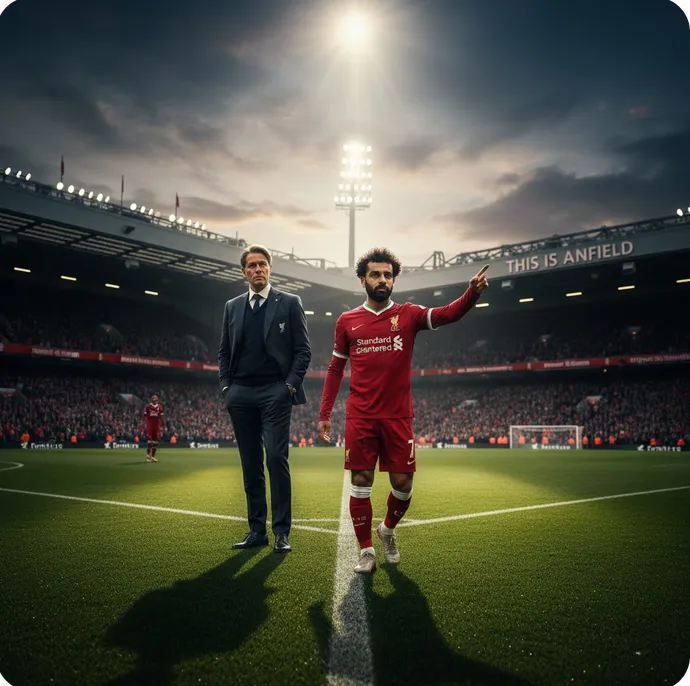
Few players in modern football command attention quite like Mohamed Salah. For nearly a decade, the Egyptian forward has been more than just Liverpool’s most reliable goal threat — he has been a symbol of the club’s resurgence, ambition, and global identity. But as Liverpool navigates a turbulent campaign under new leadership, Salah’s future at Anfield has suddenly become a topic of intense debate.
A series of benchings, a public expression of frustration, and growing interest from Saudi Arabia have created a perfect storm of speculation. At the center of it all stands Liverpool’s new manager, Arne Slot, who now faces one of the most delicate challenges of his early tenure: how to manage a club legend whose influence stretches far beyond the pitch.
This is not merely a question of selection for one match. It is a moment that could define the next chapter of Salah’s career — and potentially shape Liverpool’s identity for years to come.
A New Era Meets an Old Hero
Liverpool entered the 2025–26 season in transition. The departure of a long-serving manager marked the end of a defining era, one built on intensity, emotional connection, and loyalty to trusted performers. Arne Slot arrived with a different footballing philosophy, a calmer presence on the touchline, and a reputation for tactical structure over sentiment.
For any incoming manager, inheriting a dressing room filled with icons is a challenge. For Slot, managing Mohamed Salah — arguably the most iconic Liverpool player of the modern era — was always going to be the ultimate test of authority.
Salah is not just another senior player. He is a two-time Premier League winner, a Champions League winner, a Ballon d’Or contender, and the face of Liverpool’s global brand. His goals have carried seasons. His consistency has defied age curves. His name alone fills stadiums.
And yet, football moves quickly.
At 33, Salah is no longer the untouchable figure he once was. Slot’s early decisions suggested that even legends would be subject to rotation, tactical recalibration, and performance-based selection. What seemed pragmatic from a managerial perspective quickly became controversial when Salah found himself repeatedly starting on the bench.
The Benchings That Changed the Conversation
Rotation is normal in elite football. Even star players accept it — up to a point. But when Salah was named among the substitutes for a third consecutive match, murmurs turned into headlines.
Liverpool’s league form had been inconsistent. Expectations were high following their title success the previous season, yet the team found itself drifting mid-table earlier than anyone anticipated. Pressure mounted, and questions grew louder: Why was Liverpool’s most prolific attacker not starting?
After a dramatic draw against Leeds United, Salah didn’t hide his frustration. His comments were striking not only for their honesty, but for their emotional tone. He suggested he felt scapegoated, pushed aside during a difficult run of form, and left to shoulder blame without influence.
In modern football, players often speak through agents or social media. Salah spoke directly — and the message resonated.
For fans, it was jarring. This was not a fringe player complaining about minutes. This was a club legend expressing genuine hurt.
Milan, Exclusion, and the Spark of Transfer Rumours
The situation escalated when Liverpool traveled to Milan for a Champions League fixture — and Salah was not included in the squad at all.
Officially, it was framed as a footballing decision. Unofficially, it sent a message.
Leaving a player of Salah’s stature behind is rarely accidental. It signals either a disciplinary stance, a tactical reset, or a desire to cool tensions. Whatever the intention, the outcome was predictable: speculation exploded.
Within hours, reports emerged linking Salah with renewed interest from the Saudi Pro League. The narrative wrote itself. A global superstar. A league aggressively targeting marquee names. A player nearing the final phase of his career. A club facing internal tension.
The timing could not have been more combustible.
Saudi Arabia’s Long Courtship
Saudi interest in Salah is not new. For years, clubs in the Pro League have viewed him as the ultimate prize: a Muslim icon, a global star, and a commercially transformative figure.
Unlike many late-career moves, a Saudi transfer for Salah would not feel like an afterthought. It would be strategic, symbolic, and monumental.
Financially, the offers would dwarf anything available in Europe. Beyond money, Saudi football presents a chance for Salah to become the face of an entire league — not just a team.
For Liverpool, resisting such interest has previously been easy. Salah was central to their sporting ambitions. But circumstances change.
At 33, with Liverpool rebuilding and a new manager stamping authority, the balance of power feels different.
Arne Slot’s Tightrope Walk
In his press interactions following the Milan match, Slot chose his words carefully. He neither dismissed Salah’s importance nor offered guarantees about his future. Instead, he emphasized one thing repeatedly: conversations must happen privately.
This approach reflects Slot’s managerial style. Calm. Measured. Controlled.
He confirmed plans to meet Salah face-to-face — a crucial step. In football, relationships between manager and player are often defined not by tactics but by communication. Trust is built behind closed doors, not in press conferences.
Slot’s refusal to be drawn into speculation was intentional. Any public statement would either undermine his authority or inflame tensions further.
Yet the subtext was clear: this situation is unresolved.
The Authority of the Manager vs. the Power of the Player
Football history is filled with moments where managers and legends collide.
From Ferguson and Beckham, to Guardiola and Ibrahimović, to Conte and Costa — these moments test who truly controls the direction of a club.
Slot’s challenge is unique because he is still establishing his authority. Conceding too much to Salah could weaken his standing. Pushing too hard could alienate a player who remains one of Liverpool’s most productive assets.
This is the fine line between leadership and rigidity.
For Salah, the issue goes beyond minutes. It touches on respect, legacy, and recognition. Players of his stature expect honesty. They expect clarity about their role. They expect acknowledgment of what they have given.
When those expectations are not met, resentment can grow quickly.
The Dressing Room Factor
One often overlooked element in situations like this is the impact on the rest of the squad.
Younger players watch closely. Veterans take cues. If a legend is sidelined without explanation, it can unsettle morale. If a legend publicly challenges authority, it can fracture unity.
Slot must manage not only Salah — but the perception of fairness.
Other attackers have benefited from increased minutes, and competition has intensified. Slot has praised emerging partnerships and tactical flexibility. In isolation, these are positive developments.
But when juxtaposed against Salah’s benchings, they fuel the narrative that the club is preparing for life without him.
Africa Cup of Nations: A Natural Pause — or a Breaking Point?
Salah’s imminent departure for the Africa Cup of Nations adds another layer of complexity.
International tournaments often provide space — emotionally and physically. Time away can cool tensions, restore perspective, and reset relationships.
But they can also become moments of finality.
If Salah leaves for AFCON amid uncertainty, returns to a changed role, and feels marginalized, the door to a summer exit may swing wide open.
Conversely, strong performances for Egypt could remind Liverpool of exactly what they risk losing.
What Liverpool Stand to Lose — and Gain
From a footballing perspective, losing Salah would be seismic.
Even in a challenging season, his output remains elite. His positioning, movement, and finishing instincts are rare. Replacing his goals would require either a generational talent or a system overhaul.
Commercially, Salah’s departure would also resonate. He is one of the most marketable players in the world, particularly across Africa and the Middle East.
Yet, there is also an argument for evolution.
Liverpool cannot be forever shaped by past glories. At some point, renewal becomes necessary. Slot’s project appears to prioritize collective structure over individual dependence.
If Salah no longer fits that vision — tactically or culturally — then difficult decisions must be made.
Fans Caught in the Middle
Liverpool supporters are deeply divided.
Some believe Salah deserves unwavering loyalty. They argue that his legacy earns him patience, trust, and a central role until he decides to leave on his own terms.
Others support Slot’s authority. They argue that no player is bigger than the club and that renewal requires bold choices.
What unites both camps is anxiety. The fear that a poorly handled situation could damage both Salah’s legacy and Liverpool’s stability.
The Meeting That Matters
Slot’s planned conversation with Salah may be the most important meeting of his managerial career so far.
This is where tone matters. Where honesty must outweigh ego. Where both sides must decide what they truly want.
Does Salah still see himself as the centerpiece of Liverpool’s project?
Does Slot believe Salah can adapt to a new role without resentment?
Can both sides accept compromise?
If the answer to any of these is no, then separation — however painful — may be inevitable.
Beyond Transfers: A Question of Identity
At its core, this saga is about identity.
Liverpool are redefining who they are.
Slot is defining what leadership looks like.
Salah is defining how he wants his final elite years remembered.
Whether this story ends with reconciliation or departure, it marks a turning point.
Legends do not fade quietly. They exit in moments of tension, emotion, and consequence.
What Comes Next?
In the immediate term, Salah’s availability for the Brighton match will offer clues. Selection will speak louder than words.
Beyond that, the January window looms. Saudi clubs are patient. They are watching.
Liverpool, meanwhile, must decide whether they are willing to let go of a symbol to build something new — or whether the past still holds the key to their future.