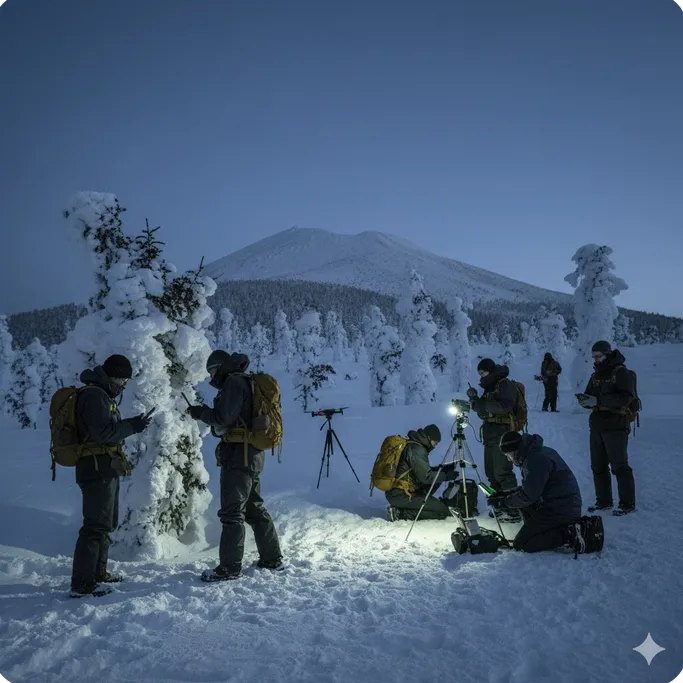
High in the wintry mountains of northern Japan, along the ridgeline of Mount Zao, stands a spectacle so surreal that thousands make the journey each year just to witness it. Under the right conditions, the alpine slopes transform into a frozen kingdom populated by towering white giants. Trees stiffen into strange, sculpted forms—gnarled figures swollen with snow and ice, leaning like silent guardians over the landscape. Locals call them juhyō; to the outside world, they’re better known as “snow monsters.”
But this fantastical winter tableau—one of Japan’s most iconic seasonal sights—is in danger. The legendary creatures are shrinking, thinning, and in many places, disappearing entirely. Their decline is quiet and slow, driven by warming winters and forests under siege, yet the outcome could be dramatic: a once-in-a-generation natural marvel at risk of vanishing.
This is the story of what is happening to the snow monsters of Mount Zao, why they form in the first place, and the passionate scientists, students, and community leaders fighting to preserve them.
A Landscape That Exists Nowhere Else on Earth
The first time visitors gaze upon Mount Zao’s peak in midwinter, they often pause in disbelief. What look like small, snow-shrouded creatures scattered across the mountain are actually fir trees buried beneath layers of rime ice—ice formed not by snowfall, but by supercooled clouds of water freezing on impact.
Only a handful of places on Earth see these conditions come together, and even fewer produce them at the scale seen on Mount Zao. For the “monsters” to materialize, nature must choreograph a perfect interplay of weather and ecology:
- Strong winter winds, blowing for days at a time
- Moisture-laden clouds carrying droplets that remain liquid in subzero air
- Persistent cold, but not extreme cold—between about –6°C and freezing
- The presence of a specific evergreen, the Aomori todomatsu fir
As the icy mist hits the trees, layer after layer accumulates on the wind-facing side, eventually forming ridged patterns known as “shrimp tails.” Over weeks, those ridges swell, twist, and join into the towering shapes that attract winter travelers from around the world.
You won’t find juhyō in Hokkaido’s vast forests, nor in the snowy peaks of the Japanese Alps. They belong to a narrow belt of mountain terrain where atmospheric conditions are unusually precise—making Mount Zao the most famous and accessible sanctuary for this natural phenomenon.
Yet the very forces that create them are the same ones that now threaten their future.
Ghostly Giants Growing Smaller Each Year
For decades, residents and hikers on Mount Zao have remarked that the juhyō looked thinner than in childhood memories. They seemed less bulky, less rounded, less monstrous.
A research team led by geochemistry expert Fumitaka Yanagisawa set out to quantify what had long been felt but never fully measured. By examining nearly a century’s worth of photographs taken from identical vantage points—as far back as 1933—they built a timeline of how the formations have changed.
What they found confirmed the worst fears:
- In the 1930s, many snow monsters spanned five to six meters in diameter.
- By the post-war era, they had shrunk to two to three meters.
- Since 2019, many barely reach half a meter across.
- Some no longer resemble hulking figures at all—just thin columns of ice clinging to dying trunks.
Yanagisawa explains that two forces are responsible for this dramatic decline: the warming climate and the weakening of the fir forests themselves.
The Aomori todomatsu trees—the skeletons on which the snow monsters form—have been in crisis. In 2013, a significant moth infestation stripped their needles. Only two years later, bark beetles moved in, attacking the compromised trees. More than 20,000 have died on Yamagata Prefecture’s slopes alone. With fewer needles, branches, and healthy surfaces, there is less material for rime ice to attach to.
Combine this with rising temperatures and shorter windows of ideal conditions, and the giants no longer have the chance to fully grow.
A 2019 climate analysis revealed that winter temperatures in nearby Yamagata City have climbed approximately 2°C over the last 120 years—pushing the altitude at which juhyō can form higher and higher up the mountain. As the air warms, the season in which they appear grows shorter too.
If current trends continue, says forest-climate specialist Akihiko Ito, there could be winters where the phenomenon fails to appear at all.
That possibility has galvanized a region that relies on the snow monsters not only for their beauty, but for their livelihood.
A Community Facing the Loss of Its Winter Identity
The snow monsters are the beating heart of Mount Zao’s winter tourism. Hotels, hot springs, restaurants, ropeways, and ski resorts all depend on the crowds who come to see them.
Every year, visitors pile into cable cars to glide silently past forests of white giants—an experience that many describe as both otherworldly and deeply calming. Without them, the winter economy would feel the loss immediately.
“People don’t just come to Zao to ski,” says Genji Akiba of the Zao Onsen Tourism Association. “They come to see the snow monsters. Losing them would change everything.”
And beyond the economic cost lies something harder to measure: the emotional impact on those who call the mountain home. For generations, the juhyō have been the region’s winter guardians, with their eerie silhouettes appearing on countless postcards, travel posters, and childhood memories.
Local officials realized that saving the monsters would require bold, long-term planning—and that it needed to start immediately.
Japan Launches a Revival Movement
In 2023, Yamagata Prefecture established the Juhyo Revival Conference, a permanent council tasked with restoring the fir forests and preserving the climatic conditions the snow monsters depend on.
The initiative brings together:
- Forestry experts
- Climate scientists
- Local leaders
- Tourism associations
- Residents
- Environmental agencies
Their primary mission: rebuild the fir ecosystem that supports the monsters.
Since 2019, the local forest office has already transplanted nearly 200 young fir trees from lower elevations up toward the summit area. These native saplings have a better chance of surviving than artificially grown seedlings—but even then, their growth will be painstakingly slow.
Aomori todomatsu trees require 50–70 years to reach maturity.
This means that the efforts of today’s workers may not bear full fruit until the end of the century.
That hasn’t deterred the people of Yamagata. If anything, it has strengthened their resolve. As one official put it: “Saving the snow monsters is not a project for a season. It’s a project for generations.”
The Next Generation Steps Forward
Perhaps the most inspiring part of this story is how young people have stepped up to participate in the revival effort.
At Murayama Technical High School—about 20 kilometers from Mount Zao—students specializing in forestry and environmental science have joined the battle to save the firs.
Since 2022, these teenagers have:
- Gathered saplings from the slopes of the mountain
- Researched fir propagation techniques
- Experimented with growing seedlings from cuttings
- Protected young shoots from hungry field mice
- Studied the forest’s changing conditions
Their involvement has become a source of pride for the region.
One student, Rin Oizumi, recalls the mixture of excitement and disappointment during early planting efforts. Heavy rains delayed germination, and once the seedlings sprouted, mice devoured several patches.
Another student, Kanon Taniai, shared the emotional weight of walking up the mountain and seeing how many trees had already fallen or withered.
“It felt like watching part of our heritage disappear,” she said. “The snow monsters are unlike anything else in the world. I don’t want future generations to know them only from photos.”
For these students, the fight is not just scientific—it’s personal.
Why Climate Change Threatens More Than Just the Snow Monsters
Mount Zao’s plight reflects broader patterns happening in alpine regions across Japan. Higher altitudes are warming faster than lowlands, causing:
- Shorter snow seasons
- More frequent insect outbreaks
- Damage to delicate forest ecosystems
- Increasingly unstable weather patterns
The snow monsters are simply one of the most visible—and culturally cherished—victims of these shifts.
And because the phenomenon requires such an exacting blend of temperature, humidity, wind strength, and forest health, it acts as a sensitive barometer for environmental change.
If the juhyō disappear, it’s a sign that much more is going wrong in the mountain ecosystem.
Can the Snow Monsters Be Saved?
The outlook is challenging, but not hopeless.
What’s working in their favor:
- Reforestation has already begun
- Local governments and scientists are aligned
- Young people are engaged and motivated
- The tourism industry is strongly invested
- Climate awareness is growing across Japan
What could stop their return:
- Continued warming that pushes ideal conditions above the summit
- Loss of too many mature firs before new ones grow
- Extreme weather damaging delicate saplings
- Insect outbreaks intensifying with climate change
Ultimately, the battle to save the snow monsters mirrors the global fight against climate change itself. It requires long-term commitment, cross-generational cooperation, and the recognition that some natural wonders cannot be rebuilt once they are lost.
More Than a Scenic Attraction — A Symbol of What We Stand to Lose
Visitors often describe Mount Zao’s snow monsters as haunting, mystical, or otherworldly. But their beauty goes deeper than their unusual shapes. They remind us of the delicate balance required for extraordinary natural phenomena to exist. They show how climate, forests, living organisms, and weather systems intertwine to create wonders that feel almost magical.
When we lose such wonders, we lose part of our connection to the planet.
As one student said simply, “Nothing else looks like them.” And that is precisely why the fight to save them matters.
Japan’s snow monsters are more than frozen sculptures—they are a living testament to what nature can create when left undisturbed, and a warning about what we risk if we fail to protect the environments that make such marvels possible.
The people of Yamagata, from seasoned scientists to schoolchildren just beginning their careers, understand this deeply. Their determination offers a hopeful model: one that blends tradition, science, community, and passion in the effort to preserve something irreplaceable.
Whether future generations will gaze upon forests of snow monsters years from now remains uncertain. But the commitment to bring them back—and the recognition of their cultural and environmental significance—suggests that Japan will not let these extraordinary winter giants vanish without a fight.