For more than a century, cities around the world have relied on fossil fuels to keep homes warm in winter. Coal-fired power plants, gas boilers, and oil-based systems became the backbone of urban heating, locking entire regions into carbon-intensive infrastructure that now feels increasingly out of step with climate goals.
But a quiet revolution is underway.
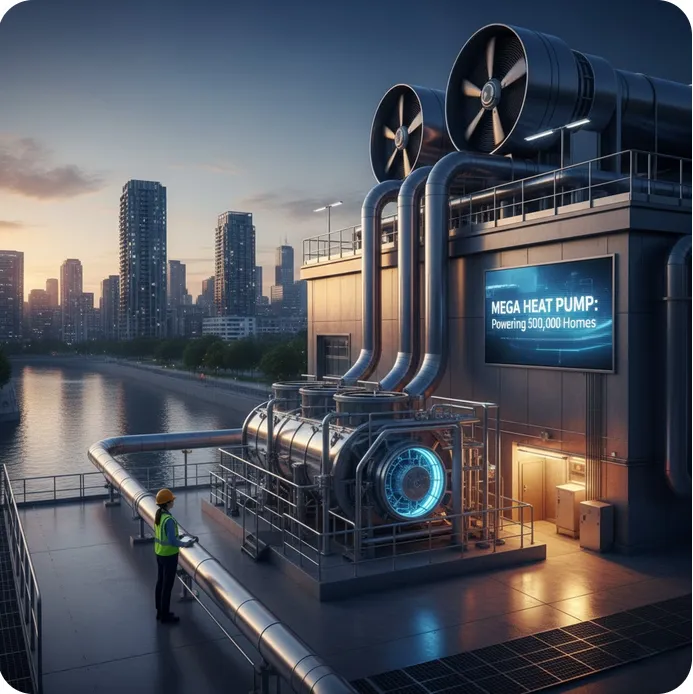
Across Europe, a new generation of enormous heat pumps—machines so large their pipes are wide enough to walk through—are beginning to replace coal plants and gas boilers at a citywide scale. These systems don’t heat individual houses. Instead, they supply warmth to tens of thousands of buildings at once, using rivers, seas, wastewater, and even cold winter air as their energy source.
What was once considered a niche technology is rapidly becoming one of the most important tools in the global push to decarbonise heating. And the size of these machines is growing at an almost unbelievable pace.
Welcome to the era of the world’s biggest heat pumps.
Why Heating Is the Hardest Climate Problem to Solve
Electricity generation often dominates climate conversations, but heating is just as critical—and far more stubborn.
In many countries, heating accounts for a massive share of carbon emissions. Unlike electricity, which can be decarbonised by switching generation sources, heating systems are deeply embedded in buildings, pipes, and urban layouts. Replacing them is expensive, disruptive, and technically complex.
Individual heat pumps for homes are part of the solution, but they are not always practical in dense cities, older buildings, or large apartment blocks. That’s where district heating comes in.
District heating networks distribute hot water or steam from a central source through kilometres of insulated pipes, delivering heat to entire neighbourhoods. These systems already exist in many European cities—but historically, they were powered by coal, gas, or waste incineration.
Now, heat pumps are stepping in as the clean alternative.
From Kitchen Appliance to Industrial Giant
Most people associate heat pumps with small boxes mounted outside houses. But at their core, heat pumps follow the same principle regardless of size: they move heat from one place to another.
Even cold air, river water, or seawater contains thermal energy. A heat pump captures that low-grade heat, concentrates it using compression, and upgrades it to a temperature suitable for heating buildings.
Scaling this process up to supply an entire city, however, requires machinery on an entirely different level.
In Mannheim, Germany, engineers are preparing to install heat pumps with a combined output that rivals small power stations. These machines will sit on the site of a former coal plant—symbolically and practically replacing one of the dirtiest forms of energy with one of the cleanest.
Instead of burning fuel, they will draw heat from the River Rhine, one of Europe’s most important waterways.
Pipes Bigger Than People
To understand the scale of these systems, it helps to start with the pipework.
The intake pipes planned for Mannheim are around two metres in diameter. That’s large enough for an adult to stand upright inside them. Every second, roughly 10,000 litres of river water will flow through the system.
The process is deceptively simple:
- River water enters the system.
- Heat exchangers extract a small amount of thermal energy.
- The slightly cooler water is returned to the river.
- The harvested heat is amplified and sent into the district heating network.
The temperature change in the river is so small that it is barely measurable—fractions of a degree spread over an enormous volume of flowing water.
From an environmental standpoint, this approach offers one of the lowest-impact ways to generate heat at scale.
Why Cities Are Betting Big on Heat Pumps
The shift toward massive heat pumps isn’t happening by accident. Cities and utilities are under growing pressure to meet emissions targets while keeping energy affordable and reliable.
Large heat pumps offer several compelling advantages:
- Efficiency: A heat pump can turn one unit of electricity into three to five units of heat.
- Scalability: One installation can replace dozens of fossil-fuel boilers.
- Fuel independence: Heat sources like rivers and air don’t need to be imported.
- Grid flexibility: Heat production can be timed to match renewable electricity availability.
These benefits make heat pumps particularly attractive for cities already operating district heating networks.
In Mannheim, the infrastructure was already in place: pipes, grid connections, and a workforce experienced in managing large energy systems. Replacing coal with heat pumps wasn’t just a climate decision—it was a logical evolution.
A New Arms Race in Heat Pump Engineering
As demand for district-scale heat pumps grows, manufacturers are racing to build ever larger and more powerful machines.
German and Danish engineering firms are now competing to deliver systems measured not in kilowatts or megawatts, but hundreds of megawatts.
One project underway in Denmark aims to supply nearly a third of an entire city’s heating demand using heat pumps alone. Another combines multiple units with enormous hot water storage tanks—each capable of holding hundreds of thousands of cubic metres of water.
This modular approach allows operators to switch individual units on and off depending on demand, electricity prices, and weather conditions.
It’s not just about size. Flexibility is becoming just as important as raw capacity.
The Hidden Role of the Oil and Gas Industry
Ironically, some of the key technologies enabling this clean-energy transition were perfected in the fossil fuel sector.
The massive compressors used in industrial heat pumps are closely related to those used in oil and gas processing. For decades, these machines compressed hydrocarbons for transport and storage. Now, similar designs are being repurposed to compress refrigerants in heat pumps.
This crossover has accelerated development, allowing heat pump manufacturers to scale up more quickly than they otherwise could.
In a twist of fate, the machinery that once supported fossil fuel extraction is now helping to dismantle it.
How District Heating Supercharges Heat Pumps
Heat pumps become especially powerful when paired with district heating networks.
Unlike individual home systems, district networks can:
- Balance supply across thousands of buildings
- Store heat in massive insulated tanks
- Combine multiple heat sources
- Smooth out peaks and dips in demand
If demand is low in autumn, only part of the system needs to run. During deep winter, everything ramps up. When electricity prices spike, stored heat can take over temporarily.
This flexibility is one reason experts see district heating and heat pumps as a perfect match.
Water Isn’t the Only Heat Source
Rivers and seas are ideal heat sources, but they’re not always available—or practical.
In Helsinki, engineers faced a problem: the water near the city’s coastline is too shallow and too cold to provide sufficient heat year-round. Digging tunnels far out to sea would have been expensive and disruptive.
Instead, the city turned to another approach: air-source heat pumps, electric boilers, and biomass—all integrated into a single district heating network.
This hybrid model reflects a broader trend. Cities are increasingly mixing technologies to reduce risk and maximise resilience.
Heat pumps handle most of the work. Electric boilers step in when electricity is cheap or abundant. Biomass provides backup during extreme cold.
The result is a system that is cleaner, more adaptable, and far less dependent on fossil fuels.
Why Electric Boilers Still Matter
At first glance, electric boilers seem inferior to heat pumps. They convert electricity directly into heat, with no efficiency multiplier.
So why install them at all?
The answer lies in economics and grid management.
Electric boilers are:
- Cheaper to install
- Simple to operate
- Excellent for absorbing surplus renewable power
When wind or solar generation exceeds demand, electricity prices can drop sharply. At those moments, electric boilers can soak up excess power and convert it into heat, stabilising the grid.
In modern district heating systems, efficiency isn’t the only metric that matters. Flexibility is just as valuable.
Environmental Safeguards and Public Concerns
Large infrastructure projects inevitably raise environmental questions.
Will rivers be harmed? What about fish? Could temperatures change enough to affect ecosystems?
Engineers have spent years modelling these effects. In river-based systems, water is filtered before entering heat exchangers, preventing harm to aquatic life. Temperature changes are minimal and spread across huge volumes of flowing water.
In many cases, the environmental impact is far smaller than that of the fossil fuel plants these systems replace.
Still, public engagement remains crucial. Transparency and rigorous monitoring are essential to maintaining trust as cities transition to new heating technologies.
Cost: Expensive, But Transformational
There’s no denying that mega heat pumps require serious investment.
Projects often cost hundreds of millions of euros once buildings, pipework, grid connections, and storage systems are included. On a per-megawatt basis, heat pump equipment alone can cost around half a million euros.
But these systems are long-term assets.
They reduce fuel imports, stabilise heating costs, and cut emissions for decades. When viewed over their lifetime, many projects compare favourably to continued investment in fossil infrastructure—especially as carbon pricing increases.
What About the UK?
Compared with parts of Europe, the UK is still in the early stages of district heating expansion.
However, momentum is building. New networks are planned for university campuses, city centres, and redeveloped industrial sites. Some projects are exploring the use of flooded mine workings, which maintain stable underground temperatures and offer an untapped heat source.
Former industrial regions, with space for large equipment and storage tanks, may become ideal candidates for district-scale heat pumps.
Experts argue that the technology is ready. What’s needed now is policy support, long-term planning, and public awareness.
The Future: Heating as Infrastructure, Not Appliance
Perhaps the most important shift is philosophical.
For decades, heating has been treated as an individual household concern. Boilers were hidden away in cupboards and basements, quietly burning fuel out of sight.
Mega heat pumps turn heating into shared infrastructure—more like water supply or public transport than a private appliance.
This change opens the door to smarter, cleaner, and more resilient cities.
A Quiet Revolution Beneath Our Feet
You won’t see giant heat pumps on postcards. They don’t sparkle like wind turbines or stretch across landscapes like solar farms. Most sit quietly in industrial zones, doing their work unseen.
But their impact may be just as profound.
As cities race to meet climate targets while keeping residents warm, these enormous machines are emerging as one of the most powerful tools available. They represent a fusion of old engineering expertise and new environmental priorities—a bridge between the fossil fuel past and a low-carbon future.
The age of coal-fired heating is ending. In its place, rivers, air, and clever engineering are taking over—one massive heat pump at a time.