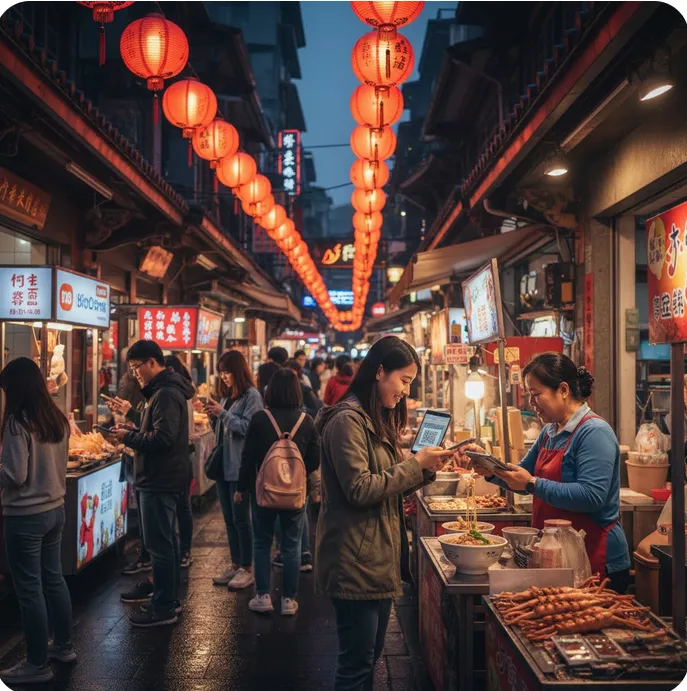
In many parts of the world, cashless payments are invisible by design. You tap your phone, scan a code, or swipe a card, and the transaction vanishes into the background of daily life. Convenience is the goal, friction is the enemy, and personality is often an afterthought.
Taiwan took a very different path.
Instead of making digital payments purely utilitarian, Taiwan transformed them into something tactile, personal, and even playful. In this small island economy, cashless payments are not confined to smartphones or plastic cards. They dangle from backpacks, sit on keyrings, and come shaped like cartoon characters, miniature food items, and nostalgic objects from another era.
It’s a system that feels less like “fintech” and more like everyday culture—and it offers a fascinating counterpoint to how digital payments have evolved elsewhere.
A Convenience Store That Tells a Bigger Story
Walk into a convenience store in Taiwan, and you’ll quickly notice something unusual. Alongside snacks, drinks, and magazines, you’ll find racks of small collectible objects: plush animals, toy phones, tiny lunchboxes, and whimsical charms. At first glance, they look like novelty keychains or souvenirs.
But these objects are not just decorative.
Hidden inside each one is a contactless chip that allows it to function as a digital wallet. Tap it at a checkout terminal, and the purchase is complete. No phone. No QR code. No app to open.
This small moment reveals something much larger about Taiwan’s approach to cashless payments: technology here is designed to blend into daily life, not dominate it.
Beyond Phones: A Different Philosophy of Digital Payments
In many countries, the rise of cashless payments has followed a predictable trajectory. First came credit and debit cards. Then mobile wallets. Eventually, QR codes became ubiquitous, especially in parts of Asia.
Taiwan’s system stands apart because it never relied on a single dominant interface. Instead of forcing everyone into a phone-based ecosystem, the country embraced stored-value contactless systems that could take almost any physical form.
Cards, wristbands, keychains, figurines—all can function as payment tools.
This diversity reflects a deeper design philosophy: payments should adapt to people’s habits, not the other way around.
The Origins of Taiwan’s Stored-Value Ecosystem
To understand how Taiwan arrived here, it helps to look back at how its payment infrastructure developed.
Taiwan’s stored-value cards originally emerged to solve practical problems, particularly in public transportation. Urban transit systems needed a fast, reliable way to process millions of small transactions every day. Contactless cards offered speed, durability, and simplicity.
Once these systems were in place, their usefulness quickly expanded beyond buses and subways. Convenience stores, vending machines, parking meters, and small retailers began accepting the same cards.
Rather than fragmenting into dozens of incompatible systems, Taiwan allowed multiple stored-value platforms to coexist and interoperate in many contexts. This created a flexible foundation that encouraged experimentation.
When Payments Become Objects You Care About
One of the most striking aspects of Taiwan’s payment culture is emotional attachment.
In many countries, a payment method is interchangeable. Lose a card, replace it. Upgrade a phone, migrate your wallet. The tools themselves carry little meaning.
In Taiwan, people often form personal relationships with their payment objects.
A commuter might use the same character keychain for years. A student might carry a charm bought during a specific phase of life. A souvenir purchased at a convenience store becomes part of daily routine.
These objects are not just functional—they’re sentimental.
This emotional dimension changes how people think about money and technology. Payments become something you touch, choose, and express, rather than something abstract and invisible.
Decentralization as a Feature, Not a Flaw
Unlike countries where a single company or platform dominates cashless payments, Taiwan’s ecosystem is notably decentralized.
Multiple stored-value systems operate side by side. Different issuers, retailers, and transit operators participate. While this might sound inefficient, it has produced resilience and flexibility.
No single company controls the entire system.
No single app is required for participation.
No single interface defines how people pay.
This decentralization encourages innovation. It allows cultural institutions, retailers, and even pop-culture brands to design payment objects that reflect their identity.
In effect, Taiwan treats digital payments as infrastructure rather than a product—a foundation upon which creativity can flourish.
A Quiet Contrast With QR-Code Economies
In much of Asia, QR codes have become synonymous with cashless payments. They are cheap to implement, easy to scale, and tightly integrated with smartphones.
Taiwan chose not to go all-in on this model.
While QR codes exist, they never became the sole or dominant method of payment. Instead, contactless stored-value systems retained a central role.
The difference is subtle but important.
QR-code payments require visual attention, phone screens, cameras, and apps. Contactless objects require only proximity. You tap and go, often without breaking conversation or interrupting your flow.
This makes transactions feel less like digital interactions and more like physical gestures.
Payments That Work Without Constant Connectivity
Another overlooked advantage of Taiwan’s approach is reliability.
Stored-value systems can function even when networks are slow or temporarily unavailable. Transactions are fast and predictable. This matters in high-traffic environments like transit stations and convenience stores, where delays quickly become chaos.
By contrast, app-based systems often depend on stable internet connections, up-to-date software, and compatible devices.
Taiwan’s system prioritizes continuity. Payments are expected to work everywhere, all the time, with minimal friction.
Cultural Design Meets Financial Technology
What truly sets Taiwan apart is how deeply culture is embedded into its payment tools.
Design matters. Nostalgia matters. Humor matters.
Payment objects are often tied to popular characters, seasonal themes, or local traditions. Limited-edition designs encourage collecting. Collaborations with artists and brands turn financial tools into cultural artifacts.
This approach reframes fintech as something human-centered rather than purely efficiency-driven.
It also lowers psychological barriers. For children, elderly users, or people uncomfortable with smartphones, a familiar object is far less intimidating than an app interface.
Accessibility Without Complication
Cashless systems often claim to improve accessibility, but they can inadvertently exclude people who lack smartphones, technical literacy, or reliable internet access.
Taiwan’s contactless objects offer an alternative.
They are simple to use.
They require no passwords.
They don’t demand constant updates.
They don’t collect attention.
This simplicity makes digital payments more inclusive across age groups and socioeconomic backgrounds.
The Role of Convenience Stores as Innovation Hubs
Convenience stores play an outsized role in Taiwan’s daily life. They are everywhere, open almost constantly, and serve as hubs for logistics, bill payments, ticketing, and more.
It’s no coincidence that they also became central players in the evolution of cashless payments.
By selling and supporting payment objects, convenience stores normalize digital payments in an approachable setting. Buying a payment charm feels no different from buying a snack or magazine.
This everyday integration accelerates adoption without formal campaigns or mandates.
A Payment System That Encourages Play
There is something quietly radical about making payments playful.
In many societies, money is treated with solemnity. Financial tools are serious, standardized, and deliberately neutral.
Taiwan disrupts this narrative.
By allowing payments to take whimsical forms, the system acknowledges that money is part of everyday life—not something that needs to be hidden behind sterile interfaces.
This playfulness doesn’t undermine security or reliability. Instead, it enhances engagement.
Security Through Simplicity
Ironically, Taiwan’s low-key approach to cashless payments may enhance security.
Because payment objects store limited value and are often reloadable, the risk of catastrophic loss is reduced. Losing a keychain is inconvenient, not devastating.
Additionally, the absence of constant user authentication reduces exposure to phishing, password theft, and social engineering attacks common in app-based systems.
Security here is not achieved through complexity, but through thoughtful design.
Lessons for the Rest of the World
Taiwan’s model challenges several assumptions about digital payments:
- That smartphones must be the primary interface
- That consolidation is always beneficial
- That efficiency requires uniformity
- That financial tools must be invisible
Instead, Taiwan shows that payments can be diverse, expressive, and culturally grounded—without sacrificing speed or reliability.
For countries grappling with payment fragmentation, digital divides, or consumer fatigue, this approach offers valuable insights.
Why This Matters Beyond Payments
At a deeper level, Taiwan’s payment system reflects a broader philosophy of technology.
Technology should fit into human life, not reshape it entirely.
Infrastructure should enable creativity, not constrain it.
Digital systems should respect cultural context.
These principles extend far beyond money.
The Future of Cashless, the Taiwanese Way
As digital payments continue to evolve globally, Taiwan’s approach may become increasingly relevant.
In an era of app overload, subscription fatigue, and digital burnout, tactile systems offer a refreshing alternative. They remind us that progress doesn’t always mean more screens, more data, or more complexity.
Sometimes, it means a small object on a keychain that simply works.
Final Thoughts: When Technology Feels Human
Taiwan didn’t just build a cashless payment system. It built an ecosystem that feels alive, personal, and deeply embedded in daily culture.
By allowing digital money to take physical form—cute, nostalgic, and meaningful—it transformed transactions into experiences.
In doing so, Taiwan quietly answered a question many technologists overlook:
What if the future of payments isn’t about disappearing into software—but about becoming something people actually enjoy using?