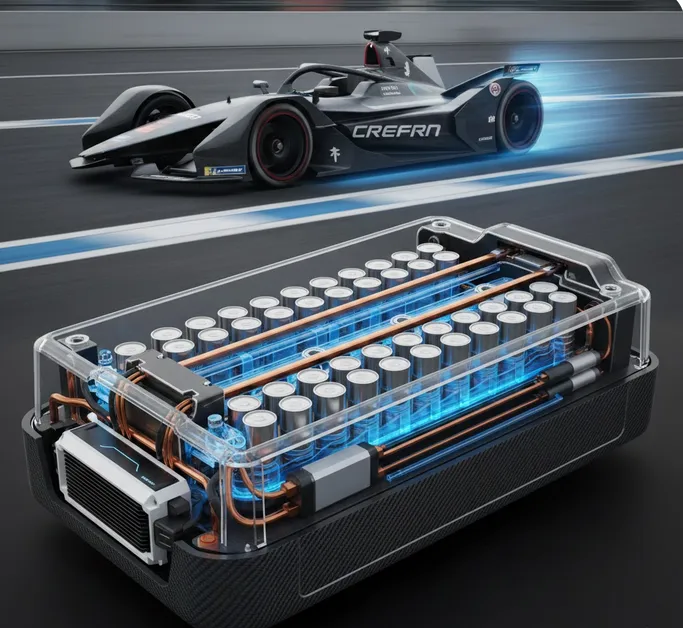
Electric vehicles have reached a point where they’re not just an alternative to gas-powered cars—they’re challenging the limits of speed, endurance, and engineering. Nowhere is this more apparent than in Formula E, the all-electric racing series that has gone from a niche experiment in 2014 to one of the most advanced motorsport laboratories in the world.
And while Formula E might look like a futuristic spectacle meant purely for racing fans, the reality is far bigger: the battery systems powering these cars are influencing the technology that will eventually run everyday electric vehicles around the globe.
This story isn’t just about racing. It’s about how EVs of tomorrow are being built today—under the extreme conditions of professional motorsport.
A New Season, a New Benchmark for Speed
Early December marks the beginning of another Formula E season, and this year’s opener in São Paulo showcases just how far electric racing machines have evolved. Twenty cars will rip through a 2.93 km urban circuit, spending most of their time on blazing-fast straight sections that allow the vehicles to reach their maximum pace.
These cars can now rocket from 0 to 60 mph (96 km/h) in an astonishing 1.8 seconds—faster than many high-end supercars and only a shade slower than the pinnacle of combustion racing, Formula One. Their top speeds now exceed 200 mph (322 km/h), closing the gap with F1 closely enough that comparing them has become part of fan culture.
What’s even more impressive is how quickly these cars have improved. In 2014, drivers had to switch vehicles halfway through the race because batteries could not last the full distance. Eleven seasons later, not only do the cars complete an entire race on a single pack—they can sprint, regenerate energy, and even recharge mid-race.
Formula E has become the greatest real-world testing ground for high-performance EV batteries ever created.
The Fastest EVs on Earth Aren’t on the Track
Before we dive deeper into Formula E engineering, it’s worth noting something surprising: the most blisteringly fast electric cars in the world aren’t part of the championship.
Record-Breaking Production EVs
The Yangwang U9 Xtreme, a Chinese supercar from BYD, recently became the fastest street-legal electric car ever produced. It hit an astonishing 308 mph (496 km/h), making it not just the fastest EV but the fastest production car of any kind.
Experimental EV Rockets
In the world of land-speed experimentation, vehicles like Ohio State University’s Venturi Buckeye Bullet 3 have smashed records with average speeds above 341 mph (549 km/h).
These projects, however, do not need to perform the way Formula E cars do. The challenge in modern EV racing isn’t simply speed—it’s combining speed, endurance, energy recovery, and agility while using a battery pack compact enough to survive intense physical forces and temperature swings.
That’s where Formula E batteries take center stage.
Battery Basics: The Same Chemistry, Better Engineering
What surprises many people is that the foundational chemistry inside a Formula E battery is not exotic. The battery powering a billion-dollar race series shares the same elementary principles as the battery inside your TV remote.
Every lithium-ion cell consists of an anode, a cathode, and electrolytes that allow electrons to move during discharge or charge. The battery in a race car simply pushes these same principles to the extreme.
In Formula E:
- A battery pack contains hundreds of flat cells roughly the size of a small notebook.
- These are stacked into modules.
- Between each cell lies a cooling plate, crucial for temperature control.
- The entire assembly is housed in a structure that doubles as part of the car’s chassis.
This last point is essential: the battery pack provides physical rigidity. Without it, the chassis would fail structural tests. Engineers must therefore balance energy storage, thermal stability, structural strength, and weight—all while ensuring the car remains safe during crashes.
That’s a level of engineering complexity that directly benefits consumer EVs.
The NMC Chemistry Behind High-Power EV Racing
Most Formula E batteries use a version of lithium-ion chemistry that incorporates nickel, manganese, and cobalt (NMC). These materials allow extremely rapid energy flow—both into the battery (charging) and out of it (discharge).
- NMC cells excel at high power density.
- They can release enormous bursts of power (e.g., overtaking) without degrading quickly.
- They can also accept energy at very high rates, which is essential for regenerative braking and pit-lane fast charging.
In racing, this flexibility is everything. EVs must be able to accelerate instantly, recover energy at every braking zone, and absorb massive charges mid-race—all tasks that standard EV batteries simply cannot handle.
The Real Challenge: Outrunning Their Own Energy Supply
This is where Formula E gets interesting. Even with advanced NMC cells and enormous power output, the batteries don’t begin the race with enough energy to finish it outright.
A Formula E car:
- Starts with about 52 kWh of usable energy
- Consumes up to 90 kWh during a race
That math doesn’t work without creative solutions.
Drivers begin each race with roughly 65% of the full energy they’ll need. The sport is intentionally designed this way because energy recovery and management strategy are core elements of competition.
Two breakthroughs make it all possible:
1. Energy Regeneration: Turning Braking Into Power
Unlike traditional racing, where braking systems burn off huge amounts of energy as heat, Formula E cars use electric motors as generators.
When the car slows down:
- The motors reverse into generator mode.
- The spinning wheels feed energy back into the battery.
- The rear axle has no friction brakes at all—a radical departure from combustion racing.
This eliminates particulate emissions from brake pads and dramatically improves energy efficiency.
Race organizers even design tracks to optimize regeneration. More corners and technical sections mean opportunities to recharge. It’s part of the strategic fabric of Formula E.
2. Mid-Race Ultra-Fast Charging: Pit Boost
In the latest generation of the sport, teams gained the ability to recharge during the race. This technology—known as Pit Boost—is one of the most groundbreaking elements of electric motorsport.
Pit Boost provides:
- 3.85 kWh of energy
- In just 30 seconds
- At an unbelievable 600 kW charging speed
To put that into context:
- The fastest public chargers today peak around 150–350 kW.
- Formula E nearly doubles the highest commercial charging rates.
This isn’t just a racing gimmick. Pit Boost is essentially a prototype of the ultra-fast charging that could appear in public EV infrastructure in the coming decade.
Imagine pulling into a charging station and adding dozens of miles of range in seconds—not minutes.
Why Fans Love the Energy Drama
Formula E broadcasts show the percentage of energy remaining in each car in real time. This creates a tension that combustion racing doesn’t typically have.
Drivers who mismanage their energy risk running out before the finish. Others calculate just well enough to surge ahead in the final laps. Energy strategy has become as memorable as speed itself—and this mirrors the challenge EV owners face daily.
The sport has taken the anxieties of EV drivers—range, recharge timing, efficiency—and turned them into the heart of competition.
From Track to Highway: How Formula E Tech Reaches Consumer EVs
Formula E isn’t just entertainment; it’s an engineering laboratory that runs 16 races per season under extreme stress, high heat, and unpredictable conditions. Innovations made here routinely trickle into everyday cars.
Faster Charging for Everyone
As drivers expect shorter charge times, manufacturers are studying Formula E’s thermal systems, wiring designs, and battery management techniques to safely increase charging speeds.
Better Battery Management Systems
Companies like Fortescue Zero have built advanced systems—such as Elysia—that monitor battery health, detect anomalies, and optimize performance. These systems are already being integrated into brands like Jaguar Land Rover.
Stronger and Lighter Battery Packs
Using the battery as a structural component reduces weight. This same idea is making its way into Tesla’s structural battery packs, BYD’s blade system, and future EV platforms.
Improved Regenerative Braking
Formula E cars regenerate so aggressively that they eliminate friction brakes on the rear axle. While this level of regen isn’t yet road-safe for consumer cars, manufacturers are pushing regen levels higher each year.
Reduced Battery Degradation
In racing, battery packs undergo brutal cycles. Improvements made to survive racing conditions translate into longer-lasting consumer EV batteries.
Racing Has Always Influenced Road Cars
Many technologies we take for granted—ABS, rear-view mirrors, disc brakes—were born in motorsport. Formula E is becoming the EV equivalent of Formula One’s innovation pipeline.
The Final Lap: Why Formula E Matters Beyond Racing
When 20 electric race cars launch into the São Paulo grid this season, they will carry technology that will eventually find its way into mass-market EVs.
Formula E is teaching the world:
- How to charge EVs faster
- How to build lighter, stronger battery packs
- How to extend battery life
- How to maximize energy efficiency
- How to make EVs more reliable and more fun
Racing has always pushed the limits of engineering. Now, it is pushing the limits of electrification.
While fans will tune in to see who wins, the real victory happens behind the scenes—where engineers take lessons from the track and bring them to everyday vehicles.
The car you drive in five or ten years will almost certainly contain ideas born in Formula E. The racetrack is still the world’s greatest laboratory, and electric racing is shaping the future of transportation one lap at a time.