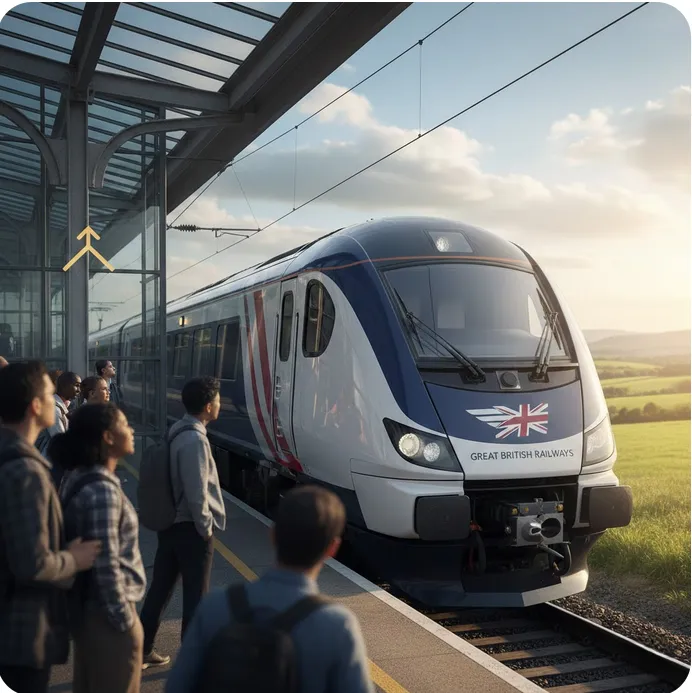
The United Kingdom’s railway system is entering a transformative era. In a move that signals both continuity and change, the government has unveiled the branding and logo for Great British Railways (GBR), a nationalised rail system designed to unify and modernise the way people travel across the country. This development marks a key milestone in the ongoing restructuring of the rail industry, which has seen several franchises return to public control in the past year.
The unveiling is more than a design refresh—it is a statement of intent. Through renationalisation, modernised branding, and technology upgrades, the government aims to create a railway network that is publicly owned, customer-focused, and responsive to the needs of passengers rather than private shareholders.
In this article, we will explore what the new GBR branding entails, why it matters, and how it fits into the broader transformation of the UK rail system. We will also examine the role of technology, app integration, and operational improvements in creating a modern, seamless travel experience for millions of passengers.
The New Branding: Red, White, and Blue
The newly revealed GBR branding features a red, white, and blue color scheme, designed to reflect the Union Flag and emphasise the national character of the network. This visual identity will appear on GBR trains, at stations, and across digital platforms, including the railway’s website and mobile app.
Passengers will start seeing the rebranded trains gradually rolling out across the national network from next spring, providing a consistent, recognisable image for the railway system. In the meantime, stations in major hubs—such as London Bridge, Birmingham New Street, Glasgow Central, Leeds City, and Manchester Piccadilly—will display the new design throughout December, giving commuters a first glimpse of the transformation.
The GBR logo builds on the iconic double-arrow symbol, first introduced in the 1960s as the logo of British Rail. This design has long been associated with UK rail travel and continues to serve as a symbol of national connectivity and public service.
Why Branding Matters
A logo or livery is not just about aesthetics; it communicates the values, mission, and identity of the organisation it represents. Transport Secretary Heidi Alexander emphasised this point, noting that the new design “isn't just a paint job.” Instead, it represents a new railway system, focused on delivering a proper public service and leaving behind the frustrations of the past.
For decades, passengers have faced challenges like delays, inconsistent service quality, fragmented ticketing, and complex fare structures. GBR’s branding signals a commitment to tackling these issues and creating a cohesive, customer-first network.
The Context: Renationalisation in Action
The GBR branding is part of a broader initiative to bring the UK’s rail network under public ownership, something the Labour Party included in its manifesto. Over the past year, the government has taken three major franchises back into public control: Greater Anglia, South Western Railway, and c2c. These moves represent a growing trend toward public oversight of essential transport services, allowing for more consistent standards and greater alignment with public interests.
Currently, seven train operators are already under public ownership, collectively accounting for roughly one-third of journeys in the UK. More acquisitions are expected throughout 2026, as franchises reach the end of their private contracts and are absorbed into GBR.
While the government has pledged to freeze rail fares next year, officials have been careful to note that renationalisation does not automatically mean lower prices. The focus, instead, is on service quality, operational efficiency, and long-term sustainability.
Technology and Passenger Experience: The GBR App
One of the standout elements of the GBR rollout is the digital infrastructure accompanying the rebranding. A mobile app is being developed to allow passengers to check train times, book tickets, and access services without incurring additional fees. For disabled passengers, the app will provide easy access to assistance booking, ensuring a more inclusive travel experience.
This integration of technology is crucial. In an age where passengers expect real-time information, seamless ticketing, and digital convenience, the GBR app positions the network as a modern, forward-looking system. Beyond ticketing, the app is expected to provide updates, service alerts, and potentially loyalty features, helping passengers navigate the network efficiently.
Operational Benefits of Nationalisation
Renationalisation is not simply about ownership—it also allows the government to coordinate and standardise services across the entire network. Historically, rail franchises operated with varying standards, fare structures, and schedules. GBR aims to create a unified system in which passengers experience consistent quality and predictability.
Key operational benefits of GBR include:
- Integrated Scheduling: Coordinated timetables across regions to minimise delays and optimise connections.
- Standardised Fare Systems: Simplified pricing structures, reducing confusion for passengers.
- Centralised Management: Streamlined oversight, allowing for quicker decision-making and investments in infrastructure.
- Public Accountability: Transparent reporting and accountability, ensuring taxpayer money is spent effectively.
By taking control of franchises as their contracts expire, the government can also phase improvements gradually, avoiding service disruption while modernising the network.
Economic and Social Implications
Nationalisation of the railways carries significant economic and social implications. Rail travel is essential for commuting, tourism, business, and regional connectivity. A modern, reliable railway system benefits the economy by:
- Reducing travel times and delays, improving productivity.
- Supporting regional economies by enhancing access to markets and job opportunities.
- Boosting tourism with more consistent, efficient services.
- Encouraging environmentally friendly travel, reducing reliance on cars and domestic flights.
The rebranding and operational improvements of GBR also signal government investment in public infrastructure, a move likely to generate public confidence and encourage wider use of rail services.
Industry Reaction
Industry leaders have responded positively to the government’s plans. Jacqueline Starr, Executive Chair and CEO of the Rail Delivery Group—a collective of Britain’s train operators—welcomed the initiative, stating:
"We will continue to work closely with industry partners to support a smooth transition to Great British Railways."
The reaction highlights the importance of collaboration between public authorities and private stakeholders during this transition. While nationalisation shifts ownership, successful implementation requires continued cooperation with employees, operators, and technology providers.
Design Philosophy and Passenger-Centric Focus
The GBR branding, while visually striking, is underpinned by a passenger-centric philosophy. Transport Secretary Alexander has described the initiative as more than a visual update—it represents a commitment to:
- Eliminating historical frustrations experienced by passengers.
- Focusing on service reliability and accessibility.
- Bringing all parts of the rail network under a cohesive framework.
The design team worked in-house to ensure that the livery, logo, and app interface communicate simplicity, clarity, and trustworthiness, echoing the government’s broader commitment to public service.
Challenges Ahead
Despite the excitement, GBR faces several challenges:
- Integration Complexity: Merging multiple franchises into a single cohesive system is operationally complex.
- Financial Pressures: Maintaining fare stability while investing in infrastructure requires careful fiscal management.
- Public Expectations: Passengers will judge GBR on tangible improvements in punctuality, reliability, and ease of travel.
- Technological Rollout: Ensuring the app functions seamlessly across all devices and supports real-time updates is critical.
Success will depend on the government’s ability to balance innovation with operational stability while delivering a service that passengers can trust.
The Road Ahead: A Gradual Rollout
The rollout of GBR branding and services will be gradual. Initial displays of the new livery at major stations allow passengers to familiarise themselves with the new look. From spring 2026, trains across the country will begin sporting the red, white, and blue branding, with the double-arrow logo prominently displayed.
As more franchises are absorbed into public ownership, the national network will gradually reflect a unified identity, both visually and operationally. The app and digital infrastructure will continue to evolve, providing passengers with enhanced services and more streamlined travel planning.
Conclusion: GBR as a Symbol of a New Era
Great British Railways is more than a rebrand—it represents a philosophical shift in UK transport policy. By bringing railways under public control, integrating technology, and standardising services, the government aims to create a system that is reliable, modern, and passenger-focused.
The new red, white, and blue livery, combined with the iconic double-arrow logo, signals national pride and unity, while the app and operational reforms demonstrate a commitment to modern convenience and accessibility.
For passengers, GBR promises:
- Simplified travel planning through a single app.
- Consistent service quality across regions.
- Expanded access to public transport services nationwide.
- A sense of ownership, as the railways become truly public.
While challenges remain, the strategic vision behind GBR is clear: a modern, integrated railway system that works for the public, not for private shareholders. Over the next few years, as the network is gradually nationalised and services enhanced, GBR has the potential to transform the experience of rail travel in Britain, creating a system that is efficient, accessible, and celebrated nationwide.
In short, the Great British Railways branding and operational initiative is a signal that the UK is committed to reimagining its public transport infrastructure for the 21st century. For passengers, industry stakeholders, and the broader public, GBR represents a new era in British rail travel—one defined by public ownership, innovation, and passenger-first priorities.
This article provides a comprehensive overview of the GBR initiative, including its branding, operational impact, technological integration, and socio-economic implications, offering readers a detailed understanding of the significance of this historic transition.