Is Google finally prepared to return to a device category it famously stumbled in? Here’s a deep look at the tech giant’s second attempt—and why 2026 might be very different from 2013.
For more than a decade, Google has carried the weight of one of Silicon Valley’s most iconic product flops: Google Glass. Launched with enormous hype and futuristic promise, the early version of Glass became shorthand for the risks of releasing technology before the world—or the product—was ready.
But in 2026, Google plans to try again. This time, the company says the ecosystem has matured. Artificial intelligence is now a household term. Google’s own AI platform, Gemini, has soared in popularity. And the hardware world has changed dramatically, with stylish, AI-infused eyewear from Meta and luxury brands like Ray-Ban already in consumers’ hands.
In other words, Google is stepping back into the smart-glasses arena—but the environment is almost unrecognizable from 2013.
So what exactly is Google planning? Why now? And can the company avoid repeating the mistakes that derailed its first attempt?
Let’s break it all down.
A Second Act: Google Confirms Return to Smart Glasses in 2026
In December 2025, Google revealed plans to relaunch a smart glasses line powered entirely by artificial intelligence. The announcement comes years after Google quietly retired Glass and after Meta surged ahead, capturing millions of early adopters.
Unlike Google’s first smart glasses—which were mocked for their asymmetrical design and viewed with suspicion for their built-in camera—the upcoming models aim to blend into everyday life. The company says it is building two distinct products:
1. A “screenless” assistance-focused pair of AI glasses
These will act as a voice-driven interface for Google’s AI systems, letting wearers receive information and interact with Gemini hands-free. Think of it as an audio-only AI assistant made wearable—something like blending Pixel Buds with traditional eyewear.
2. A display-equipped variant with an integrated visual interface
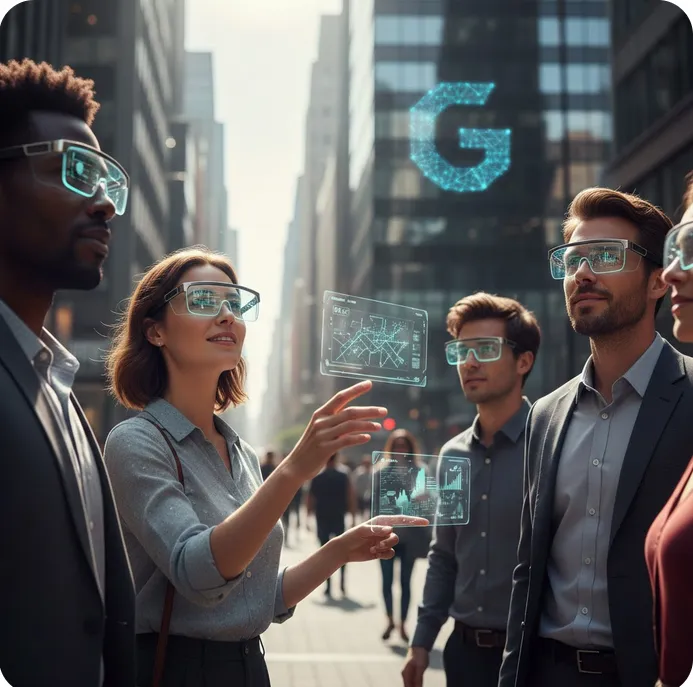
This version is closer to the original promise of Glass, but with more polished styling and far more advanced technology. The built-in display is expected to overlay contextual information, help with navigation, and possibly support lightweight AR applications.
While Google has not revealed the final industrial design, early hints point to thicker, translucent lenses and a more conventional silhouette—something far less conspicuous than the 2013 version, which was criticized for resembling a tech prototype rather than a product meant for daily life.
What Went Wrong the First Time? A Look Back at Google Glass
Before examining why Google believes the market is ready now, it’s important to revisit the history of the original Glass—because that history still shapes public perception today.
The 2013 Launch: A Vision Ahead of Reality
When Google Glass debuted, it was pitched as a revolutionary leap forward. A wearable computer perched above the eye, complete with a miniature display, voice commands, and the ability to take photos and videos with a subtle tap or voice prompt.
In 2012, the demo stunned crowds. Google co-founder Sergey Brin himself wore the device publicly, contributing to the mystique. Early adopters and developers imagined endless possibilities—hands-free messaging, real-time navigation, on-the-go video streaming.
But the excitement didn’t last.
Why People Turned Against Google Glass
Glass ran into three major problems:
1. Privacy fears
The built-in camera made people deeply uncomfortable. Wearers could record without being noticed, and businesses, bars, and public spaces began banning the device. The term “Glasshole”—an insult for those wearing Glass—went viral.
2. Design issues
The device didn’t look like a pair of glasses; it looked like a tech experiment. The asymmetrical frame was widely ridiculed, and the device clashed with personal style.
3. Limited usefulness
Despite its futuristic appeal, the tech wasn’t polished. The display was small, battery life was short, and applications were few. It worked, but it didn’t solve enough daily problems to justify wearing something so conspicuous.
By 2015, Google pulled the consumer version from the market less than a year after expanding availability.
The Enterprise Detour
Google attempted a comeback in 2017 with Glass Enterprise Edition, aimed at medical workers, engineers, and logistics teams. This version found some niche adoption, but it never crossed into mainstream use and was fully discontinued in 2023.
These failures left many wondering whether Google would ever re-enter the consumer wearables space.
**So Why Try Again Now?
Because the world—and the tech—has changed dramatically.
Google’s new attempt isn’t happening in a vacuum. Over the past three years, smart glasses have evolved from a novelty into a genuine category.
Meta Changed Everything
Meta’s collaboration with Ray-Ban and Oakley produced some of the first smart glasses people actually wanted to wear. Styled like premium sunglasses and powered by increasingly capable AI, Meta’s glasses sold over two million units by early 2025—an astronomical jump for a new category.
Consumers weren’t merely experimenting—they were adopting, recommending, and using smart eyewear in real life.
The Market Is Growing at Breakneck Speed
According to Counterpoint Research, sales of AI-enabled glasses jumped more than 250% year-over-year during the first half of 2025.
This surge was driven not just by Meta, but by a wave of smaller companies experimenting with lightweight AR displays, audio-only AI assistants, and frames that look indistinguishable from standard glasses.
Simply put: people are now ready for the concept.
AI Has Advanced in Ways That Make Smart Glasses Make Sense
In 2013, Google Glass could deliver snippets of info—weather updates, short alerts, turn-by-turn directions—but the system lacked the intelligence needed to truly augment daily life.
Now, Google has Gemini.
The new glasses are designed around this AI system, enabling capabilities like:
- real-time translation
- contextual awareness
- summarizing what the user is seeing or hearing
- responding to conversational queries
- helping with tasks and productivity
- interacting with other Google services naturally
The glasses won’t just display information—they’ll understand context and predict what the user might need, delivering a far more helpful experience than the original Glass ever could.
Inside Google’s 2026 Vision: What the Company Wants Its New Glasses to Be
Although the company hasn’t revealed full details, its strategy is becoming clear. Google wants to position the new glasses not as a futuristic gadget, but as a natural extension of the AI assistant you already use.
The Screenless Model: A Less Intrusive Option
This version is expected to appeal to users who want AI assistance but dislike displays or AR overlays. Think of it like having a hands-free, head-up version of the Gemini chatbot with:
- audio responses
- voice input
- subtle haptics
- possibly a small indicator light or sensor
It could become a favorite for productivity, accessibility, and multitasking.
The Display Model: Subtle Augmented Assistance
Rather than full augmented reality, this model is likely to offer "micro-glance" information. This could include:
- basic heads-up notifications
- navigation arrows
- translation captions
- contextual labels or tips
- real-time object recognition
- AI-generated summaries
Google seems determined not to repeat the “spy camera” controversy, so expect far clearer visual indicators of recording and possibly stricter limitations around what can be captured.
Experts Warn Google: Don’t Repeat the Same Mistakes
Technology analyst Paolo Pescatore summarized industry sentiment bluntly: Google must avoid the errors that derailed the original Glass. He described the first launch as:
- ahead of its time
- poorly conceived
- poorly executed
In 2026, however, he believes Google has the right conditions to succeed. The ecosystem for AI is booming, thanks largely to the very product Google now wants to integrate into the new glasses: Gemini.
Privacy, Style, and Usability: Will These Issues Haunt Google Again?
Even with AI advancements, Google faces familiar challenges.
Privacy Concerns Haven’t Gone Away
Smart glasses with cameras remain controversial. People still worry about being recorded unknowingly, and businesses are increasingly cautious about allowing devices with integrated lenses.
Google will need to introduce strict transparency measures, clearly visible recording indicators, and aggressive privacy-first settings to earn public trust.
Design Matters More Than Ever
Consumers won’t wear technology that makes them feel self-conscious. Meta’s success is partly due to partnerships with fashion-forward brands that make the tech invisible.
Google appears to have learned from this, pursuing a more conventional, stylish approach to its new frames. But until the final design is revealed, the jury is still out.
Usability Must Be Effortless
Wearable tech succeeds only when it disappears into daily life. The device must be:
- lightweight
- intuitive
- durable
- helpful within seconds
- easy to forget you’re wearing
These were weaknesses of the original Glass. Google will need to prove it has solved them.
The Wearable Computing Landscape Has Transformed Since 2013
One of the biggest differences between then and now is simply technological maturity. Today’s glasses can pack far more computing power into far smaller frames. Batteries are more efficient. Cameras can be ultracompact. Displays can be embedded inside lenses. And AI models are drastically smarter.
Tech giants also now understand something they didn’t in 2013:
wearables need to blend into human environments—not disrupt them.
This explains why:
- Meta partnered with Ray-Ban
- Amazon’s Echo Frames look like ordinary glasses
- Smaller startups prioritize minimalist designs
If Google embraces this philosophy, its 2026 launch could resonate with consumers in a way the original Glass never did.
Can Google Actually Catch Up?
Google is not just returning to a category—it’s returning to a category where it is no longer the pioneer. Meta already owns a huge early lead, and several smaller competitors are carving out promising niches.
But Google does have two enormous advantages:
1. Gemini and the Google ecosystem
No other company has such deep integration across:
- search
- maps
- photos
- messaging
- productivity tools
- Android
- wearables
- home devices
If Google can unify all of these through the glasses, the product could become indispensable.
2. Google’s long history in AI and wearables
Despite the failure of Glass, Google’s work in:
- Pixel phones
- Pixel Buds
- Fitbit
- Wear OS
- cloud AI
- ambient computing
…gives it massive institutional knowledge to draw from.
What a Successful Google Smart Glasses Launch Could Mean
If Google’s 2026 smart glasses take off, it could reshape how people interact with technology over the next decade.
A shift away from smartphones?
Wearable AI could reduce our reliance on screens. Instead of pulling out a phone constantly, people might rely on voice-activated assistance and subtle displays within their glasses.
New modes of interaction
Imagine:
- getting real-time subtitles in another language
- receiving a summary of what you’re looking at
- having your schedule pop up softly in your vision
- identifying landmarks hands-free
- receiving a quiet reminder about a task as you walk past a location
The potential is enormous.
Accessibility breakthroughs
Screenless AI glasses could transform the daily lives of people with disabilities. Features like audio descriptions, environmental awareness, and real-time translation could become life-changing tools.
So… Will Google Succeed in 2026?
The answer depends on three critical factors:
1. Execution
Google must deliver hardware that is stylish, comfortable, and reliable—not experimental.
2. Privacy transparency
The new glasses must not trigger the same backlash as before. Google needs to prove it respects boundaries.
3. AI usefulness
The biggest selling point will be Gemini’s capabilities. If the glasses become the easiest, fastest way to access AI, adoption could skyrocket.
The stakes are high, but the timing may finally be right.
In 2013, Google pressured the world to adapt to its vision.
In 2026, Google appears ready to build a product that adapts to the world.