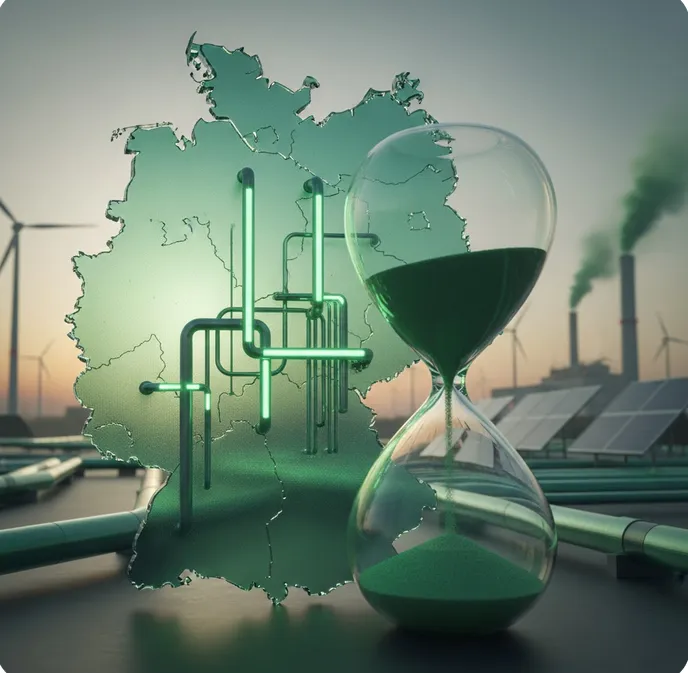
Germany envisioned itself as a global leader in the clean-hydrogen economy—a nation that would swap fossil-fuel dependence for home-grown electrolysers, renewable power, and an exportable industrial advantage. But as 2026 approaches, the dream is wobbling. Factories designed for high-volume hydrogen technology sit half-idle, project pipelines are shrinking, and industry insiders speak openly about a market that has not materialized fast enough.
To understand what's happening, you have to zoom in on a quiet manufacturing hub outside Hamburg. There, in an immaculate facility filled with robotic arms and polished metal components, one can see both the promise and the problems of Germany’s green-hydrogen ambitions.
A Factory Built for High Demand That Never Arrived
Quest One—the hydrogen-technology arm nestled inside a Volkswagen-owned umbrella company—built its Hamburg plant with speed, precision, and industrial scaling in mind. Robots assemble proton-exchange-membrane (PEM) electrolysers, devices designed to split water into hydrogen and oxygen using renewable electricity. They can churn out components far faster than human technicians ever could.
The irony? That speed currently isn’t needed.
Despite global enthusiasm for hydrogen as a climate solution, Quest One’s order book remains thin. The factory can operate at nearly double its current staffing—but instead of expanding, it recently had to lay off about 20% of its domestic workforce.
The company’s executives don’t mince words. The problem is not manufacturing capacity, technology readiness, or the skill of the workforce.
The problem is demand.
Hydrogen—at least the green variety Germany hopes to scale—is still too expensive for most industries, too inefficient for household uses, and too politically uncertain for investors to bet on.
And so, the robots wait.
Why Germany Expected a Hydrogen Boom
Hydrogen was never just an energy source in Germany’s climate strategy. It was supposed to become the backbone of a new industrial era.
The national vision included:
- massive electrolyser factories like Quest One’s
- regional hydrogen pipelines stretching from German ports to industrial centers
- underground storage caverns to hold hydrogen for winter energy shortages
- multi-billion-euro import deals with Namibia, Chile, India, and Saudi Arabia
- revamped heavy industries using hydrogen instead of coal or natural gas
- and, importantly, a new export product: German-made hydrogen technology
For a while, this vision looked unstoppable. Five years ago, global forecasts predicted explosive demand. Hydrogen hype peaked. Companies expanded. Politicians promised a new “Wasserstoffwirtschaft”—the hydrogen economy.
Then reality struck.
The Price Problem No One Can Ignore
Green hydrogen production relies on three expensive ingredients:
- Electrolysers (like the ones Quest One makes)
- A huge supply of renewable electricity
- Infrastructure to transport, store, and use the hydrogen
Today, green hydrogen in Germany costs roughly twice what companies say they need to pay for it to be competitive. Quest One hopes costs will drop to around €4 per kilogram, but that’s still a distant target.
Even globally, low-emission hydrogen (both green and blue) accounts for less than 1% of total hydrogen production.
This means:
- too little supply to bring prices down
- too little demand to justify scaling factories
- too many delays in building supportive infrastructure
It’s a classic chicken-and-egg problem—but on a national scale.
A Misalignment of Needs and Narratives
Hydrogen does have essential roles—just not in all the places politicians or car companies once implied.
Where green hydrogen is needed:
- steelmaking
- chemicals
- shipping
- high-temperature industrial processes
Where it is not efficient:
- home heating
- passenger cars
- most everyday energy uses
Experts like Christian Stöcker have been outspoken about this mismatch. He argues that hydrogen’s branding as a universal energy source was pushed in part by industries that benefit from keeping fossil-fuel infrastructure relevant—pipelines, gas utilities, and legacy automakers included.
This misalignment has wasted both time and political capital, leaving core industrial users without affordable hydrogen while public debate gets stuck on hydrogen-powered cars that were never viable in the first place.
Germany vs. China: A Strategic Gap
German manufacturers can build sophisticated electrolysers—but China can build far more of them, far faster, at dramatically lower prices. At the moment, China controls 60% of global electrolyser manufacturing capacity.
German companies warn that without:
- stronger domestic incentives,
- clearer long-term policies, and
- aggressive industry support
Germany risks losing the hydrogen race before it even begins.
The fear isn’t imaginary. In the past 18 months alone, over 50 planned hydrogen projects worldwide have been canceled or frozen due to economic uncertainty.
Some major energy companies, including Norway’s Statkraft, have stopped pursuing new green-hydrogen ventures altogether.
The global hydrogen mood has shifted from hype to hesitation.
Hydrogen Infrastructure: Built on Hope, Not Guarantees
Germany is already investing in infrastructure that assumes demand will appear. Some examples:
🔷 1. A Northern Hydrogen Pipeline Network
A web of planned pipelines branching from the Port of Hamburg to:
- renewable hydrogen producers
- storage hubs
- heavy-industry sites
This network is expensive and requires years to build. If demand doesn’t materialize, it risks becoming a stranded asset.
🔷 2. Underground Storage Caverns in Lower Saxony
Storengy Deutschland is converting salt caverns—currently used for natural gas—to store hydrogen 1,000 meters below ground. These caverns would act as seasonal energy buffers.
But commercial operations may not start until the 2030s.
🔷 3. International Hydrogen Corridors
Germany hopes to import hydrogen or hydrogen-derived ammonia from:
- Namibia
- Chile
- Saudi Arabia
- India
Yet critics warn:
- transporting hydrogen as ammonia is energy-inefficient
- reconverting ammonia back into hydrogen wastes even more
- foreign production could damage ecosystems
- hydrogen imports could replicate the same energy-dependency problems Europe faces with natural gas
There is no consensus on whether these global supply chains will actually work.
The Industry’s Warning: “We Need Policy—Now”
Germany’s hydrogen companies say the problem is not technological—it’s political.
They argue that:
- without firm government commitments to purchase green hydrogen,
- without stable pricing subsidies,
- and without strategic protection from Chinese competition,
Germany’s hydrogen market will stagnate.
There is, they say, no plan B.
If the government does not step in soon, the factories, pipelines, and industrial relationships built over the last five years may simply stall out.
Executives mention “crunch time.” And they mean it literally: wait too long, and companies will collapse or relocate.
The Human Side: Factories That Could Run Full, but Don’t
Inside Quest One’s Hamburg facility, the tension is visible.
Robots are idle more often than planned. Output is far below design capacity. Teams can build far more electrolysers than the market wants to buy.
A factory built to scale up is being forced to scale down instead.
For a country that once led global renewable-energy innovation, it’s a symbolic setback—and a potential economic one.
How Long Does Germany Have?
The global hydrogen momentum hasn’t died—but it has slowed, fragmented, and grown more cautious.
Industry analysts say:
- hydrogen will remain crucial for hard-to-electrify industries
- the hydrogen economy will grow—but slower and more unevenly than predicted
- countries that wait for perfect economics will fall behind
- countries that invest too aggressively risk wasting billions
Germany is stuck between those extremes.
If it moves too slowly, China dominates the market.
If it moves too fast, taxpayers foot the bill for unused pipelines and storage caverns.
Right now, the market is sending mixed signals. Governments are hesitating. And companies like Quest One are caught in the middle—too prepared to stop, but without the demand to grow.
The Big Question: Is Green Hydrogen Still Worth It?
Despite the bad news, the broader picture isn’t hopeless.
- Steel and chemical companies are experimenting seriously with hydrogen.
- International standards are improving.
- Electrolyser costs are declining globally.
- Several energy-hungry industries have no viable alternative to hydrogen.
As Ivana Jemelkova of the Hydrogen Council puts it: the sector isn’t experiencing doom and gloom—but it’s also nowhere near the rapid acceleration once promised.
The forest, she says, is still growing—even if individual trees are falling.
Conclusion: Germany Built the Stage—Now It Needs the Show
Germany has spent years preparing for a hydrogen future:
- high-tech electrolyser factories
- visionary infrastructure plans
- research institutions teaming with industry
- a political narrative centered around climate leadership
But ideas alone don’t build markets.
Right now, Germany’s green-hydrogen industry sits at a crossroads:
- With strong policy support it could become a global leader in a critical clean-tech sector.
- Without it, factories may close, foreign competitors will dominate, and billions in early investments may be lost.
Time is running out—not for hydrogen as a technology, but for Germany’s chance to shape its future.