Introduction
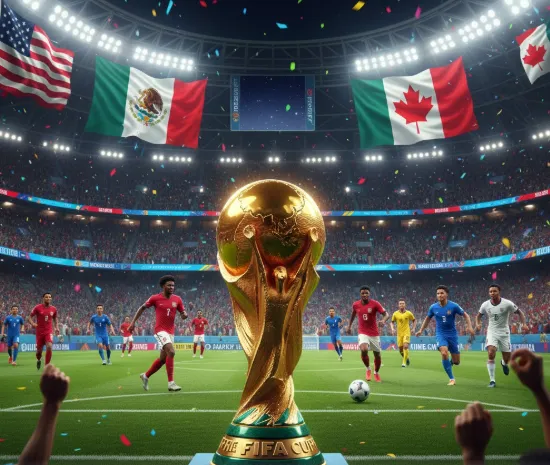
The FIFA World Cup has long been the pinnacle of international football — a festival of passion, unity, national pride, and global spectacle. The upcoming FIFA World Cup 2026 is set to redefine what the tournament can be: bigger, broader, more inclusive, and more global than ever. With three host countries, 48 teams, and 104 matches, World Cup 2026 promises a football extravaganza unlike any other. In this article, we explore what makes this edition special — from format changes and host cities to global significance and what fans should watch out for.
What Is FIFA World Cup 2026?
The 2026 edition of the world’s premier men’s football tournament, FIFA World Cup 2026, will be the 23rd edition of the competition.
It is officially branded as “World Cup 26”.
This tournament marks a series of significant firsts:
- It will be co‑hosted by three countries: United States (USA), Canada, and Mexico.
- It will feature 48 teams, expanded from the 32‑team format that had been used since 1998.
- The tournament will contain 104 matches — substantially more than in previous editions.
The tournament is scheduled to take place from June 11 to July 19, 2026.
Why 2026 Is a Game‑Changer
Bigger, More Inclusive, Global
Expanding to 48 teams means more nations from every continent—giving underrepresented regions greater chance to feel the World Cup magic. The slot allocations per confederation are more generous than ever, allowing more African, Asian, Oceanian, and CONCACAF nations to qualify.
For many countries, especially those that seldom reach the final tournament, 2026 could be their shot at the biggest stage. That increased global representation helps strengthen the worldwide appeal of football and brings diverse fanbases together under one global celebration.
New Format — More Matches, New Opportunities
Because of the expansion, the tournament structure has changed. The 48 teams will be drawn into 12 groups of four teams each.
From each group:
- The top 2 teams will advance automatically.
- Additionally, the eight best third‑placed teams across all groups will also advance — giving more teams a second chance.
This yields a Round of 32 (first knockout stage), then Round of 16, Quarter‑finals, Semi‑finals, Third place playoff, and Final.
Because of this, teams that go all the way to the final will play eight matches — one more than in previous editions.
More matches means more chances for underdog stories, more drama, and more opportunities for smaller nations to surprise the world.
Return to North America, Three‑Nation Hosting
World Cup 2026 returns to North America after decades. It will be the first World Cup co-hosted by three countries — USA, Canada and Mexico. Wikipedia
Of the three, for:
- United States: this will be the second time hosting (first was in 1994). Wikipedia
- +1
- Mexico: this will be the third time to host (after 1970 and 1986), making it the first nation to host/co‑host three men’s World Cups. Wikipedia
- +1
- Canada: first time hosting or co‑hosting the men’s tournament. Wikipedia
- +1
The tournament will be held in 16 cities across the three countries — 11 U.S. cities, 3 Mexican cities, and 2 Canadian cities. Wikipedia
This broad base of host cities ensures that fans across North America can experience World Cup matches — and also reflects the ambition of FIFA to globalize football and increase accessibility.
Host Cities & Venues: Where the Action Takes Place
The 2026 World Cup will leverage 16 host cities, providing world‑class stadiums and broad geographic coverage across North America. Wikipedia
United States – 11 Cities
The lion’s share of matches will occur in the U.S. — including major cities known for their infrastructure, stadiums, and fan culture. Encyclopedia Britannica
Mexico – 3 Cities
Mexico will bring football heritage, passionate fans, and historic venues back into the spotlight. Their cities will host group matches and participate significantly in the tournament’s opening phase. FIFA
Canada – 2 Cities
Canada will make its debut on the men’s World Cup hosting stage — offering fresh energy, diverse culture, and modern stadium facilities to welcome fans from all over the world. Wikipedia
The use of existing stadiums across all three countries reduces the need for building new venues, which had been a major stumbling block for competing bids. This practical approach underscores the sustainability and realism of the 2026 bid. The Guardian
Qualification & Representation: More Nations, More Dreams
Because of the 48‑team format, the allocation of spots per continental confederation has been significantly increased compared to previous tournaments. Goal
The spots roughly break down as follows (before inter‑confederation playoffs and hosts):
- UEFA (Europe): ~16 places Encyclopedia Britannica
- +1
- CAF (Africa): ~9 places Encyclopedia Britannica
- +1
- AFC (Asia): ~8 places Encyclopedia Britannica
- +1
- CONMEBOL (South America): ~6 places Encyclopedia Britannica
- +1
- OFC (Oceania): ~1 place Encyclopedia Britannica
- +1
- CONCACAF (North & Central America + Caribbean): ~6 places — including the three automatic (hosts). FIFA
- +2Goal
- +2
On top of that, there will be inter‑confederation playoffs to decide a few remaining spots — giving nations that might have missed direct slots another shot. FIFA
This structure means increased representation from Africa, Asia, Oceania — regions that have historically had fewer places. The 2026 World Cup, thus, stands to be a truly global festival of football, where emerging football nations may get their chance to shine on the biggest stage.
What Changes for Teams & Players
With a larger tournament, more matches, and greater diversity of opponents, teams will need depth, flexibility, and consistency to succeed. Traditional powerhouses will have to manage more games. Underdog nations might benefit from the expanded group and playoff format.
For players, this means:
- More opportunity to shine — especially for those from smaller football nations.
- A longer path to the trophy — champions will need to play up to eight matches.
- Greater exposure — more games broadcast across the world means more visibility for rising stars.
For fans, it means richer storylines, more variety, more matches to follow, and more opportunities to see their national teams compete.
What’s at Stake — Why World Cup 2026 Matters
Global Football Growth & Inclusion
With expanded slots and wider representation, World Cup 2026 can help grow football in traditionally underrepresented regions. Small or emerging football nations may reach the global stage, inspiring a new generation of players and fans. The expanded format could help democratize football success beyond traditional strongholds.
Economic, Cultural & Social Impact
Hosting across three countries adds huge economic potential — from tourism and hospitality to media and broadcasting — across North America. For host cities and countries, hosting the World Cup brings global attention, infrastructure upgrades, and enduring cultural legacy.
Culturally, a three‑nation World Cup fosters cross‑country fan interaction, shared excitement, and a massive celebration of diversity. The global appeal of the tournament will likely reach new heights, bringing together fans from all corners of the world.
Football Evolution & Competitiveness
With more matches and more teams, every edition becomes more competitive. Upsets become more likely. Dark‑horse teams might arise. The larger format breaks the monotony and could usher in a more unpredictable — and exciting — tournament.
Teams may need different strategies: deeper squads, rotation, intelligent resource management — which could redefine how national teams prepare for World Cups in the future.
Challenges & Criticisms — What Could Go Wrong
As with any big change, there are challenges that come with expansion and multi‑host formats.
Logistics, Travel & Fatigue
With matches spread across 16 cities in three large countries, logistics will be complicated. Teams and fans may face long travel times. Time zones, climate differences, jet-lag — all of these could affect performance and experience.
Risk of Dilution of Quality
Some critics worry that expanding to 48 teams might dilute the overall level of competition — more “weaker” teams may lead to more one-sided matches or dead rubbers in group stages. There is also concern that qualification thresholds may lower, leading to a less elite competition.
Uneven Host Spotlight
Although there are three hosts, there is a risk that one or two may dominate media attention and investment, leaving smaller-host nations overshadowed. Balancing attention, fairness, and infrastructure across host nations is a challenge.
Managing Expectations & Pressure
With more teams and more matches, expectations — from fans, nations, media — will be massive. Handling schedule, safety, fan movement, accommodation and broadcasting logistics will be crucial to the success of the tournament.
What Fans Can Expect — Atmosphere, Drama, Surprises
World Cup 2026 promises to be:
- Bigger and busier: With 104 matches, fans will have more games to watch, more chances for their team to shine, and more stories to follow.
- More international flavor: Many more nations participating means greater diversity of playing styles, cultures, fanbases — making it a uniquely global festival.
- Underdog chances: Smaller or emerging nations could surprise conventional powerhouses, leading to upsets, underdog heroes, and fresh narratives.
- New rivalries and dynamics: Expanded teams and group configurations could spark new rivalries, unexpected matchups and fresh storylines.
- Massive fan engagement: Host cities spanning USA, Canada, and Mexico, meaning fans across North America and beyond can participate, travel, and enjoy the games.
For football fans — on streets, homes, bars, or stadiums — 2026 will likely deliver excitement, heartbreak, jubilation and memories to last a lifetime.
How to Keep Up: What to Watch Before & During World Cup 2026
- Follow qualifying rounds — As confederations complete their qualification campaigns, you’ll learn which nations make it. With more spots available, surprises are possible.
- Watch for group draw — The group draw (pots, seeding, groups) will define early matchups — often where we see tricky groups, “groups of death,” and underdog chances.
- Plan venues & travel — If you’re planning to attend, knowing host cities, match schedules, stadiums and logistics will help make the experience smoother.
- Stay alert for surprises & rising stars — Smaller nations, debutants or underdogs may produce breakout performances. 2026 could give us the next surprising football sensations.
- Expect atmosphere & spectacle — With multiple host nations, diverse fans, global media coverage and world-class stadiums — World Cup 2026 will be more than just football: a cultural and global festival.
The Legacy of World Cup 2026 — Beyond the Trophy
The significance of World Cup 2026 extends beyond who lifts the trophy. It may reshape world football — widening access, changing how global tournaments are hosted, and setting a precedent for inclusivity.
Future generations may view 2026 as a turning point — when the World Cup embraced global diversity fully and became more accessible to nations beyond traditional powers. The broader representation might boost football development in emerging regions, inspire young players, and expand the sport’s global footprint.
For host nations, the infrastructure upgrades, global attention, tourism, and cultural exchange may leave lasting benefits. For fans worldwide, it means more stories, broader connection, and a richer football experience.
In short: FIFA World Cup 2026 could transform football’s landscape — making the “beautiful game” even more beautiful, and even more global.
Conclusion
As the world gears up for FIFA World Cup 2026, one thing is clear: this won’t be just another edition. It will be a milestone — a massive leap forward for global football. With three host nations, 48 teams, 104 matches, and unmatched diversity, 2026 promises to deliver drama, dreams, heartbreaks, and joy on a global scale.
Whether you’re a die‑hard fan, a casual watcher, or simply someone who loves great stories — World Cup 2026 is set to be unforgettable. Get ready. The world will be watching. 🌍⚽
Frequently Asked Questions (FAQs)
Q: When does FIFA World Cup 2026 start and end?
A: The tournament is scheduled from June 11 to July 19, 2026. Wikipedia
Q: How many teams will participate?
A: A record 48 teams will participate — the largest field in World Cup history. Wikipedia
Q: Which countries are hosting?
A: The tournament will be co‑hosted by the United States, Canada, and Mexico. Wikipedia
Q: What is the format of the competition?
A: There will be 12 groups of 4 teams each in the group stage. The top two teams from each group, along with the eight best third-placed teams, will advance to a Round of 32, followed by knockout rounds culminating in the final. FIFA
Q: How many matches will be played in total?
A: The tournament will feature 104 matches from group stage through final. FIFA 2026
Q: Why is World Cup 2026 important?
A: Because of its expanded format, global representation, multi‑nation hosting, and scale — it has the potential to reshape global football, increase inclusivity, create broader fan engagement, and leave lasting legacy on the sport worldwide.