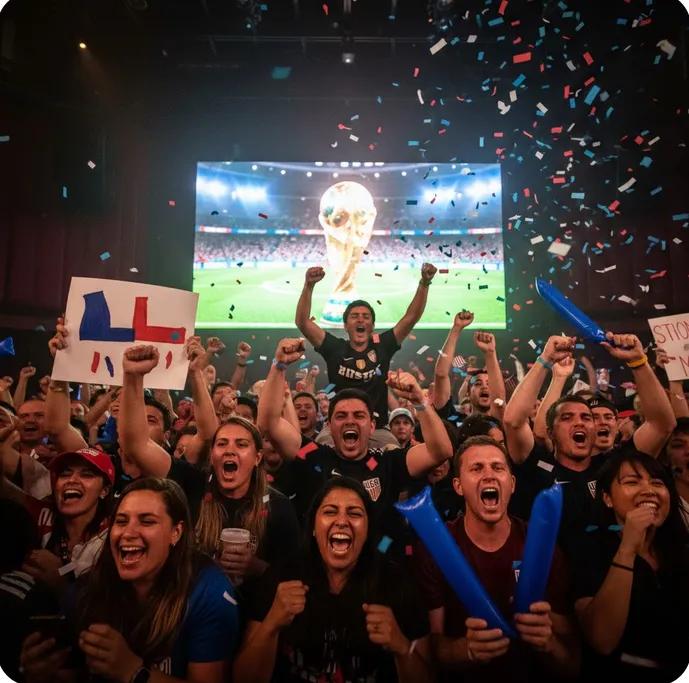
World Cup draws rarely pass quietly. Even when the teams have already played dozens of qualifying matches, even when pundits have analyzed every permutation, even when most groups are predictable—something about the moment of the draw sparks raw, unfiltered emotion. Fans peer at giant screens, chew nervously on snacks, pace around, clutch flags, and inevitably start shouting as the pairings are revealed.
This year was no different. At a lively watch party in Philadelphia—set up inside a sprawling indoor space to shelter fans from the freezing weather—a lively crowd representing nations from every continent packed in around televisions suspended from rafters and scattered across walls. Jerseys from Argentina, South Korea, Germany, Ecuador, Australia, South Africa, Portugal, Mexico, the U.S., and countless others created a patchwork of color and culture. At this event, the World Cup wasn’t just a tournament; it was a noisy, bustling global reunion.
And if there was one chant that captured the mood of the afternoon, it came from a Jordan supporter who let out a gleeful roar when his team was placed alongside Argentina:
"Give me Messi!"
Two simple words. But they captured what so many fans feel: If your country qualifies for the biggest tournament on Earth, you may as well face the best. You may as well stand on the same pitch as a legend.
A Tale of Two Events: The Elegant Ceremony vs. the Fan Frenzy
Roughly 140 miles south, at Washington’s John F. Kennedy Center, the official draw unfolded with theatrical lights, polished speeches, and the presence of three heads of state: the leaders of the tournament’s host nations. Cameras panned elegantly across the hall as famous athletes stepped up to shuffle the names and determine the tournament’s fate.
But in Philadelphia, far from the elegance of Washington, the scene couldn’t have been more different—and more fun.
Fans arrived hours before the draw to secure good seats. They brought banners, scarves, and portable drums. Food vendors ladled out hot soup and coffee to fight the cold that had followed everyone in from the windstorm outside. Every screen was showing pre-draw commentary, and every few minutes, someone in the room started a chant that traveled through the building like a wave.
If the ceremony in D.C. was the formal wedding, the Philly watch party was the boisterous reception where everyone loosened up.
U.S. Fans Feel Optimistic: “This Group Looks Winnable”
When the U.S. was drawn into a group with Australia and Paraguay, the room erupted. Red-white-and-blue confetti cannons weren’t part of the plan, but some American fans improvised—tossing handfuls of paper scraps high into the air.
One fan, Jim House from Atlantic City, stood with his son, both wearing home jerseys. He watched the group come together and spoke with the mix of hope and practicality that American fans have mastered in the past decade.
“Look, it could’ve been worse,” he said. “This is a group where we can compete. And there are definitely tougher groups out there.”
His son nodded, absorbing the moment with wide-eyed excitement. It was his first World Cup draw experience, and the joy on his face told a story of its own. For this next generation of U.S. supporters, the tournament’s arrival on home soil is becoming part of their identity.
Another fan, Philadelphia local Chris Day—who had somehow managed to buy tickets to all six games being hosted in the city—was even more blunt:
“If we don’t reach the knockout round,” he said, “that’s a failure. Plain and simple.”
American fans have grown more confident since the team’s strong youth development pipeline started producing elite talent. That confidence was unmistakable in the room.
Colombian Fans Brace for Portugal: “If You Want to Win, You Face the Big Boys”
Just a few feet away, the mood was different.
When Colombia landed in a group with Portugal, the Colombian fans exhaled in frustration—some groaned, some shook their heads, and others just laughed in resignation. Facing one of the world’s most talent-packed teams was not on their wish list.
But one fan, Julio Mahecha, offered a refreshingly bold perspective. He hadn’t been hoping for an easy group—quite the opposite.
“I wanted Germany,” he said. “I’d rather play the giants. We have this weird habit of losing to teams we should beat.”
He shrugged with a mix of pride and realism.
“If you want to lift the World Cup, you prove it by beating strong opponents. No shortcuts.”
His attitude seemed to shift the mood around him. Sometimes, a group draw feels less like being handed an obstacle and more like being handed an opportunity.
Argentina Draws Jordan — and the Room Erupts with ‘Give Me Messi!’
Few moments matched the intensity that rippled through the room when Jordan found itself placed in the same group as Argentina. A Jordanian supporter leapt from his seat so fast that he nearly knocked over his drink, shouting at the top of his lungs:
“Give me Messi! Give me Messi!”
A crowd formed around him instantly, patting him on the back, laughing, and cheering along.
He explained his excitement with infectious enthusiasm:
“Everyone knows Messi is one of the greatest ever. Why wouldn’t you want to see him? Saudi Arabia beat Argentina last time—so why not us? Anything can happen at a World Cup.”
For Jordan, a nation experiencing the tournament for the very first time, simply sharing a pitch with the reigning champions felt monumental. Even facing the most intimidating opponent in world football didn’t dampen the pride. If anything, it elevated it.
Ecuador Fans Show No Fear in a Group of Death
One of the most surprising reactions came from an Ecuadorian supporter named Wilson, who broke into a big grin when Ecuador was paired with Germany, Ivory Coast, and Curacao.
“Not worried at all,” he said, radiating confidence. “We have good players, a strong coach, energy, speed. We’re ready.”
Facing Germany alone would be enough to make many fans nervous, but Wilson seemed almost relieved.
“There’s no more being afraid,” he said. “That phase is over. It’s a new era.”
Around him, Ecuadorian supporters drummed and danced after their group was revealed. Whether it was bravery or optimism—or both—they turned the room electric.
Cameroonian Fans Turn to South Africa for Hope
Not every supporter in the building had a team in the 2026 tournament. Cameroon, for instance, missed out—and for fans of a nation known for famous World Cup upsets (including stunning wins over Argentina and Brazil in past tournaments), that disappointment still stung.
One such fan, Christine Titih, arrived wearing Cameroonian colors but had already chosen to throw her support behind South Africa.
“They’ve got a real chance,” she said. “I’m excited for them.”
South Africa, grouped with South Korea, the host nation Mexico, and the winner of a European playoff, found moderate support in the building. Their group was tough but far from impossible.
That’s the thing about watch parties: allegiances can shift, at least temporarily. With Cameroon absent, South Africa became part of Christine’s extended football family for the tournament.
Europeans Eye Their Path: Ireland’s Calculated Optimism
Nearby, a cluster of fans wearing green jerseys—some authentic, some thrift-store purchases—huddled together with nervous anticipation. Ireland still had to qualify through a playoff to reach the tournament, but their path, though difficult, wasn’t impossible.
One Irish fan, Gerry Grace, analyzed his team’s odds with a mix of hope and self-awareness.
“Denmark is tough,” he admitted. “But if we get through, honestly, our World Cup group is more manageable than the playoff.”
He paused, letting out a laugh.
“Look, I’m not saying we’re going to win the group. But I’m also not not saying it.”
It was a perfect distillation of the Irish football spirit: humor first, belief second, humility somewhere in the mix.
Why Fans Love the Draw—Even More Than Some Matches
Around the room, one theme kept emerging: the draw isn’t just administrative. It’s an emotional event. It’s the moment when dreams begin—and heartbreak sometimes starts. It’s where imagination takes over.
Here’s why fans love it:
1. Every team starts with a blank slate
No goals conceded, no mistakes made. Every team still has a chance.
2. Rivalries and dream matchups take shape
Argentina vs. Jordan. Portugal vs. Colombia. South Korea potentially facing a European playoff winner. The narrative starts here.
3. Fans discover who they’ll see in host cities
People who already bought tickets suddenly see which teams will play in their cities—and the energy skyrockets.
4. Fans get bragging rights instantly
Whether it’s “easy group,” “group of death,” or “we’re doomed,” fans start decorating their social media pages within minutes.
5. The fantasy begins
Every supporter can still dream big—sometimes too big—but that’s the beauty of it.
The Watch Party Becomes a Microcosm of the Tournament Itself
In Philadelphia, something magical happened. Fans who had never met began debating tactics. People exchanged predictions, swapped jerseys, bought drinks for one another, argued playfully about referees from tournaments years ago, and—most importantly—celebrated the idea that once again, the world will come together on a football pitch.
The hosting nations—the U.S., Mexico, and Canada—may have Been represented formally in Washington, but in the watch party in Philly, the global spirit felt even more real. No borders. No politics. Just passion.
This is what the World Cup does best: it collapses distances.
Looking Ahead to Next Summer: What the Draw Really Means
The draw is just the beginning. But it gives fans a glimpse of what’s coming:
• For the U.S., optimism is sky high.
A return to home turf, a manageable group, and a fanbase growing rapidly.
• For Colombia, adversity is opportunity.
Facing Portugal may be daunting, but it could also be defining.
• For Jordan, the dream is alive.
Facing Argentina is a gift—even if it’s dangerous.
• For Ecuador, belief runs deep.
The mix of established giants and newcomers could create surprises.
• For South Africa, the door isn’t closed.
Their group is unpredictable.
• For European hopefuls, everything hinges on playoff drama.
The anticipation for the summer tournament is already palpable. Tickets are nearly impossible to get in some cities, fan zones are expanding, and the whole continent is preparing for a football frenzy unlike anything North America has ever hosted.
Final Thoughts: A Celebration Before the Competition Even Begins
As fans began pouring out of the Philadelphia venue after the draw, the temperature outside felt even colder—but no one seemed to care. They wrapped scarves tighter, chatted excitedly with strangers, and predicted scores for matches still months away.
A father lifted his young son onto his shoulders. Ecuadorian fans played a drumbeat as others danced and recorded videos. Irish fans left chanting. A Jordanian fan smiled ear to ear, still shouting about Messi. Even those disappointed by their draw found solace in the joy around them.
The tournament hasn’t started. But for many fans, it already feels like it has.
The World Cup is coming. And if the watch parties are already this intense, imagine what the matches will be like.