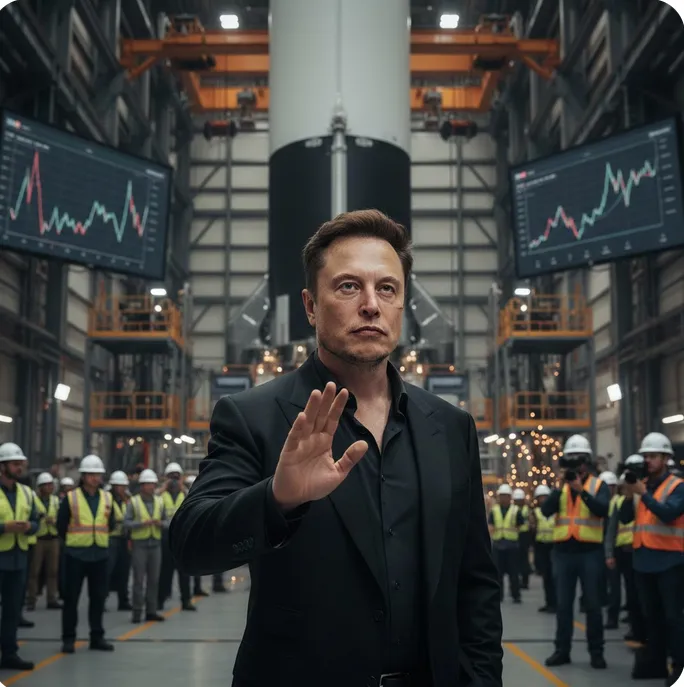
Rumors move fast in the tech world—especially when they involve Elon Musk, one of the most talked-about figures in modern business. Over the years, Musk has become a central character in global conversations about space travel, electric vehicles, and artificial intelligence. So when a series of headlines surfaced claiming SpaceX was raising new capital at a staggering $800 billion valuation, the story spread instantly across social media, financial blogs, and investment circles.
But as quickly as the speculation grew, Musk shut it down. In a short but pointed statement on X (formerly Twitter), he insisted that the reports were off-base. Instead, he clarified that the aerospace company has been profitable for years and that any activity related to its stock is mainly tied to internal liquidity programs for employees and early investors—not external fundraising.
While Musk’s comment might seem straightforward, the situation is far more nuanced. SpaceX’s valuation has been rising rapidly over the past decade, driven not only by its rocket launches but also by the explosive growth of its satellite internet system, Starlink. This makes any rumor about funding—accurate or not—highly sensitive, with implications for investors, competitors, and governments around the world.
In this long-form analysis, we’ll break down:
- Why the valuation rumor exploded so quickly
- The real financial mechanics behind SpaceX’s employee buyback program
- How SpaceX’s current market position compares to other private tech giants
- Why this controversy highlights the broader tension between private companies and public scrutiny
- What Musk’s denial means for the future of the company—and the evolving global space economy
This is a complex story with many moving parts, and understanding it requires a broader look at SpaceX’s trajectory, its business model, and the pressures that come with being one of the world’s most influential private companies.
The Rumor: Reports of an $800 Billion Valuation Spread Quickly
Just a few days before Musk’s rebuttal, several media outlets, citing unnamed sources “familiar with the matter,” published stories claiming that SpaceX was preparing to raise funds based on a valuation approaching or exceeding $800 billion. If accurate, such a valuation would place SpaceX nearly on par with some of the biggest public companies in history—including behemoths in the tech and energy sectors.
The comparison would be especially dramatic considering that SpaceX remains a private corporation. Most private companies, even those considered “unicorns,” rarely exceed valuations of $20–50 billion. SpaceX has blown past those metrics for years, becoming one of the first private firms to reach valuations typically reserved for publicly traded titans.
But with that massive valuation potential comes intense attention—and in this case, the attention spiraled into speculation. Within hours of the first report, analysts were building models based on hypothetical Starlink revenues, venture capitalists were commenting on expected IPO timelines, and social media was buzzing with questions about how close SpaceX is to becoming a trillion-dollar company.
Then came Musk’s response.
Musk Responds: “Not Accurate”
Musk took to his platform, X, to refute the story. He did not mince words. According to him:
- SpaceX has been cash-flow positive for years.
- The company performs stock buybacks twice annually.
- These buybacks are intended to offer liquidity—not to raise capital.
This distinction is extremely important. Buybacks serve an entirely different purpose from fundraising. Instead of bringing in new money from investors, buybacks spend company money to purchase shares from employees or early investors who want to cash out.
So why the confusion?
Because these transactions often occur at prices that reflect the company’s current valuation. When buybacks happen, the share price used for the transaction becomes a de facto way for outside observers to gauge what the company is “worth”—even if that number isn’t tied to new funding rounds.
That’s likely what happened here: internal transactions were mistaken for a major capital raise.
But Musk wasn’t having it.
His message was clear: SpaceX is not raising new funds, and the $800 billion claim doesn’t reflect reality.
How SpaceX’s Liquidity Program Works—and Why It Matters
A big part of this story comes down to how late-stage private companies handle equity. When a startup is young, investors and founders generally hold their shares tightly. But once a company grows large—especially one like SpaceX, now over two decades old—there are thousands of employees holding stock options.
They need ways to convert those shares into money without forcing the company to go public prematurely.
This is where buyback programs come in.
What is a buyback program?
A buyback is when a company repurchases its own stock from investors or employees. This serves several purposes:
- Provides liquidity for employees who want to sell some of their shares
- Reduces share count, which can increase the value of remaining shares
- Allows the company to control who becomes a shareholder
- Lets early investors exit without requiring an IPO
In private companies, this system is often essential. Employees who receive stock options as part of their compensation need a way to unlock that value. SpaceX employees, for example, often accumulate significant equity—but unlike public-stock employees, they can’t sell their shares freely on a stock exchange.
So how does the valuation get calculated?
The price at which SpaceX buys shares back signals the current internal valuation. If a buyback valued shares at, say, $400 billion or $500 billion company-wide, observers might extrapolate.
A misunderstanding about such internal transactions likely contributed to the $800 billion number circulating in the media.
How SpaceX Reached the Point Where $800 Billion Even Sounds Possible
Even though Musk denied the specific figure, the fact that such a number seemed plausible to many observers shows how far SpaceX has come.
1. Reusable Rockets: The Core of the Business
SpaceX revolutionized the space industry with reusable rockets. Falcon 9 and Falcon Heavy are now considered the global industry standard for low-cost, reliable access to orbit. No competitor has matched SpaceX’s cadence or cost efficiencies.
This alone is worth tens of billions in value—possibly more, considering how many government and commercial contracts SpaceX now holds.
2. Starlink: The Real Engine Behind the Valuation
If SpaceX were just a rocket company, it would still be massive. But Starlink takes the valuation conversation to another level.
Starlink aims to build a global internet network made up of tens of thousands of satellites. It already serves millions of customers in dozens of countries.
Key points:
- Starlink revenue is estimated to be in the billions annually.
- The system could eventually serve 100+ million customers worldwide.
- It has applications in rural broadband, aviation, maritime, military, and emergency communications.
Many analysts argue that Starlink alone could be worth hundreds of billions, depending on future growth.
And because SpaceX owns Starlink entirely, its value inflates the company’s overall valuation.
3. Starship: The Long-Term Play
Starship is designed to be the world’s largest and most powerful rocket, capable of transporting cargo and humans to the Moon, Mars, and beyond.
If successful, it could transform:
- Off-planet manufacturing
- Lunar logistics
- Space tourism
- Deep-space exploration
- Satellite deployment markets
Governments, including NASA, already rely on Starship.
While Starship is not yet fully operational, its potential boosts confidence in SpaceX’s future revenue models.
Why SpaceX Has Become a Magnet for Valuation Rumors
SpaceX holds a unique position in the tech industry:
- It is extremely valuable.
- It is extremely secretive.
- It is extremely important to national and global interests.
This creates fertile ground for rumors.
Unlike public companies, SpaceX doesn't publish quarterly earnings. There is no official, publicly traded stock price. Analysts and journalists must rely on leaks, insider information, and speculation.
When a company is this consequential, even a whiff of new information—accurate or not—generates headlines.
The $800 billion number, regardless of accuracy, fits into a narrative many believe: that SpaceX is on track to become one of the most valuable companies in history.
What Musk’s Denial Actually Tells Us About SpaceX
Musk’s dismissal of the valuation rumor reveals several things about the company’s current strategic position.
1. SpaceX is not urgently seeking outside capital
Musk emphasized the company has been cash-flow positive “for many years.” This suggests:
- Rocket launches are profitable
- Starlink’s revenue is significant
- Operational efficiency is high
This also indicates that Starship’s development, expensive as it is, is not straining the company’s finances.
2. The company wants to remain private—for now
Buyback programs usually signal that a company prefers private control rather than opening itself to public market volatility.
An IPO for SpaceX or Starlink has been discussed repeatedly, but Musk has consistently said he wants Starlink to achieve stable cash flow before considering going public.
3. Musk wants to control the narrative
Musk has been known to push back hard against stories he believes misrepresent his companies. SpaceX plays a critical geopolitical role, and maintaining control over financial perception is part of risk management.
The Bigger Picture: What This Means for the Future of SpaceX
While Musk denied the specific rumor, one thing is clear: the company’s valuation continues to grow. Whether that number is $200 billion, $300 billion, or more, SpaceX remains on a trajectory to become one of the most influential companies of the 21st century.
Possible future developments include:
1. A Starlink spin-off IPO
Musk has previously hinted that Starlink may go public after revenue stabilizes. When that happens, it could become one of the biggest IPOs in history.
2. Significant government partnerships
As global tensions rise, satellite communications have become crucial for national security. Several countries might deepen collaboration with SpaceX.
3. Accelerated Starship deployment
More test flights, more NASA missions, and eventually commercial cargo to the Moon or Mars.
4. Increasing pressure from competitors
Amazon’s Project Kuiper, China’s growing space sector, and emerging aerospace companies will fight for market share.
5. More rumors—and more denials
As SpaceX’s influence expands, media speculation will only intensify.
Conclusion: A Valuation Rumor That Reveals a Larger Truth
While the reports of an $800 billion valuation turned out to be inaccurate, the public reaction to the rumor underscores SpaceX’s significance in today’s technological landscape. The company is reshaping:
- Global communications
- Space transportation
- Defense capabilities
- Scientific exploration
- The future of humankind beyond Earth
Musk’s quick pushback was not only an attempt to correct the record but also a reminder that despite its massive influence, SpaceX remains a private enterprise guided by internal strategy, not public speculation.
Whether SpaceX eventually reaches $800 billion—or surpasses it—will depend on the success of Starlink, the commercialization of Starship, and the company’s ability to maintain its lead in a rapidly evolving aerospace race.
For now, the message from Musk is simple:
SpaceX isn’t raising new money.
It isn’t valued at $800 billion.
And it’s doing just fine on its own terms.