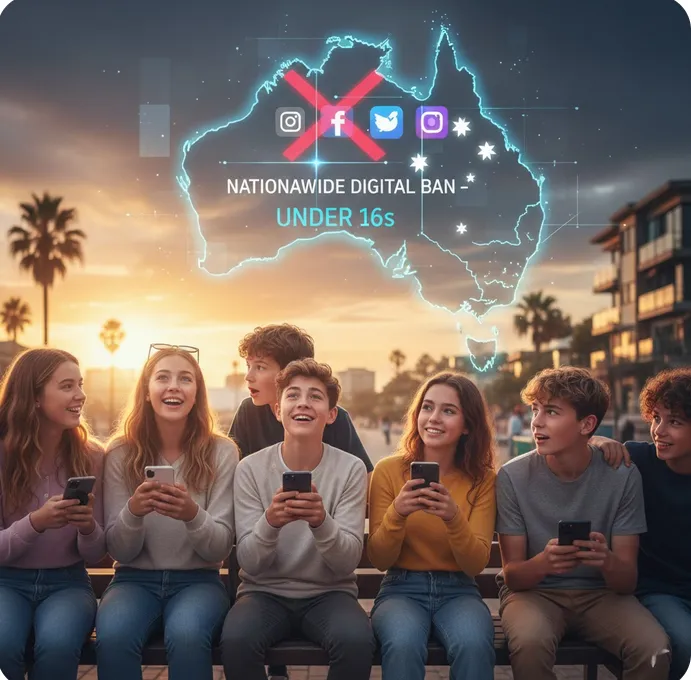
If you’re following tech news or digital policy around the world, Australia’s latest move is impossible to ignore. The country is breaking new ground by rolling out a sweeping ban that will prevent anyone under the age of 16 from holding accounts on major social media platforms. This isn’t just another tweak to online regulations—it’s the first of its kind globally, and its implications are already sending shockwaves through families, schools, and the tech industry alike.
The first wave of this change has already begun. Meta, the parent company behind Facebook, Instagram, and Threads, has started removing accounts belonging to Australian users under 16, days before the December 10 official deadline. This step signals a massive shift—not just for Meta, but also for the millions of young Australians who have grown up navigating the digital world. It’s more than an account removal initiative; it’s a glimpse into how governments might regulate youth engagement online in the years to come, and it’s drawing global attention from tech executives, policymakers, and social researchers.
Let’s explore what this unprecedented policy entails, why it has been introduced, and what consequences it could have for teens, parents, and the tech ecosystem.
Meta Moves First: Early Compliance Ahead of the Law
A week ahead of the nationwide enforcement date, Meta has already begun putting the regulations into practice. Teenagers flagged as under 16 have started receiving notifications, and their accounts are being systematically disabled.
The numbers are significant:
- Around 150,000 Facebook accounts
- About 350,000 Instagram accounts
Even Threads, Meta’s text-based social platform that requires Instagram login credentials, is affected. Unlike a quiet background policy change, this action is highly visible and impacts the online presence of hundreds of thousands of teens across Australia.
Meta has clarified that this process will not be instantaneous. Compliance will unfold as a “multi-layered, continuous effort,” indicating that account removals, age verification, and related enforcement actions will continue over the next several weeks. This early implementation sets the stage for the broader ban on December 10.
Why Australia Is Taking Such a Radical Step
The push for this legislation did not come out of nowhere. Concerns over children’s safety, mental health, and exposure to harmful content online have been growing steadily. Research has shown alarming trends in how young users experience social media:
- 96% of Australian children aged 10–15 are active on social platforms
- Over 70% encounter harmful or disturbing content
- One in seven report exposure to grooming or predatory behavior
- More than half have experienced cyberbullying
For years, educators, psychologists, and child safety advocates have urged lawmakers to take more decisive action. The government’s response, led by Communications Minister Anika Wells, frames this ban as a protective measure for Generation Alpha. Minister Wells describes today’s social media environment as a “dopamine loop,” engineered to capture attention through addictive algorithms. This constant engagement, she argues, exposes children to unsafe content—from misogyny and violent imagery to unrealistic beauty standards and self-harm triggers—without the maturity or resilience to navigate these spaces safely.
Australia’s approach is a direct intervention aimed at giving children a chance to grow up with reduced exposure to the most pernicious elements of digital life.
The Law: A First on the Global Stage
The new legislation requires social media companies to prevent anyone under 16 from having an account, regardless of parental permission. This is a stricter requirement than in most other countries, where under-16 access often comes with restrictions, supervised modes, or parental controls.
Non-compliance carries heavy penalties. Platforms that fail to take “reasonable steps” to block underage users can face fines up to A$49.5 million (roughly US$33 million).
Platforms affected by the ban include:
- Meta-owned Facebook, Instagram, and Threads
- YouTube
- TikTok
- Snapchat
- X
- Kick
- Twitch
Essentially, nearly all mainstream social apps are caught in the sweep.
Australia is now the first country in the world to implement an across-the-board minimum age for social media with legally enforceable consequences. While other nations have considered age regulations, Australia’s approach is unmatched in scope and speed. Policymakers around the globe are closely watching to see how it unfolds.
How Meta Is Responding
Meta has expressed concerns about the law while taking steps to comply. The company argues that the regulation places a heavy operational burden on platforms and believes that age verification should ideally occur before app download, rather than after accounts are created. This approach, Meta suggests, would:
- Standardize age checks across platforms
- Make it harder to bypass restrictions
- Reduce repeated data sharing and privacy risks
Currently, Meta uses a combination of artificial intelligence, behavior analysis, user-submitted information, and age classifications to identify accounts likely belonging to under-16 users. Those flagged are notified, given the chance to download their content, and can contest the classification.
To verify their age, teens can provide:
- A government-issued ID
- A driver’s license
- A “video selfie” that uses AI to estimate age
While this system attempts to balance accuracy and privacy, Meta acknowledges that errors—both false positives and negatives—are inevitable, and the company expects some initial challenges.
Protecting Digital Memories
A major concern for teens and their families is losing years of digital content—photos, videos, chat histories, and posts accumulated over time. Meta is providing a limited window for users to download their data, including images, Reels, and messages, ensuring that personal memories are not permanently lost. After this window, however, access disappears, marking a definitive end to their social media presence.
Industry-Wide Ripple Effects
The ban’s impact extends far beyond Meta. Other platforms are adjusting their policies or publicly reacting to the new rules.
YouTube, for example, initially believed it was exempt due to its parental controls and YouTube Kids features. Regulators later included it in the ban, prompting the platform to call the law “rushed.” YouTube warns that banning supervised accounts could paradoxically make children less safe by pushing them to unauthorized or unregulated accounts.
Lemon8, an image and lifestyle app owned by TikTok, was not listed in the ban but has voluntarily chosen to bar under-16s from its platform. This proactive approach shows how some companies are anticipating enforcement scrutiny.
Yope, a private messaging app, claims it does not qualify as a social media platform because it has no public content or discovery algorithm. It likens its functions to WhatsApp, focusing on private, small-group interactions. Despite this, the platform expects continued regulatory attention.
Potential for Migration to Other Platforms
Regulators are concerned that teens will seek workarounds, such as:
- Niche or lesser-known apps
- Unregulated foreign platforms
- VPN access to bypass age restrictions
- Apps masquerading as utilities but used for social interaction
The government recognizes that restricting mainstream platforms could inadvertently push children into riskier, less-monitored environments. This concern is among the strongest criticisms of the ban and highlights the complexity of regulating digital spaces for minors.
The Social and Emotional Impact on Teens
For many young Australians, social media is more than entertainment—it’s a central hub for:
- Communication with friends
- Creative expression
- Participating in cultural trends
- Engaging with hobby or interest communities
- Staying connected to school and social groups
For certain groups, including LGBTQ+ teens, neurodivergent youth, and those who are socially isolated offline, these digital communities offer crucial support. Critics warn that the ban may leave some children feeling cut off from their social networks, while supporters argue it offers a chance to reduce screen dependency and encourage real-world socialization.
Either way, thousands of teenagers are waking up to notifications telling them their online spaces—often deeply integrated into their lives—will no longer be accessible.
Parents in the Spotlight
The ban shifts significant responsibility back to families. Questions parents are asking include:
- How will kids stay in touch with friends?
- Will they use VPNs or create fake accounts?
- Which platforms are safe alternatives?
- Could less-regulated apps pose more risk than mainstream platforms?
- How can parents manage technology they may not fully understand?
Families, educators, and communities will play a crucial role in guiding children through this transition.
Could This Set a Global Precedent?
Countries facing rising youth mental health concerns are monitoring Australia’s approach closely. International discussions are emerging around:
- Age limits for algorithmic content
- Treating social media as a restricted service
- Requiring formal ID verification for young users
- Holding tech companies accountable for harm to minors
While political and cultural differences may delay similar legislation elsewhere, Australia’s move has already sparked a worldwide conversation on protecting children online.
What Lies Ahead
Meta will continue removing accounts over the coming weeks, and other platforms are expected to accelerate compliance. Regulatory authorities will monitor:
- Circumvention attempts
- Migration to alternative platforms
- Technical adherence
- Mental health outcomes for youth
- Parental engagement
- Industry response and potential pushback
Whether this law will become a blueprint for the world or a cautionary tale about unintended consequences remains to be seen. One thing is certain: Australia’s bold experiment is reshaping how societies think about digital safety, childhood development, and the responsibilities of technology companies.
The consequences of this unprecedented legislation will ripple far beyond Australia, offering lessons and warnings for countries, companies, and families everywhere.