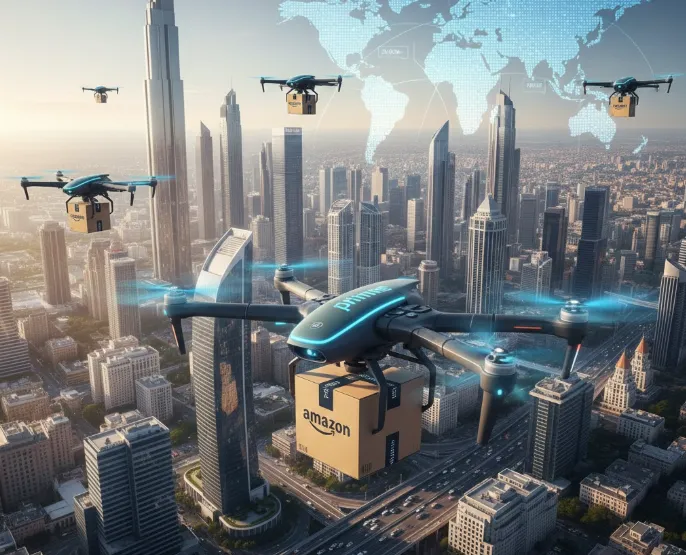
The global logistics industry is changing faster than ever before, and one company remains at the center of this transformation — Amazon. What began as a small online bookstore has evolved into the world’s most advanced logistics and supply-chain powerhouse. In 2026, Amazon is making one of its most ambitious moves yet: expanding drone delivery worldwide.
This massive shift is not just a technological milestone — it is a redefinition of how products move from warehouses to doorsteps. Amazon’s drone delivery program, powered by Prime Air, is becoming a global standard for hyper-fast, eco-friendly, and automated delivery solutions.
From North America to Europe, Asia to the Middle East, Amazon is setting the stage for a new era of logistics where customers get products in 30 minutes or less, drones operate with near-perfect efficiency, and carbon emissions are dramatically reduced.
In this in-depth, SEO-optimized article, we explore why Amazon is expanding drone delivery worldwide, how the technology works, which countries are adopting it first, challenges Amazon must overcome, and what the future of drone-powered logistics looks like for the entire world.
Why Amazon Is Expanding Drone Delivery Across the Globe
Amazon’s global drone expansion is driven by three core goals: speed, efficiency, and sustainability.
1. Unprecedented Delivery Speed
Consumers today demand faster shipping than ever. Same-day delivery has become a basic expectation in major markets. But Amazon’s drone program goes beyond that — the platform is capable of delivering packages in under 30 minutes.
To maintain dominance over competitors like Walmart, Alibaba, Temu, and local quick-commerce services, Amazon must offer the fastest possible delivery solution. Drones are the key to making ultra-fast deliveries scalable worldwide.
2. Reducing Operational Costs
Traditional delivery methods rely heavily on trucks, vans, and human labor. These methods are expensive, time-consuming, and limited by traffic, fuel prices, and workforce availability.
Drones drastically lower operational expenses by:
- Reducing fuel consumption
- Cutting last-mile delivery costs
- Minimizing labor dependency
- Increasing delivery capacity
With automation, Amazon can deliver more packages with fewer limitations and lower costs.
3. Achieving Sustainability Goals
Amazon is committed to reaching net-zero carbon emissions by 2040. Drone delivery is a massive step toward this goal because drones:
- Use electric power
- Produce zero direct emissions
- Optimize delivery routes
- Reduce dependence on carbon-heavy vehicles
As governments worldwide push for greener logistics, Amazon’s drone fleet becomes a strategic advantage.
How Amazon’s Prime Air Drone Technology Works
Amazon’s drone delivery system is not just about flying devices dropping packages. It is a complex, cutting-edge ecosystem powered by AI, machine learning, advanced sensors, and automated routing.
Autonomous Navigation
Amazon drones navigate using:
- Lidar sensors
- GPS-enabled mapping
- Computer vision algorithms
- Onboard AI
This combination allows drones to avoid obstacles, adjust to weather conditions, and deliver packages with exceptional precision.
Secure Delivery Process
Drones deliver packages to specific drop zones near a customer’s home. Using downward-facing cameras and environmental recognition, the drone identifies the delivery area and safely releases the package.
Long-Range Capability
New Amazon Prime Air drones can travel 60–80 km on a single charge, depending on weather and load. This extended range allows Amazon to cover wider regions without requiring thousands of drone hubs.
Payload Capacity
Amazon drones can currently carry packages weighing up to 5 pounds (2.3 kg) — which accounts for almost 80% of Amazon’s shipments.
Real-Time Monitoring
Each drone is monitored through:
- Remote operations centers
- Autonomous AI-driven diagnostics
- Real-time battery health systems
This ensures safety, reliability, and compliance with aviation regulations.
Amazon’s Global Expansion: Which Countries Are Getting Drone Delivery?
Amazon’s drone program is no longer limited to a handful of test areas. Between 2025 and 2027, the company plans to deploy drones at scale across multiple continents.
1. United States
The U.S. is Amazon’s primary testing ground. Drone delivery is expanding rapidly in states such as:
- California
- Texas
- Arizona
- Ohio
- Florida
The Federal Aviation Administration (FAA) has approved multiple forms of Beyond Visual Line of Sight (BVLOS) operations, allowing drones to travel long distances without human oversight.
2. United Kingdom
The UK government fully supports drone innovation. Amazon plans to launch multiple Prime Air hubs across:
- Cambridge
- Birmingham
- Manchester
- London suburbs
Strong regulatory support makes the UK one of the fastest-growing drone markets.
3. European Union
Countries like Germany, France, Italy, and Spain are partnering with Amazon to modernize last-mile delivery.
The EU’s unified aviation standards make adoption smooth across borders, enabling Amazon to roll out drone operations city by city.
4. Canada
With its vast rural areas and challenging terrains, Canada is ideal for drone logistics. Amazon is developing unique drone routes for remote towns that were previously hard to reach using traditional delivery methods.
5. Middle East
Countries like the UAE and Saudi Arabia are embracing Amazon’s technology. The region’s smart-city development aligns perfectly with autonomous delivery systems.
6. Asia-Pacific Region
Amazon is targeting rapid expansion in:
- Japan
- South Korea
- Australia
- India (select major cities)
These countries have strong e-commerce adoption and are ideal for high-density drone operations.
7. Latin America
Brazil, Mexico, and Chile are emerging drone-friendly markets. Amazon is piloting operations in areas with heavy traffic and underserved rural zones.
Benefits of Amazon’s Worldwide Drone Delivery Program
Amazon’s global drone expansion brings revolutionary changes to both customers and the logistics industry.
Faster Delivery Than Ever
Getting a package delivered in 20–30 minutes is no longer futuristic — it is becoming an everyday reality for millions.
Reduced Environmental Impact
Electric drones significantly reduce carbon footprints and help Amazon reach sustainability goals.
Improved Access in Remote Areas
Drones can deliver medical supplies, emergency tools, and essential goods to regions where road delivery is slow or impossible.
Lower Shipping Costs for Customers
As Amazon’s operational expenses decrease, customers benefit from lower delivery fees and faster service.
Reduced Traffic Congestion
By replacing thousands of trucks and vans, drones help reduce urban traffic problems.
The Challenges Amazon Must Overcome
Despite incredible progress, Amazon faces significant challenges in global drone deployment.
Regulatory Barriers
Aviation rules vary by country. Amazon must work closely with regulators to enable BVLOS operations and ensure safety.
Weather Limitations
Heavy rain, strong winds, and snow can disrupt drone operations. Amazon is investing in weather-resistant models to address this.
Privacy Concerns
Drone cameras raise public concerns, requiring Amazon to follow strict privacy protection laws.
Noise Pollution
Although drones are quieter than vehicles, large-scale operations could raise noise concerns in suburban areas.
Infrastructure Requirements
To scale globally, Amazon must build:
- Drone hubs
- Charging stations
- Automated landing pads
This requires significant investment and long-term planning.
How Amazon’s Drone Expansion Will Change Global E-Commerce
The worldwide rollout of Amazon drone delivery will impact more than just Amazon customers — it will transform e-commerce as a whole.
Same-Day Delivery Will Become Standard
Customers will expect ultra-fast delivery from all online retailers, not just Amazon. Competitors will be forced to adopt similar technology.
Retailers Will Adapt to Drone-Friendly Packaging
Products will be redesigned to fit drone payload requirements. This means lighter packaging, smaller boxes, and eco-friendly materials.
New Jobs Will Emerge
While drone delivery reduces the need for drivers, it creates new job categories such as:
- Drone operators
- Drone technicians
- AI safety supervisors
- Autonomous route planners
Global Logistics Will Become Fully Automated
Automation will extend beyond drones, with:
- Robot-powered warehouses
- Driverless delivery vehicles
- AI-powered logistics forecasting
The entire supply chain will become smarter, faster, and more efficient.
The Future of Amazon Prime Air: What to Expect Next
Amazon’s drone program is still evolving, and major innovations are on the horizon.
1. 10+ km Autonomous Recharging Network
Future drones will recharge themselves mid-route using automated charging stations.
2. Increased Payload Capacity
Amazon plans to develop drones capable of carrying:
- 10–15 kg
- Large electronics
- Multi-item packages
3. Weather-Resistant Models
Next-generation drones will fly in heavy rain, extreme heat, and windy conditions.
4. Swarm Delivery Systems
In dense urban areas, drone fleets may operate in coordinated groups for optimized route efficiency.
5. Global Drone Airports
Amazon is exploring the concept of drone-specific air hubs, similar to airports, for high-density operations.
Is Amazon Creating the Future of Delivery?
Yes — Amazon is not just improving delivery; it is reinventing the industry.
From automated warehouses to AI-powered forecasting and now worldwide drone delivery, Amazon is building a logistics framework that no other company can match.
Drones will soon become as common as delivery vans, and Amazon is leading the charge into this new era of convenience, speed, and innovation.
Final Thoughts: Amazon’s Worldwide Drone Expansion Is a Turning Point for Global Logistics
Amazon’s decision to expand drone delivery worldwide is more than a technological upgrade — it is the dawn of a new logistics ecosystem. With autonomous drones delivering packages in minutes, cities will become less congested, rural areas more connected, and e-commerce more efficient than ever.
The next decade will belong to companies that embrace automation and AI-driven logistics. And Amazon is already years ahead.
As this technology continues to grow, customers across the world will enjoy faster delivery, lower costs, and a smarter, more sustainable future.