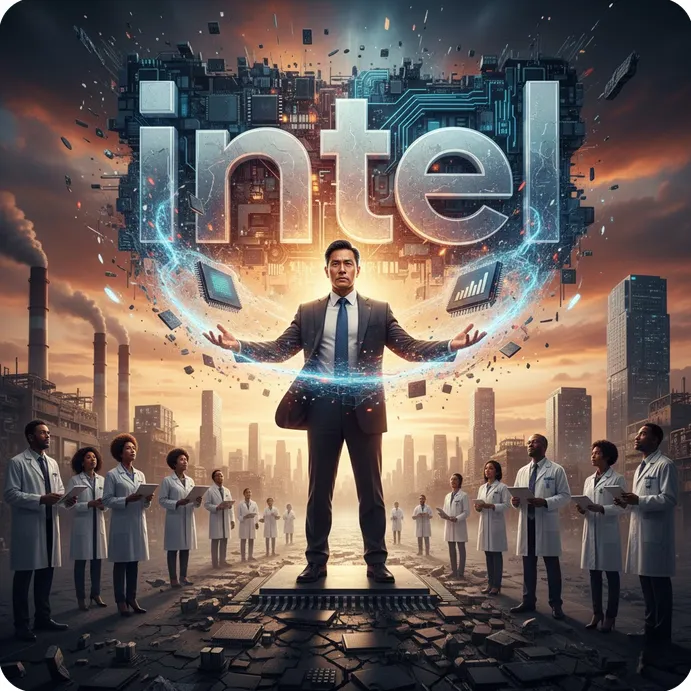
For more than half a century, Intel represented the beating heart of the modern computing age. Its microprocessors powered personal computers, servers, and global data centers. Its brand was synonymous with technological progress. But by the mid-2020s, the company’s once unshakable dominance had slipped into something far more fragile.
The rise of Nvidia in artificial intelligence, the manufacturing leadership of TSMC, and the exploding global ecosystem of AI-focused startups forced Intel to confront a reality it had spent years denying: the world had outpaced it.
Enter Lip-Bu Tan — a figure whose name has long echoed throughout the semiconductor world, but not as a traditional corporate leader. His reputation is rooted in venture capital, in backing fledgling semiconductor and AI companies long before they appear on mainstream radar. When Intel tapped him as CEO in early 2025, it was clear the board was betting on something different. Something radical.
But with Tan’s appointment came a question that still echoes today:
Can a CEO with deep personal investments across hundreds of chip startups objectively lead a corporation whose future depends on navigating that same ecosystem?
What has followed is a transformation unlike anything Intel has attempted before — bold, controversial, and undeniably consequential.
This is the story of how Intel is being reshaped from the inside, why Tan’s vast personal network is both a superpower and a strategic headache, and what this means for the future of one of technology’s most iconic companies.
A CEO Carved From Silicon Valley’s Startup Culture
Unlike Intel leaders of the past, Tan’s background wasn’t built through decades of polishing CPU product lines or managing chip fabs. His world was venture capital: risk, networks, early-stage bets, and the ability to see potential long before anyone else.
Before taking Intel’s top job, Tan spent more than 30 years investing through firms such as:
- Walden International
- Walden Catalyst
- Celesta Capital
- A&E Investments
Within these firms are stakes in hundreds of companies — many of them building AI accelerators, advanced semiconductor tools, data analytics systems, or next-generation chip design technologies.
To Intel’s board, this was an enormous asset. The company needed someone with global reach. Someone who could open doors, build relationships, inspire dealmaking, and drag Intel into the middle of the AI hardware renaissance that Nvidia was dominating.
But the same qualities that made Tan appealing also created complexity.
When the CEO personally has financial ties throughout the chip industry, how do you separate personal networks from corporate strategy?
This tension surfaced almost immediately.
The Rivos Standoff: Where Everything Became Complicated
The first major controversy centered on a rising AI hardware startup named Rivos — a company Tan had invested in heavily and where he also served as chairman.
Rivos had ambitious goals: challenge Nvidia with a different kind of AI acceleration architecture. The startup needed capital, customers, and potentially a strategic ally. Naturally, Intel evaluated the company.
Tan reportedly encouraged Intel’s board to consider acquiring Rivos.
But this raised an obvious issue:
- He led the company that wanted to be bought.
- He also led the company deciding whether to buy it.
The board, according to insiders, stopped the process almost immediately. They questioned how Intel could objectively evaluate an acquisition when the CEO would personally benefit from the outcome.
Then the situation got more complicated.
Meta enters the picture
While Intel paused, Meta — hungry to build AI hardware to reduce its dependence on Nvidia — quietly approached Rivos with its own acquisition interest.
Suddenly, a once-quiet exploration turned into a bidding contest between two tech giants.
Intel reentered the negotiation.
Meta countered.
Valuations spiked.
In the end, Meta took the prize, publicly announcing its intent to acquire Rivos. For Meta, it was a strategic move. For Tan’s venture firm, it was a lucrative victory.
Walden Catalyst even published a celebratory message praising the outcome — which did not go unnoticed internally at Intel.
Employees wondered:
Why was the CEO’s venture group cheering a win in a competitive process Intel itself participated in?
This perception challenge became the spark for broader scrutiny.
A Pattern of Overlap: SambaNova, proteanTecs, and Beyond
Rivos wasn’t an isolated case.
Two more companies highlighted the recurring question of where Tan’s interests ended and Intel’s began.
1. SambaNova Systems — The AI Startup Fighting for Survival
Once heralded as a would-be rival to Nvidia, SambaNova built AI systems designed to compete with GPU-based computing. Tan served as its executive chairman, and his firms were major early investors.
But reality hit hard:
- The AI world wanted Nvidia’s flexibility
- Revenue lagged
- Layoffs mounted
- The company’s valuation sank
As SambaNova struggled to raise new funds, Tan reportedly encouraged Intel to consider acquiring the startup — a move that could rescue the firm while giving Intel a path into advanced AI acceleration technology.
Insiders told reporters that Intel engaged in discussions and even drafted a preliminary term sheet.
But again, the optics raised questions:
Should Intel acquire a startup in which the CEO has a significant personal stake?
2. proteanTecs — When Intel Capital Boosts Tan’s Portfolio
Another example surfaced with proteanTecs, a chip-analytics company whose tools monitor semiconductor performance.
- Tan’s VC firms held stakes.
- Intel Capital — now directly under Tan’s supervision — invested in the company as well.
Even though the investment might have been strategic, it directly increased the value of Tan’s personal holdings.
This pattern — not of wrongdoing, but of overlap — is what governance experts highlight as problematic.
Intel Capital’s Restructuring: Power Centralized Under Tan
One of Tan’s first major organizational changes was restructuring Intel Capital, the company's venture investment arm.
Historically, Intel Capital operated with a degree of independence.
Tan changed that. He:
- Pulled Intel Capital directly under the CEO’s authority
- Placed himself and CFO David Zinsner as the primary investment decision-makers
- Streamlined approvals
- Accelerated dealmaking processes
On one hand, this made Intel more agile — a major departure from the slow, bureaucratic culture that had held it back for years.
On the other hand, it placed Intel’s major outbound investments under the leadership of someone who also had vast personal investment connections.
Supporters call it bold modernization.
Critics call it unnecessary concentration of power.
But one thing is clear: Intel under Tan operates with a speed and aggressiveness that would have been unthinkable a decade ago.
Why Intel Is Taking These Risks: The AI Pressure Cooker
To understand why Intel is willing to navigate these governance challenges, it’s critical to understand the crisis the company faces.
Intel once dominated:
- PC processors
- Data center CPUs
- High-end manufacturing
- Chip ecosystem leadership
Today, it lags in:
- GPU leadership
- AI computing
- chip manufacturing technology
- cloud acceleration
- custom silicon for hyperscalers
The AI revolution is remaking the semiconductor landscape at breakneck speed. Nvidia isn’t merely leading — it is defining the direction of the entire industry.
Every cloud giant now builds its own AI chips:
- Amazon has Trainium & Inferentia
- Google has TPUs
- Meta has MTIA
- Microsoft is buying silicon teams and building custom hardware
And all of them rely heavily on TSMC’s advanced manufacturing.
Intel is struggling to remain relevant in this new environment.
This is why Tan was hired.
This is why Intel is taking gambles.
This is why the board tolerates risks that previous generations wouldn’t consider.
To reclaim even a fraction of lost ground, Intel needs:
- alliances
- venture networks
- startup acquisitions
- geopolitical support
- aggressive investments
And these happen to be Tan’s strongest skill areas.
The National Security Dimension
Intel’s transformation is happening under the watchful eyes of the U.S. government.
With rising geopolitical tensions and China’s ambitions in semiconductors, Intel’s role has shifted from corporate titan to national strategic asset. In 2024, the U.S. committed nearly $9 billion to help Intel rebuild fabrication leadership.
That means:
- government oversight
- political expectations
- nationalistic pressure
- public scrutiny
President Trump has praised Tan’s leadership, particularly the stock price rebound, suggesting government confidence in the transition.
But this also means Intel must operate under higher governance standards — especially when taxpayer funds fuel part of its resurgence.
Can a Venture Capitalist Run a Global Chip Empire Without Conflict?
This is the question that defines Intel’s current era.
The Argument Supporting Tan’s Strategy
Supporters say:
- Intel needs disruption, not comfort
- His global network is unmatched
- His connections brought in billions from SoftBank, Nvidia, and others
- Under his tenure, Intel’s market value has recovered substantially
- His experience with startups is exactly what Intel needs to reinvent itself
For these advocates, Tan represents Intel’s best chance to become relevant in AI hardware again.
The Argument Against His Approach
Critics warn:
- A CEO with hundreds of holdings inevitably faces conflicts
- Even recusal policies cannot fully neutralize influence
- Employees may fear that favoring Tan-linked companies is expected
- Investors may lose trust if boundaries appear blurred
Two independent governance experts have already recommended:
- placing Tan’s assets in a blind trust
- forming independent committees for deals involving his portfolio
- increasing transparency to protect shareholder interests
Intel maintains that it is following industry standards.
But this debate isn’t going away.
Intel’s Future Under Tan: Renaissance or Risk Spiral?
The truth is that Intel has entered one of the most uncertain — and potentially transformative — periods in its history.
The company is pursuing:
- new AI chip architecture
- an advanced foundry strategy
- global alliances
- potential startup acquisitions
- revamped manufacturing timelines
- aggressive fundraising
- deep integration into government initiatives
All while navigating the personal network of a CEO whose reach spans virtually every continent and semiconductor sector.
The results so far?
Promising but precarious.
Intel’s stock has risen dramatically.
Its partnerships have strengthened.
Its narrative has shifted from stagnation to possibility.
Yet the company still trails Nvidia and TSMC decisively.
Its AI roadmap remains unclear.
And the internal discomfort around conflicts — real or perceived — continues to simmer.
Conclusion: A High-Stakes Gamble That Will Reshape Intel’s Legacy
Lip-Bu Tan’s leadership of Intel is one of the most fascinating corporate experiments of the decade.
Never before has a major semiconductor giant handed the reins to a career venture capitalist with such deep and active ties to the industry’s startup network.
Never before has Intel taken such sweeping risks to reclaim relevance.
And never before has its future depended so heavily on one individual’s ability to navigate:
- strategic vision
- conflict boundaries
- global politics
- investor confidence
- technological reinvention
What emerges from this transformation — a triumphant rebirth or a deepening storm — will define Intel’s place in the AI era.
For now, the world is watching the company reinvent itself at full speed, standing on the thin line between innovation and controversy.
And at the center of it all stands Lip-Bu Tan — the dealmaker attempting to reshape a titan.